
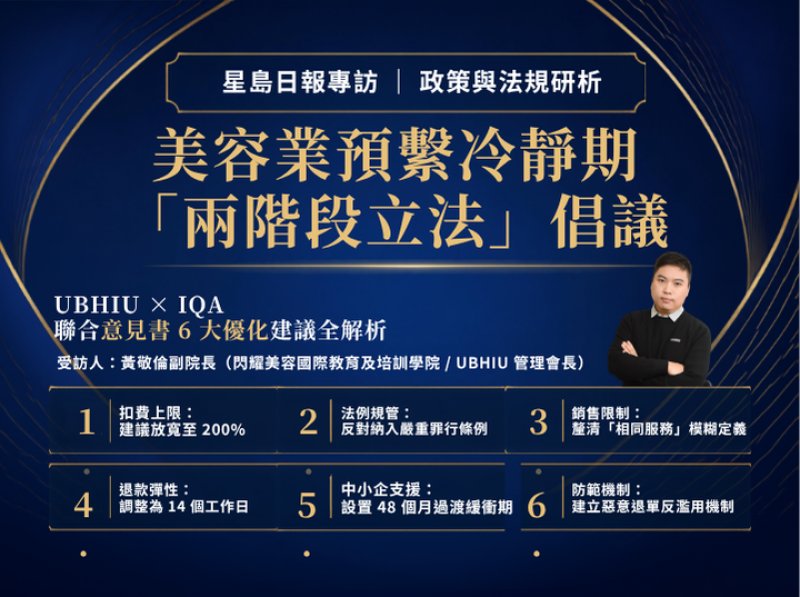
- Sing Tao Daily In‑Depth Report: On August 20, 2026, Sing Tao Daily's "Daily Magazine" published a feature titled "Regulating Beauty Industry Sales – Advocating a 'Two‑Stage Legislation' Approach with 'Easy First, Hard Later'," featuring interviews with Vice Principal Lawrance Wong of Luster Beauty International Education and Training Institute and other industry representatives.
- Advocating "Two‑Stage Legislation": The industry supports the 7‑day statutory cooling‑off period in principle to combat unfair sales practices, but opposes the "one‑size‑fits‑all" bundling of beauty and fitness industries under the same regulations. It recommends first implementing the cooling‑off period, observing for 12‑18 months, and then assessing whether contract duration caps are necessary.
- UBHIU×IQA Joint Submission: The Universal Beauty and Health Industry Union (UBHIU) and the International Qualification Assessment Alliance (IQA) jointly submitted a formal position paper, supported by LBEDU and signed by Management President Lawrance Wong, putting forward 6 key recommendations for improvement.
- Comprehensive Policy Analysis: This article fully integrates the Sing Tao Daily report and the submission content, providing a detailed section‑by‑section analysis of the industry's stance, supporting data, anti‑abuse mechanisms, and proposed improvements.
- Data & Trend Analysis: Nearly 5,000 prepayment‑related complaints were recorded across the beauty and fitness sectors over the past 6 years, but 2024‑2025 beauty industry complaints have shown a declining trend, suggesting that voluntary cooling‑off mechanisms are taking effect.
- The $15,000 Threshold Issue: Vice Principal Lawrance Wong pointed out that professional aesthetic equipment can cost HK$300,000‑400,000, and refund fluctuations directly impact the operational stability of SMEs.
- 6 Core Improvement Recommendations: ① Raise the deduction cap to 200% ② Oppose including Section 13I under the Organised and Serious Crimes Ordinance ③ Clarify the ambiguous "same service" definition in Section 5.4 ④ Introduce flexibility in cooling‑off and refund periods ⑤ Address the survival impact on micro‑businesses ⑥ Prevent malicious abuse of the cooling‑off period.
- Legislator & Industry Support: Legislative Council member Shiu Ka‑fai publicly supported the "two‑stage legislation" approach and the recommendation to record cancellation reasons. Ho Siu‑chung and Yip Sai‑hung provided professional analysis; beauty retail products should be regulated separately from prepaid services.
Sing Tao Daily Interview with Vice Principal Lawrance Wong|Beauty Industry Prepayment Cooling‑Off Period "Two‑Stage Legislation" Proposal – Full Analysis of UBHIU×IQA Joint Submission's 6 Key Recommendations
Table of Contents
- 1. Background of the Sing Tao Daily Interview: Beauty Industry Prepayment Regulations Enter Critical Phase
- 2. Core Proposal: "Two‑Stage Legislation" – Easy First, Hard Later – Balancing Consumer Protection and Business Environment
- 3. Key Points from Vice Principal Lawrance Wong's Interview: $15,000 Threshold Too Low – SME Operational Pressures Need Attention
- 4. UBHIU×IQA Joint Submission – 6 Key Recommendations, Article by Article
- 5. Views of Other Industry Representatives: Professional Advice from Ho Siu‑chung and Yip Sai‑hung
- 6. Legislative Council Member Shiu Ka‑fai: Supports Two‑Stage Legislation and Recording Cancellation Reasons
- 7. Beauty Retail and Prepaid Services Must Be Regulated Separately
- 8. Frequently Asked Questions (FAQ)
- 9. Conclusion & Further Reading
1. Background of the Sing Tao Daily Interview: Beauty Industry Prepayment Regulations Enter Critical Phase
On August 20, 2026, Sing Tao Daily, one of Hong Kong's leading newspapers, published an in‑depth feature in its "Daily Magazine" section titled "Regulating Beauty Industry Sales – Advocating a 'Two‑Stage Legislation' Approach with 'Easy First, Hard Later' – Cooling‑Off Period Implementation with Review After 12‑18 Months," written by journalist Debbie LAM.
The report comes as the government proposes amendments to the Trade Descriptions Ordinance to regulate prepaid consumption in the beauty and fitness industries, with the public consultation closing at the end of August 2026. In recent months, the beauty industry has held multiple meetings with Legislative Council members and the Commerce and Economic Development Bureau to express its stance and recommendations for improvement.
- Over the past 6 years, nearly 5,000 prepaid‑consumption complaints related to the beauty and fitness industries were recorded, accounting for 50% of all industries.
- Among the industries most frequently associated with unfair sales practices, beauty and fitness services accounted for nearly 90% of cases.
- Reports of inducement‑based sales tactics have increased by more than 3‑fold.
However, the industry points out that the data requires more nuanced interpretation. Ho Siu‑chung, Supervisor of the Hong Kong Cosmetic Products Association, noted in the report that many operators have already voluntarily implemented "cooling‑off periods." According to Consumer Council data, 2024‑2025 beauty industry complaints showed a declining trend, with the first two quarters of 2026 maintaining the decline – indicating that industry self‑regulation mechanisms are taking effect.
This Sing Tao Daily interview featured multiple authoritative beauty industry representatives, including Ho Siu‑chung (Supervisor of the Hong Kong Cosmetic Products Association), Yip Sai‑hung (Founding Chairman of the Hong Kong Beauty Industry General Association), and Lawrance Wong (Vice Principal of Luster Beauty International Education and Training Institute and Management President of the Universal Beauty and Health Industry Union – UBHIU), who jointly discussed the optimal path forward for regulating prepaid beauty services.
2. Core Proposal: "Two‑Stage Legislation" – Easy First, Hard Later – Balancing Consumer Protection and Business Environment
The core theme of this Sing Tao Daily report is the "two‑stage legislation" proposal put forward by the beauty industry – a consensus solution formed through multiple meetings with Legislative Council members and the Commerce and Economic Development Bureau.
The industry recommends implementing the Trade Descriptions Ordinance prepaid consumption amendments in two phases:
Phase 1: Implement Core Protection Mechanisms First
• Implement a 7‑day statutory cooling‑off period
• Implement a 14‑day refund period
• Establish relevant operational rules (transaction memos, cancellation notice templates, refund procedures, etc.)
• Set clear administrative fee deduction standards
Phase 2: Review Effectiveness Before Assessing Additional Restrictions
• After 12‑18 months of Phase 1 implementation, comprehensively review the actual effectiveness of the cooling‑off mechanism
• Based on real data, assess whether a 2‑year contract cap and other prepayment restrictions are necessary
• If Phase 1 proves effective in improving the industry landscape, avoid imposing excessive additional business restrictions
Yip Sai‑hung, Founding Chairman of the Hong Kong Beauty Industry General Association, used a vivid analogy in the report:
"Introducing a cooling‑off period is like a 'wonder drug' – there's no need to prove whether coercion or deception was involved; consumers can get unconditional refunds within 7 days, which is the most direct way to protect consumers. But once the first dose of the 'wonder drug' significantly improves the industry landscape, it would be unwise to over‑impose additional business restrictions."
- Easy first, hard later: The cooling‑off period is widely accepted by the industry and has the highest consensus – implement it first.
- Data‑driven: Use 12‑18 months of actual operational data to assess whether further restrictions are needed.
- Avoid over‑correction: If the cooling‑off period resolves most issues, the more controversial measures like contract caps can be postponed or fine‑tuned.
- Balance: Achieve a dynamic equilibrium between protecting consumer rights and maintaining a healthy business environment.
3. Key Points from Vice Principal Lawrance Wong's Interview: $15,000 Threshold Too Low – SME Operational Pressures Need Attention
In this Sing Tao Daily interview, Vice Principal Lawrance Wong of Luster Beauty International Education and Training Institute shared his professional insights on the contract amount threshold proposed in the consultation document.
The consultation document proposes three contract threshold options – $3,000, $8,000, and $15,000 – with the industry generally agreeing on the $15,000 standard. However, Vice Principal Wong further noted in the interview:
"Many small and medium‑sized beauty salons report that the $15,000 threshold is still too low and overly restrictive."
The underlying rationale is:
- Significant investment in professional equipment: Beauty salons typically invest HK$300,000‑400,000 in professional aesthetic devices – laser machines, HIFU equipment, advanced skincare systems – and these fixed costs need to be recovered through prepaid packages.
- Refund fluctuations directly impact operational stability: If 10 out of 30 customers suddenly request refunds during the cooling‑off period, the salon not only loses the service costs already incurred but also bears bank fees and administrative costs, making cash flow unstable.
- Conscientious business owners may lose heart: Vice Principal Wong emphasised, "In reality, there are many conscientious business owners in the industry who are genuinely dedicated to their work. Frequent refund fluctuations may discourage them and make them pessimistic about the business outlook."
- Vice Principal of Luster Beauty International Education and Training Institute: Observing the far‑reaching impact of new legislation on talent development, graduate employment, and the industry ecosystem from an educational perspective.
- Management President of the Universal Beauty and Health Industry Union (UBHIU): Representing the industry alliance, consolidating voices from frontline operators, SMEs, and educational institutions, and formally submitting recommendations to the government.
- Core Member of the International Qualification Assessment Alliance (IQA): Ensuring from an international qualification standards perspective that the new laws do not infringe on the rights of practitioners holding internationally recognised certifications.
- Industry Policy Research Expert: Having published multiple academic articles on education (e.g., Pedagogy vs Andragogy), with the professional capacity to translate practical industry concerns into policy discourse.
This multi‑faceted role gives Vice Principal Wong's views a unique combination of frontline practical perspective and policy research depth, making him one of the key industry representatives sought after by Sing Tao Daily's journalists.
4. UBHIU×IQA Joint Submission – 6 Key Recommendations, Article by Article
During the public consultation period, the Universal Beauty and Health Industry Union (UBHIU) and the International Qualification Assessment Alliance (IQA) jointly submitted a formal position paper, supported by Luster Beauty International Education and Training Institute (LBEDU, IC:854), signed by Management President Lawrance Wong King Lun, dated July 25, 2026.
The submission opens with a clear statement: "We agree with the government's legislative intent to protect prepaid consumption rights and combat unfair sales practices. In principle, we do not oppose establishing a statutory cooling‑off period and regulating contract terms for beauty service prepaid contracts. However, we must point out that many specific provisions in the current consultation document are seriously disconnected from the operational realities of the beauty industry, and some proposals suffer from over‑correction and disproportionality."
Current Consultation Proposal: When consumers who purchased a package at a discount cancel their contract during the cooling‑off period, the deduction for used services must not exceed 150% of the pro‑rata unit price.
UBHIU×IQA Position: Believes the 150% cap seriously deviates from industry cost logic and recommends raising it to 200%.
- Aligns with industry pricing practices: Using a 50%‑off package as an example, the pro‑rata unit price is only 50% of the full price. The 150% cap amounts to just 75% of the full price – insufficient to cover even basic labour, consumables, equipment depreciation, and overhead costs, creating an unreasonable situation where "services have been delivered yet the business still loses money." Raising it to 200% would broadly cover the single‑session full price of typical discounted packages.
- Balances consumer rights with commercial reasonableness: The 200% cap still provides a clear constraint on merchant deductions, eliminating room for pricing abuse.
- Reduces enforcement disputes: A clear 200% boundary, combined with the pre‑disclosed single‑session full price in the transaction memo, would significantly reduce calculation disputes during refunds.
Specific Recommendation: Adjust the used service deduction cap to 200% of the pro‑rata unit price, while clarifying that the billing basis for used services during the cooling‑off period is the merchant's publicly advertised single‑session full price, which must be stated in the transaction memo in advance.
This recommendation was also endorsed by Yip Sai‑hung, Founding Chairman of the Hong Kong Beauty Industry General Association, who stated in the Sing Tao Daily interview: "The beauty industry commonly uses promotions like 'buy one get one free.' Adjusting the deduction cap to 200% would cover normal commercial discounts while preventing inflated single‑session pricing."
Current Consultation Proposal: Considering placing improper receipt of payments in the beauty and fitness industries under the Organised and Serious Crimes Ordinance, granting enforcement agencies greater investigative powers.
UBHIU×IQA Position: Believes this proposal is completely unnecessary, seriously violates the principle of proportionality and the doctrine of commensurate punishment, and would create an indiscriminate criminal chilling effect across the entire industry. Strongly recommends withdrawal.
- Serious mismatch in nature: The Organised and Serious Crimes Ordinance targets organised crime, serious fraud, and other malicious criminal conduct. The vast majority of beauty industry operational disputes and business closures fall under civil or general administrative matters – many SME closures stem from high rents, declining consumer spending, and other business‑related factors rather than intentional fraud. Applying a serious crimes framework to the entire industry's operational risks is a classic case of disproportionate punishment.
- Existing penalties already provide sufficient deterrence: Section 13I of the current Trade Descriptions Ordinance already carries maximum penalties of a $500,000 fine and 5 years' imprisonment – more than adequate to address intentional improper receipt of payments without the need to escalate further.
- Damages industry confidence: Associating general business conduct with serious criminal offences would create immense compliance anxiety among operators, especially SMEs. To avoid criminal risk, they may reduce services, cut prepaid packages, or even close down – ultimately leading to fewer consumer choices and higher prices, which defeats the legislative purpose.
Current Consultation Proposal: Prohibits merchants from signing new contracts for the "same service" with a consumer before their existing contract expires, in order to prevent excessive selling.
UBHIU×IQA Position: Agrees with the direction of limiting excessive selling, but the current Section 5.4 provisions suffer from serious definitional ambiguity and practical difficulties, making them operationally unworkable. Strongly recommends withdrawal; if regulation is truly necessary, detailed scenario‑based implementation guidelines must be issued.
- Lack of legal clarity in determining standards: The provision uses a combination of factors – "service location, number of participants, service purpose, equipment, difficulty level" – to determine "same service." This is highly abstract and lacks clear quantitative and scenario‑based standards. Beauty services are inherently highly customised – routine adjustments such as modifying product formulations based on skin type, changing treatment areas, upgrading device parameters, or adjusting service duration are all standard operating procedures. Frontline staff simply cannot accurately determine whether such adjustments cross the "same service" line.
- Violates freedom of contract principles with no international precedent: Major jurisdictions including Australia, the UK, Singapore, and Mainland China have no legislative precedent for "pre‑emptively prohibiting the signing of new contracts for the same service" – at most, they protect consumers through post‑purchase cancellation rights or unfair contract terms regulation. This ban directly strips away consumers' legal right to voluntarily purchase additional services and merchants' right to offer loyal customers preferential treatment.
- Risk of enforcement discretion abuse: The vague definition would grant enforcement agencies excessive discretion, making it difficult for merchants to establish compliance expectations and potentially leading to inconsistent enforcement standards.
This view was also endorsed by Ho Siu‑chung, Supervisor of the Hong Kong Cosmetic Products Association, who stated in the Sing Tao Daily interview that this clause is "rare globally," noting that "the same device can have different probes, energy modes, and treatment areas – the same purpose can be achieved using different techniques – making it extremely difficult for frontline staff to draw clear boundaries."
Current Consultation Proposal: A 7‑day statutory cooling‑off period and 14‑day calendar‑day refund period, using an absolute, one‑size‑fits‑all time limit.
UBHIU×IQA Position: Agrees with the direction of establishing a statutory cooling‑off period, but the current design is overly rigid in its time limits and fails to account for special circumstances and practical operations – leaving clear room for improvement.
(a) The absolute 7‑day cooling‑off period has systemic loopholes
Problem: The current proposal adopts an absolute, one‑size‑fits‑all 7‑day cooling‑off period with no consideration for special circumstances. If a consumer suffers a serious illness, accident, or other force majeure after signing, and holds valid medical documentation confirming they cannot continue with the service, they would still lose their refund rights for missing the 7‑day deadline – clearly contrary to public policy and humanitarian principles.
More seriously, if a merchant strictly refuses a refund application from a seriously ill or injured consumer who missed the deadline, they may inadvertently violate the Disability Discrimination Ordinance – placing merchants in a "compliance equals violation" dilemma.
Recommendation: Introduce an exception clause to the cooling‑off period – for cases involving force majeure, serious illness, or injury that prevent contract performance, allow consumers to apply for a refund or contract variation within a reasonable timeframe with supporting documentation, unaffected by the absolute 7‑day limit – balancing regulatory rigidity with humanitarian flexibility.
(b) Adjust the refund period to 14 working days
Problem: The consultation document recommends that merchants complete refunds within 14 calendar days, without considering the operational challenges faced by SMEs. The beauty industry is dominated by micro‑businesses with limited finance staffing; the refund process involves multiple steps including service record verification, financial reconciliation, internal approval, and bank transfers. 14 calendar days include weekends and public holidays, effectively reducing available working days significantly – making it easy to miss deadlines and exposing merchants to penalty risk.
Recommendation: Adjust the refund period to 14 working days, calculated from the date the merchant receives the consumer's valid cancellation notice – giving merchants reasonable operational space and aligning with the normal processing cycles of banks and financial institutions.
UBHIU×IQA Position: The beauty industry is predominantly composed of SMEs and individual studios. In the current environment of normalised cross‑border consumption (to Mainland China), high rents, and rising labour costs, the industry is already under severe survival pressure. Hasty implementation of these amendments would deliver multiple blows to grassroots operators.
- Soaring compliance costs: Contract revisions, system upgrades, employee training, legal consultations – all generate additional expenses that impose a heavy burden on already low‑margin shops.
- Increased cash flow pressure: The cooling‑off refund mechanism directly impacts merchant cash flow, compounded by the issue of bank fee gaps that cannot be fully recovered – further squeezing profitability.
- Risk of adverse selection: Truly dishonest operators will find ways to circumvent regulation, while honest, skill‑based grassroots shops – with weaker compliance capabilities – may be the first to be driven out, ultimately harming the industry ecosystem.
Supporting Recommendations:
- Set a reasonable contract amount threshold to exempt small‑value prepaid contracts from cooling‑off requirements, reducing compliance burdens on small shops.
- Establish a transitional period of no less than 48 months to give the industry sufficient time to gradually adjust business models, update contract terms, and complete staff training.
- Include a grandfather clause to clarify that the new law applies only to contracts signed after the effective date, without retrospective effect – ensuring the stability of existing contracts and upholding the principle of freedom of contract.
- Reasonably adjust the cap on administrative fees for refunds, allowing merchants to deduct actual fees charged by banks and credit card institutions, as well as reasonable administrative labour costs – avoiding losses from refunds.
This aligns with Vice Principal Lawrance Wong's comments in the Sing Tao Daily interview: significant investment in professional equipment, refund fluctuations impacting operations, and conscientious business owners losing heart – all real survival pressures faced by SMEs.
UBHIU×IQA Position: It is important to alert the government that the cooling‑off mechanism contains loopholes susceptible to malicious exploitation. Without supporting safeguards, not only will legitimate merchants' operational rights be damaged, but frontline practitioners will also suffer direct and far‑reaching harm.
Specific Scenarios of Malicious Abuse:
Under the current framework, rivals or unscrupulous actors could use associates to make large‑value purchases and then cancel contracts in bulk during the cooling‑off period – disrupting the target merchant's normal operations. Such conduct not only subjects merchants to financial losses from bank fees, administrative costs, and cash flow fluctuations, but also directly undermines the labour of frontline beauty practitioners – whose commissions and performance assessments are tied to service orders. Malicious cancellations deny them the reward for their time, skill, and service dedication. Over time, this leads to psychological frustration, diminished professional identity, and even exacerbates industry talent drain.
The submission asks: "Has the government fully assessed the deep harm that malicious abuse would cause to grassroots operators and frontline practitioners? Are there more comprehensive and targeted measures to root out such malicious behaviour, rather than unilaterally restricting merchants and shifting the full cost of the system onto the industry?"
Systemic Anti‑Abuse Mechanism Recommendations:
- Establish a malicious cancellation reporting and verification mechanism: Open a dedicated complaints channel where merchants can submit evidence of suspected malicious abuse to Customs or the Consumer Council. If verified, the consumer's cooling‑off rights may be reasonably restricted, and the merchant may refuse their subsequent prepaid service orders.
- Set a reasonable exercise frequency limit: Limit the exercise of cooling‑off cancellation rights by the same consumer at the same merchant or within the same chain to no more than 2 times within 6 months. Beyond this, the merchant may, with prior notice, refuse to accept large‑value prepaid contracts from that consumer.
- Add a declaration mechanism: Require consumers exercising cooling‑off cancellation rights to sign a declaration confirming that the cancellation is not for improper purposes such as commercial competition or malicious disruption of operations. If violated, the merchant may reserve the right to pursue civil damages.
The submission emphasises: "Only by systematically closing the loopholes for malicious abuse can we truly achieve the legislative aim of 'protecting consumers and regulating industry development' – rather than making law‑abiding merchants and diligent practitioners the sole bearers of the system's costs."
5. Views of Other Industry Representatives: Professional Advice from Ho Siu‑chung and Yip Sai‑hung
In addition to Vice Principal Lawrance Wong and the UBHIU×IQA joint submission, the Sing Tao Daily interview also featured two other industry leaders, whose views strongly echo the UBHIU×IQA position – forming an industry consensus:
| Industry Representative | Title | Key Professional Recommendations |
|---|---|---|
| Ho Siu‑chung | Supervisor, Hong Kong Cosmetic Products Association | 1. Voluntary cooling‑off periods have shown results – 2024‑2025 and the first half of 2026 have seen declining complaint numbers. 2. Credit card instalment processing fees are not merchant revenue – merchants should be allowed reasonable administrative fee margins, with clear refund responsibilities established with the HKMA and banks. 3. Beauty and fitness should be regulated separately – contract duration caps should be relaxed to 3 years or more. 4. The "anti‑repeat‑sales" clause is globally unprecedented – beauty services are complex, making it extremely difficult for frontline staff to draw clear boundaries. |
| Yip Sai‑hung | Founding Chairman, Hong Kong Beauty Industry General Association | 1. The cooling‑off period is a "wonder drug" that protects consumers directly, but once results are shown, excessive business interference should be avoided. 2. 36‑month credit card instalment processing fees can reach 11% – merchants losing money on refunds effectively subsidises banks, punishing faultless businesses. 3. Deduction cap should be fine‑tuned to 200% to cover normal commercial discounts and prevent inflated single‑session pricing. 4. Address assignment/transfer disputes seriously – consider establishing official dispute resolution standards based on industry guidelines. |
6. Legislative Council Member Shiu Ka‑fai: Supports Two‑Stage Legislation and Recording Cancellation Reasons
In this Sing Tao Daily report, Legislative Council member Shiu Ka‑fai also expressed support for the industry's recommendations, providing a positive response from the legislative side.
Mr. Shiu expressed strong support for the industry's "two‑stage legislation" proposal, believing that implementing the cooling‑off period first and reviewing other restrictions after assessing its effectiveness is a pragmatic and balanced approach.
The industry hopes to include a simple reason selection field with an "unwilling to disclose" option during cooling‑off cancellations – distinguishing between personal regret and high‑pressure sales, avoiding the "stigmatisation" of merchants. Mr. Shiu agreed:
"Without such records, there is a risk that all cancellation cases would be attributed to poor sales practices or service quality – which would be unfair to merchants. Recording simple reasons – such as personal financial changes or family factors – would help reveal the truth."
Mr. Shiu also reminded consumers that the current Trade Descriptions Ordinance already classifies "unfair trade practices" such as false representation and coercion as criminal offences. If faced with forced selling or confinement, consumers should immediately refuse loudly, leave, or even call the police – and should not blindly sign contracts due to momentary weakness or embarrassment.
7. Beauty Retail and Prepaid Services Must Be Regulated Separately
The Sing Tao Daily report specifically highlighted recent sales disputes involving beauty retail shops. The beauty industry and legislators emphasised that beauty retail products and prepaid beauty services are fundamentally different in nature and that the cooling‑off period should not be extended to retail products.
Ho Siu‑chung, Supervisor of the Hong Kong Cosmetic Products Association, clearly stated:
"Beauty product sales are 'retail' – fundamentally different from prepaid beauty service contracts. If the cooling‑off period were extended to retail products, there would be a risk of malicious returns, making it impossible for legitimate retailers to operate."
He also emphasised that combating unfair sales practices requires not only enforcement but also media and government efforts to educate consumers on "smart spending." This aligns with the UBHIU×IQA joint submission's position: legislation should precisely target the core issues of prepaid services and should not be expanded beyond scope, avoiding unnecessary disruption to legitimate retail operations.
8. Frequently Asked Questions
9. Conclusion
The Trade Descriptions Ordinance prepaid consumption amendments represent the most significant legislative change facing Hong Kong's beauty industry in recent years – affecting the operational ecosystem of the entire sector and the livelihoods of tens of thousands of practitioners.
From the Sing Tao Daily in‑depth interview on August 20, 2026, to the UBHIU×IQA joint submission on July 25, we can see that the beauty industry is not simply "opposing regulation" – but rather adopting a pragmatic, professional, and responsible approach, putting forward concrete recommendations such as "two‑stage legislation," "200% deduction cap," "48‑month transition period," "grandfather clause," and "anti‑abuse mechanisms" – striving to balance consumer protection with industry sustainability.
Vice Principal Lawrance Wong, as Vice Principal of Luster Beauty International Education and Training Institute and UBHIU Management President, has played a crucial role as a conduit for the industry's voice throughout this legislative consultation – from being interviewed by Sing Tao Daily journalist Debbie Lam, to personally signing the joint submission to the Commerce and Economic Development Bureau, to leading LBEDU staff and students in monitoring the impact of the new law on talent development and employment – every step reflects the sense of responsibility and professional perspective of beauty educators committed to the industry's long‑term development.
We firmly believe that good legislation depends on full industry engagement and constructive input. UBHIU, IQA, and LBEDU will continue to maintain communication with the government, the Legislative Council, and all industry stakeholders to promote a clear, reasonable, and proportionate regulatory framework – one that protects consumer rights while safeguarding jobs and vitality in Hong Kong's beauty industry.
We will continue to monitor the legislative progress and provide timely updates on the latest provisions – please stay tuned to the LBEDU blog.
- Trade Descriptions Ordinance Beauty Industry Final Version 2026|7‑Day Cooling‑Off / Prepayment Threshold / Penalties – Compliance Guide for Salon Owners + Contract Essentials
- Beauty Industry Submission on the Trade Descriptions Ordinance Public Consultation|LBEDU Official Position (Signed by Vice Principal Lawrance Wong)
- TVB "News Perspective" Visits LBEDU|Interview with Vice Principal Lawrance Wong – Deconstructing Key Qualifications Framework Issues
- Hong Kong Beauty Job & School Selection Guide 2026|70% of Jobs Require International Certificates – High‑Employability School Comparison
References & Authoritative Sources
Sing Tao Daily "Daily Magazine" 2026‑08‑20 Report: "Regulating Beauty Industry Sales – Advocating a 'Two‑Stage Legislation' Approach with 'Easy First, Hard Later'"
UBHIU×IQA "Beauty Industry Submission on the Trade Descriptions Ordinance Public Consultation" (July 25, 2026)
Commerce and Economic Development Bureau – Trade Descriptions Ordinance Prepaid Consumption Public Consultation Document (2026)
Hong Kong Special Administrative Region – Trade Descriptions Ordinance (Cap. 362) – Section 13I and Section 5.4
Hong Kong Consumer Council – 2024‑2026 Beauty Industry Service Complaint Data and Voluntary Cooling‑Off Period Statistical Report
Comments (0)
No comments yet
Leave a Comment