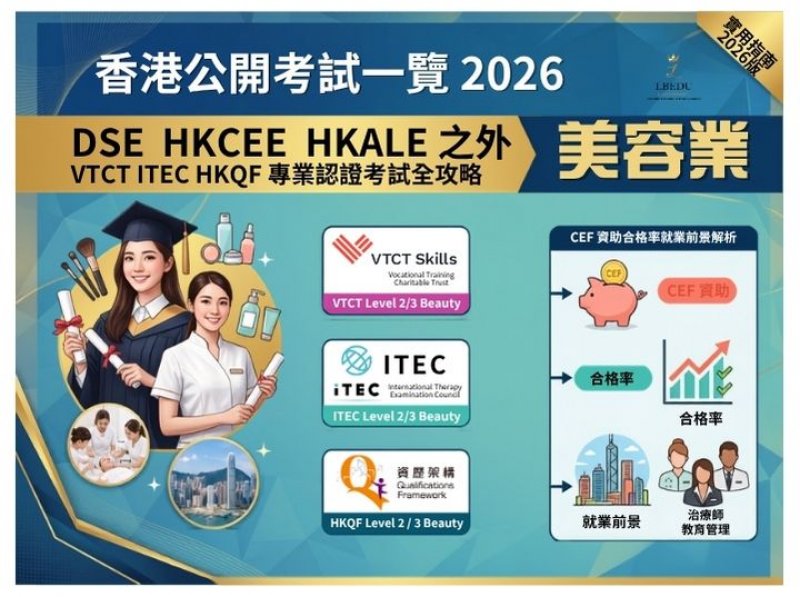
- Hong Kong Public Examination System: Besides the well‑known DSE (Hong Kong Diploma of Secondary Education Examination), the discontinued HKCEE (Hong Kong Certificate of Education Examination) and HKALE (Hong Kong Advanced Level Examination), there are a large number of "professional qualification examinations" across industries. These are essentially the industry's own "public exams" and serve as the threshold for entry and promotion.
- Beauty Industry "Professional Public Exams": Mainly include VTCT, ITEC, HKQF qualifications, etc., regulated by international or local authoritative bodies. Passing these exams awards recognised qualifications, which are important references for employers and for clients when choosing technicians.
- Complete Breakdown of Professional Qualifications: This article lists the main public examination systems in Hong Kong and focuses on the 3 major professional certification exams in the beauty industry – their differences, entry requirements, assessment methods, recognition and career prospects – to help you choose the most suitable qualification pathway.
- LBEDU Approved Examination Centre: A government-registered tertiary institution (854) and an official VTCT/ITEC approved training and examination centre, offering a full range of beauty certification courses. Small classes with pair‑work practice, zero‑experience friendly, exam coaching included to help students successfully obtain international qualifications.
- DSE and old‑system public exams: DSE is the current Hong Kong secondary school leaving public exam, conducted by the Hong Kong Examinations and Assessment Authority (HKEAA); HKCEE and HKALE were discontinued after 2012 and replaced by DSE.
- Industry Professional Qualification Examinations: Apart from academic public exams, various industries in Hong Kong have their own professional qualification exams, e.g., CPA for accountants, PCLL for lawyers, registration exams for construction, etc. The beauty industry also has corresponding international certification exams.
- 3 Mainstream Beauty Industry Certifications: VTCT (UK vocational qualifications, broadest coverage), ITEC (International Therapy Examination Council, therapy‑focused), and HKQF (local Hong Kong Qualifications Framework, eligible for CEF funding).
- Nature of Professional Exams: These professional certification exams are similar in nature to DSE/HKCEE: they are unified standards, public assessments, and award recognised qualifications upon passing – the difference is one is academic, the other is vocational expertise.
- Gateway to Entry and Entrepreneurship: For those wanting to enter the beauty industry, obtaining an international certification is like getting a "public exam pass certificate" for the industry – it is the key to job hunting, starting a business, and winning clients.
Hong Kong Public Examinations Overview 2026 | Beyond DSE and HKCEE: VTCT ITEC Professional Certification Guide for the Beauty Industry
VTCT ITEC Professional Certification Guide
Table of Contents
- 1. Overview of Hong Kong’s Main Public Examination Systems: DSE, HKCEE and Others
- 2. What is an "Industry Professional Public Exam"? Why Does Every Industry Have Its Own Exams?
- 3. Complete Breakdown of the 3 Major "Professional Public Exams" in the Beauty Industry
- 4. How to Choose a Beauty Certification Exam? Comparison Table by Personal Goals
- 5. Frequently Asked Questions about Applying for Beauty Certification Exams
- 6. LBEDU Approved Examination Centre: One‑stop Support from Courses to Exams
- 7. FAQ
- 8. Further Reading
1. Overview of Hong Kong’s Main Public Examination Systems: DSE, HKCEE and Others
When it comes to public examinations in Hong Kong, the most familiar are DSE and the now‑discontinued HKCEE. Below is a complete list of the major public examination systems in Hong Kong over the years:
- Full name: Hong Kong Diploma of Secondary Education Examination
- Administering body: Hong Kong Examinations and Assessment Authority (HKEAA)
- Status: Current secondary school leaving public exam, first held in 2012
- Subjects: 4 core subjects (Chinese, English, Mathematics, Liberal Studies / Citizenship and Social Development) + 2‑3 electives
- QF level: Corresponds to HKQF Levels 3‑5 (5** is Level 5)
- Purpose: Secondary school graduation qualification, university admission, employment academic proof
- Full name: Hong Kong Certificate of Education Examination
- Administering body: Hong Kong Examinations and Assessment Authority (HKEAA)
- Status: Discontinued, last sitting in 2011 (last sitting for private candidates in 2012)
- Subjects: About 10‑20 subjects, candidates typically took 6‑8 subjects
- QF level: Pass (Grade E or above) corresponds to HKQF Level 3
- Purpose: Old‑system Form 5 graduation qualification, progression to sixth form, employment academic proof
- Note: Commonly known as the "HKCEE" or "Certificate" in Hong Kong; it is a collective memory for many – phrases like "5 points in HKCEE" or "10 As in HKCEE" were popular at the time.
- Full name: Hong Kong Advanced Level Examination
- Administering body: Hong Kong Examinations and Assessment Authority (HKEAA)
- Status: Discontinued, last sitting in 2013
- Subjects: Advanced Level (A‑Level) + Advanced Supplementary Level (AS‑Level) subjects
- QF level: Corresponds to HKQF Level 4
- Purpose: Old‑system university admission (sixth form graduation)
- Note: Commonly known as the "A‑Level" or "HKALE" in Hong Kong – different from the mainland Gaokao, it was the final step of the old 7‑year secondary system.
In addition to the three main exams above, Hong Kong also has the following common public examinations:
- IELTS (International English Language Testing System): English proficiency test, commonly used for further study and employment
- TOEFL (Test of English as a Foreign Language): US‑based English proficiency test
- SAT / ACT: US university entrance exams
- GRE / GMAT: Graduate entrance exams
- National Judicial Examination: Mainland lawyer qualification exam (also open to Hong Kong residents)
This is the focus of this article. Besides academic exams, every industry in Hong Kong has its own "professional qualification examination", which is essentially the industry’s public exam – a required step for entry, practice, and promotion. For example:
- Accounting: HKICPA (Hong Kong Institute of Certified Public Accountants) qualification exam, ACCA
- Law: PCLL (Postgraduate Certificate in Laws), Bar exam
- Healthcare: Medical Council licensing exam, Nursing Council registration exam
- Construction: Registered Professional Engineer exam, Construction Industry Council trade test
- Finance: Securities and Futures Intermediaries Examination (HKSI), CFP
- Beauty: VTCT, ITEC, HKQF assessments (detailed below)
Although these professional exams are not called "public exams", they are essentially the same as DSE/HKCEE: unified standards, public assessment, and recognised qualifications upon passing – the difference is one is in the academic field, the other is in vocational expertise across industries.
2. What is an "Industry Professional Public Exam"? Why Does Every Industry Have Its Own Exams?
Many people think that after finishing DSE there are no more exams, but once you enter the workforce, every industry has its own "professional public exam". Why?
- Professional skills need uniform standards: DSE assesses secondary school academic knowledge, but the professional skills of each industry (e.g., laser operation for beauticians, auditing skills for accountants, structural calculations for engineers) cannot be evaluated through DSE. Industry‑specific professional bodies set uniform standards and assess whether practitioners have reached a certain level through exams.
- Protecting public safety and interests: Many industries involve public safety (e.g., healthcare, construction, and invasive procedures in beauty like laser or microblading). Without a unified qualification exam, anyone could claim to be a professional, putting public safety at risk. Professional qualification exams act as a gatekeeping mechanism to ensure practitioners have the necessary knowledge and skills.
- Elevating the profession’s status: With uniform qualification exams and certification systems, the professional status of an industry gains social recognition. For example, "Registered Doctor", "Accountant", and "Lawyer" are respected titles because behind them are rigorous exams and certification. The beauty industry is no different – technicians holding international certifications like VTCT enjoy higher social status and client trust.
- Providing clear career progression pathways: Professional qualification exams are usually divided into different levels (e.g., Level 2 entry, Level 3 professional, Level 4 advanced), allowing practitioners to advance step by step, just like progressing from HKCEE to HKALE to university.
Professional certification exams in the beauty industry have several features:
- Highly international: Beauty is a global industry; certifications like VTCT and ITEC are internationally recognised in many countries
- Practical‑skills focused: Unlike academic exams which are mostly written, beauty certification exams place great emphasis on practical assessment, usually accounting for 60‑70% of the total score
- Clear level progression: From Level 2 entry to Level 4/5 advanced, levels are clearly articulated, allowing students to progress gradually
- Strong employment orientation: Exam content is designed according to industry employment needs; after obtaining the certificate, graduates can start working immediately
3. Complete Breakdown of the 3 Major "Professional Public Exams" in the Beauty Industry
Below is a detailed introduction to the three most mainstream and highly recognised professional certification exams in the beauty industry – they are the beauty industry’s "DSE/HKCEE":
- Full name: Vocational Training Charitable Trust
- Origin: UK, established over 50 years ago
- Regulator: Office of Qualifications and Examinations Regulation (Ofqual) in the UK, qualifications mapped to the Regulated Qualifications Framework (RQF)
- Hong Kong recognition: Mapped to HKQF Levels 2‑4; some courses are eligible for CEF funding
- Assessment method:
- Theory written exam (multiple‑choice + short‑answer questions)
- Practical assessment (assessed on‑site by VTCT registered examiners)
- Coursework and learning portfolio
- Some units require a specified number of practice hours - Popular levels and units:
- Level 2: Basic facial and body treatments, basic nail, basic eyelash (entry level, mapped to HKQF Level 2)
- Level 3: Diploma in Beauty Therapy, Diploma in Nail Technology, Media & Stage Makeup, Semi‑Permanent Makeup (professional level, mapped to HKQF Level 3)
- Level 4: Laser & IPL Therapy, Advanced Skin Care, SMP Scalp Micropigmentation (advanced level, mapped to HKQF Level 4) - Recognition: ⭐⭐⭐⭐⭐
- Over 70% of beauty‑related job postings in Hong Kong recognise VTCT certificates
- Recognised in more than 50 countries worldwide
- The most widely covered and most taken international certification in Hong Kong’s beauty industry - Target audience: Beginners with no experience, those wanting to quickly enter the industry, anyone seeking an international qualification
- Full name: International Therapy Examination Council
- Origin: UK, established over 70 years ago
- Regulator: Also regulated by Ofqual in the UK; now merged with VTCT under the same group
- Hong Kong recognition: Mapped to HKQF Levels 2‑4
- Assessment method:
- Theory written exam (deeper questions, heavier focus on therapy theory)
- Practical assessment (extremely strict standards, high examiner expectations)
- Case studies and treatment records - Popular levels and units:
- Level 2: Basic facial and body treatments
- Level 3: Diploma in Beauty Therapy (the classic), Diploma in Massage Therapy, Diploma in Aromatherapy, Electrotherapy
- Level 4: Advanced Electrotherapy, Skin Care Management - Recognition: ⭐⭐⭐⭐⭐
- Highly recognised internationally, especially in Commonwealth countries
- Many senior beauticians and spa therapists in Hong Kong hold ITEC certificates
- Known for its strict examinations, so certificate holders are assured of high technical competence - Target audience: Those wanting to focus on therapy‑based areas (beauty therapy, massage, aromatherapy), pursue international recognition, and have high standards for their own skills
- Full name: Hong Kong Qualifications Framework
- Origin: Hong Kong Government, administered by the Qualifications Framework Secretariat under the Education Bureau
- Regulator: Hong Kong Council for Accreditation of Academic and Vocational Qualifications (HKCAAVQ)
- Hong Kong recognition: Officially recognised by the Hong Kong Government, the most authoritative local qualifications system
- Assessment method:
- Accredited courses follow the institution’s own assessment methods (usually theory + practical)
- Some qualifications can be obtained through Recognition of Prior Learning (RPL), i.e., applying based on work experience
- Qualifications must be registered on the Qualifications Register to be valid - Levels: 7 levels in total, Level 1 foundation to Level 7 doctorate
- Common in beauty: Level 2 (Foundation Certificate), Level 3 (Diploma), Level 4 (Higher Diploma) - Recognition: ⭐⭐⭐⭐⭐
- Officially recognised by the Hong Kong Government; qualifications are credible for local employment, promotion, and further study
- Eligible HKQF courses can apply for CEF (Continuing Education Fund) funding (up to 80%, max HK$25,000)
- Can progress to university degree programmes through articulation arrangements - Target audience: Those wanting to develop their career in Hong Kong, apply for CEF funding, or possibly articulate to a university degree later
| Dimension | VTCT | ITEC | HKQF |
|---|---|---|---|
| Origin | UK | UK | Hong Kong Government |
| Regulator | Ofqual | Ofqual | HKCAAVQ |
| Levels | Level 2‑4 | Level 2‑4 | Levels 1‑7 |
| Assessment focus | Practical‑oriented, theory equally important | Deep therapy theory, strict practical | Course‑specific, must pass accreditation |
| Recognition | Broadest in Hong Kong, 50+ countries worldwide | High internationally, therapy‑focused | Officially recognised by HK Government |
| CEF funding | Some courses eligible | Some courses eligible | Eligible courses can apply |
| Entry difficulty | Medium, beginners can enrol | Medium‑high, high theory requirements | Medium, increases by level |
| Suitable stage | Entry to advanced, full coverage | Focus on therapy‑related intermediate‑advanced | Local entry to advanced |
4. How to Choose a Beauty Certification Exam? Comparison Table by Personal Goals
With so many certification exams, which one should you take? Below are recommendations based on different personal goals:
- Recommended exam: VTCT Level 2/3 Certificate in Beauty Therapy (or equivalent HKQF course)
- Reason: VTCT has a low entry barrier, practical course content, wide recognition; graduates can find jobs directly. Choosing a course that also maps to HKQF allows CEF funding.
- Estimated time: 3‑6 months
- Recommended exam: VTCT Level 3/4 Specialist Certificate (semi‑permanent makeup, laser, nails, SMP, etc.)
- Reason: Specialist certification is key to attracting clients; advanced procedures (like laser) require Level 4 certification to operate safely. VTCT has the highest recognition in Hong Kong and is most trusted by clients.
- Estimated time: 1‑3 months (single specialism)
- Recommended exam: ITEC Level 3 Diploma in Beauty Therapy / Massage / Aromatherapy
- Reason: ITEC is the most authoritative in therapy‑focused areas, with strict exams and guaranteed technical standards; highly recognised in high‑end SPA and therapy settings.
- Estimated time: 4‑8 months
- Recommended exam: HKQF‑accredited courses (often those with dual VTCT/ITEC certification)
- Reason: Only courses under the HKQF framework are eligible for CEF funding, with up to 80% of tuition fees reimbursed. Choose courses with both international and local recognition to get the best of both worlds.
- Estimated time: 3‑12 months depending on level
- Recommended exam: HKQF Level 4 or above (e.g., VTCT Level 4 mapped to HKQF Level 4), then articulate to university via articulation arrangements
- Reason: HKQF qualifications can be used to enter university year 2 or 3 through articulation, serving as a bridge from vocational qualifications to academic degrees.
- Estimated time: 6‑12 months to obtain HKQF Level 4, then 2‑3 years to complete a degree
5. Frequently Asked Questions about Applying for Beauty Certification Exams
• VTCT Level 2/3: Pass rate about 85‑95%. Most students pass as long as they attend classes and practise sufficiently.
• ITEC Level 3: Pass rate about 75‑85%. Theory requirements are higher, so more revision is needed.
LBEDU students, with small classes, ample pair‑work practice and pre‑exam coaching, consistently achieve pass rates above the industry average.
1. Theory written exam: Multiple‑choice and short‑answer questions covering skin physiology, disinfection and infection control, product knowledge, etc.
2. Practical assessment: A registered examiner observes you performing a full treatment, evaluating technique, hygiene, client communication, etc.
3. Portfolio / coursework: Some units require submission of class assignments and case records.
The exact format varies by level and unit; please check with the institution before enrolling.
• VTCT: Over 50 countries worldwide
• ITEC: Widely recognised in Commonwealth countries and Europe
If you plan to work or study abroad, these international certifications are more valuable than local certificates.
6. LBEDU Approved Examination Centre: One‑stop Support from Courses to Exams
LBEDU Shining Beauty International Education & Training Institute is an official VTCT/ITEC approved training and examination centre, and a Hong Kong government‑registered tertiary institution (registration no. 854). We provide one‑stop support from course training to certification exams:
- Official approved examination centre: Directly authorised by VTCT/ITEC. Course syllabi fully follow official standards, and exams are held on‑campus – students do not need to go to unfamiliar venues.
- Dual qualification recognition: Most courses offer both VTCT/ITEC international certification and HKQF local qualifications – gain two qualifications in one course, and can apply for CEF funding.
- Small classes with pair‑work practice: Class sizes are strictly controlled, prioritising even‑number pairings so students practise on each other as models, ensuring ample real‑person practice time and confidence for practical exams.
- Taught by experienced registered examiners: Instructors are VTCT/ITEC registered examiners, familiar with exam requirements and marking criteria; teaching directly targets exam content.
- Pre‑exam coaching and mock exams: Courses include focused revision and mock practical exams to familiarise students with the exam process, reduce anxiety, and increase pass rates.
- Lifelong post‑graduation technical support: Graduates can return for technical queries at any time, and enjoy discounted refresher rates for new technique courses.
- VTCT Level 2 Certificate in Beauty Therapy (Basic)
- VTCT Level 3 Diploma in Beauty Therapy
- VTCT Level 3 Diploma in Nail Technology
- VTCT Level 3 Certificate in Media and Stage Makeup
- VTCT Level 3 Certificate in Semi‑Permanent Makeup
- VTCT Level 4 Certificate in Laser and IPL Therapy
- VTCT Level 4 Certificate in SMP Scalp Micropigmentation
- ITEC Level 3 Diploma in Beauty Therapy
- IQA International Beauty Instructor Certificate
- More courses available upon enquiry
If you would like to know more about any course details, class schedules, tuition fees, CEF funding, or exam arrangements, please WhatsApp our admissions counsellor to book a free one‑on‑one consultation or campus visit.
7. Frequently Asked Questions
Summary: Hong Kong’s examination system goes far beyond DSE and HKCEE. Besides academic public exams, every industry has its own "professional public exam" – professional qualification certification exams. For the beauty industry, VTCT, ITEC, and HKQF are the three most important "public exam pass certificates", representing unified professional standards, industry recognition, and employability.
Whether you are a beginner wanting to enter the industry or a practising professional looking to upskill, choosing the right certification exam is the strongest foundation you can build for your career. Just as performing well in the HKCEE or HKALE was crucial in the past, the beauty industry’s "professional public exams" are your key to opening doors and achieving your career goals.
LBEDU, as an official VTCT/ITEC approved examination centre and a government‑registered institution, is committed to accompanying every student from the very beginning to obtaining international certification, ensuring your effort and investment yield the greatest returns.
8. Further Reading
- Academic Qualifications vs Vocational Training Qualifications 2026 | How to Choose Beauty Courses in Hong Kong? Full Analysis of the Two Qualification Systems
- Complete Guide to Finding Beauty Jobs and Choosing Schools in Hong Kong 2026 | 70% of Jobs Require International Certificates – Comparison of 4 High‑Employability Colleges
- Complete Guide to CEF Continuing Education Fund for Beauty Courses | HKQF‑Accredited Courses and Application Process
- 2026 Complete Guide to SMP Scalp Micropigmentation Courses | VTCT Level 4 Certification – Entry, Income and Prospects for Beginners
Comments (0)
No comments yet
Leave a Comment