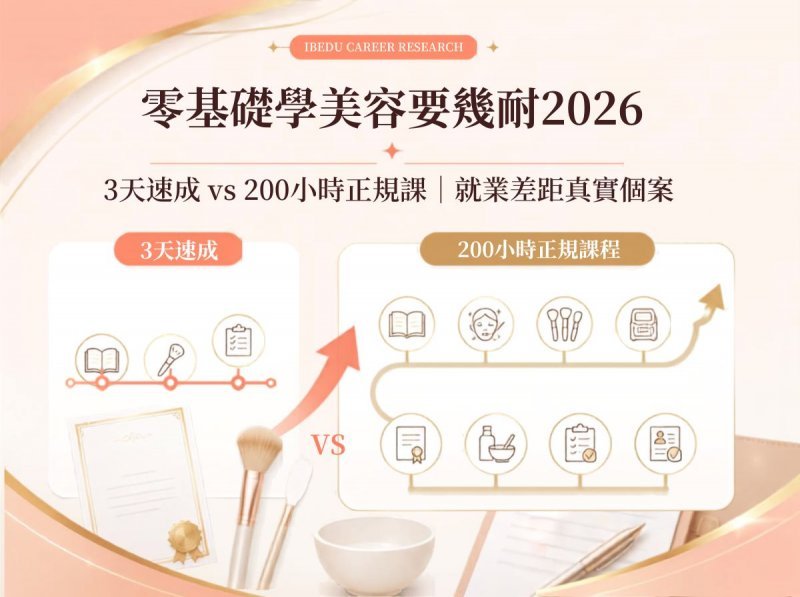
- How long does it take to learn beauty from zero? Depends on your goal: 2-3 days for experience, 50-200 hours for entry-level employment, 200-300 hours for professional level. The key is not "study time" but "total time cost" (study time + unemployment period)
- Beauty is a skilled trade that cannot be rushed: skin types vary infinitely, client needs differ, emergencies arise anytime, muscle memory takes time to form, and professional judgment requires experience. 3 days only covers the surface, insufficient for real hands-on practice
- Industry-recognised minimum hours: entry beauty therapy 50h, nail technology 60h, semi-permanent makeup 60h, laser beauty 72h. A 3-day crash course totals only 15-25h with 5-10h hands-on, far below any course minimum
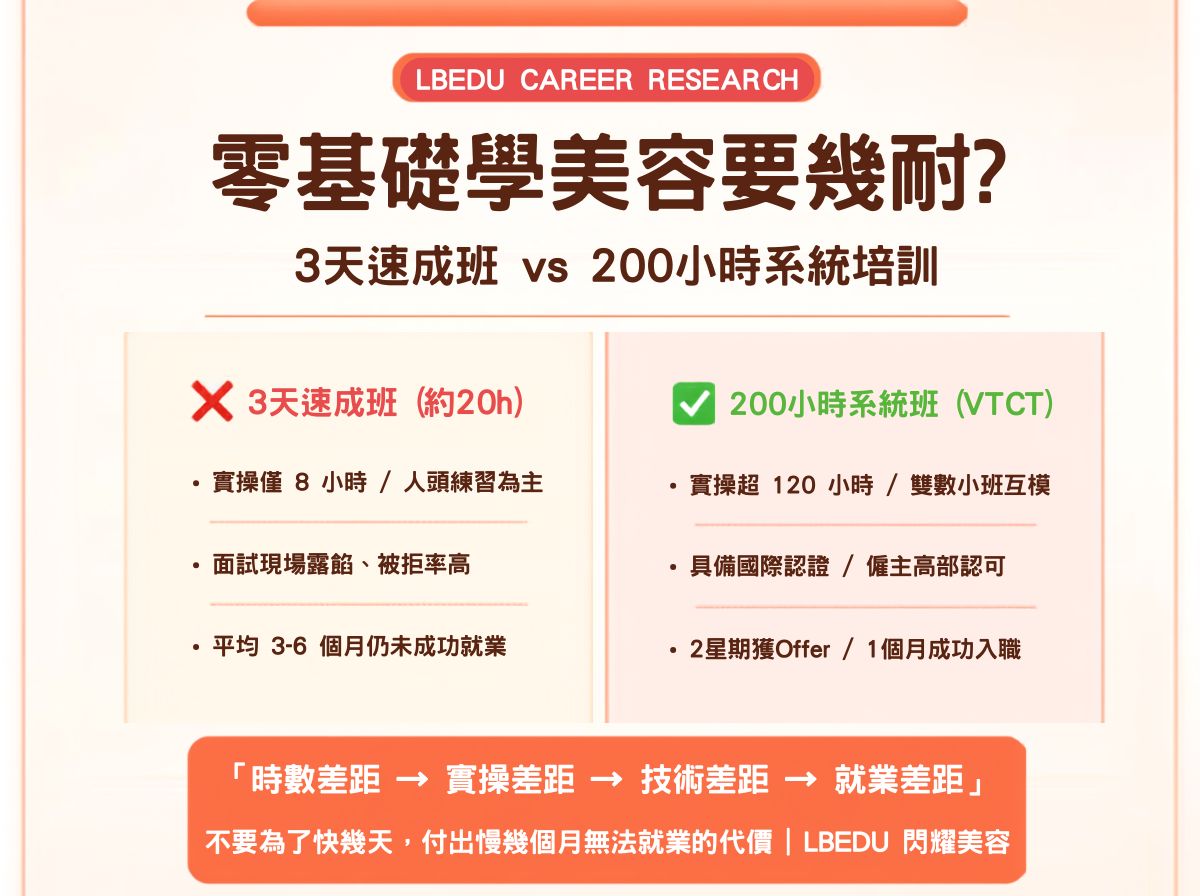
- Real case comparison: Student A took a 3-day crash course, rejected by all 10 employers (failed practical test), still unemployed after 6 months, real cost ~HK$75,000. Student B took a 200-hour systematic course, got offer in 2 weeks, employed in 1 month at HK$12,000, real cost ~HK$30,000
- Hours gap = skills gap = employment gap = income gap: 3 days vs 200 hours is a 10x total hours and 15x hands-on gap, directly determining whether you dare to perform, how well you do, and whether employers hire you. 5-year total income difference can reach HK$120,000-240,000
- Time planning for zero-experience learners: 1-3 day trial for hobby only; 100-200 hour VTCT Level 2/3 systematic course for employment; 60-150 hour specialised course for studio business; 200-300 hour foundation plus continuous learning for long-term career
- LBEDU zero-experience advantages: government-registered institution (854), VTCT/ITEC official recognised training and exam centre, 100-200 hour systematic courses, paired small class live model practice (ample hands-on per student), Employment Office job referral, 100+ partner employers, open to zero experience
How long does it take to learn beauty from zero? The answer depends on your goal: 2-3 days for experience, 50-200 hours for entry-level employment, 200-300 hours for professional level. Beauty is a skilled trade requiring hands-on practice, not just observation. Industry minimum hours: beauty 50h, nails 60h, semi-permanent 60h, laser 72h. Real case: Student A (3-day crash) rejected by 10 employers, unemployed 6 months, cost HK$75,000; Student B (200h systematic) employed in 2 weeks at HK$12,000, cost HK$30,000. Choose total time cost, not just study duration.
How Long Does It Take to Learn Beauty from Scratch 2026
3-Day Crash Course vs 200-Hour Formal Course — The Real Employment Gap
How long does it take to learn beauty from scratch? Is a 3-day crash course enough? How many hours do you need for nail art, semi-permanent makeup, and laser treatments? Real cases tell you the truth! Many people who choose to switch careers into beauty want to graduate quickly and start earning money as soon as possible. But does "fast graduation" equal "fast employment"? This article honestly breaks down the decisive impact of learning hours on employment outcomes, using industry standards, real case studies, and data comparisons.
1. The Most Common Question from Zero-Base Students
In LBEDU's education consultations, the most common question from zero-base students is: "How long does it take to learn beauty? Are there fast courses? I want to graduate quickly and find a job." This desire to start earning income as soon as possible is completely understandable, but "fast" doesn't equal "good," and "fast graduation" doesn't equal "fast employment."
Many students are attracted by "3-day crash course certificate" advertisements, only to discover after graduation that their skills aren't solid, they panic when facing clients, they're exposed during interview practical tests, their CVs are filtered out because of the school's poor reputation, and they end up spending more time and money on formal courses to "fix" the problem — wasting even more time.
2. Why Is Beauty a Handcraft Industry That Cannot Be Rushed?
Beauty is a handcraft industry — skills come from "doing," not "watching":
- Skin types vary endlessly: The same face might have an oily T-zone, dry cheeks, and a sensitive chin, changing with climate and condition. Experience must be accumulated through extensive hands-on practice with real people.
- Client needs differ: Assessing client needs, communication skills, and service adjustments all require accumulated experience.
- Emergencies happen anytime: Client allergies, redness, bleeding, or equipment failure — a 3-day crash course simply cannot teach you how to respond.
- Muscle memory takes time: Fluidity of movement and stability of pressure require dozens to hundreds of hours of repeated practice to form muscle memory.
- Professional judgment cultivation: The core value of a senior beautician lies in independently judging which treatments and parameters are suitable — judgment comes from time and accumulated practical experience.
3. Reasonable Minimum Hours Comparison Table for Different Courses (Industry Standards)
According to VTCT/ITEC official standards and Hong Kong beauty industry requirements, the reasonable minimum hours for different courses are as follows:
| Course Type | Reasonable Minimum Total Hours | Minimum Practical Hours | Is a 3-Day Crash Course (~20 hours) Sufficient? |
|---|---|---|---|
| Entry-Level Beauty Care | 50 hours | 30 hours (60%) | ❌ Insufficient — only basic concepts covered |
| Nail Technology | 60 hours | 40 hours (67%) | ❌ Insufficient — gel nails and nail art require extensive practice |
| Semi-Permanent Makeup | 60 hours | 45 hours (75%) | ❌ Severely insufficient — invasive procedures require rigorous training |
| Laser Beauty | 72 hours | 50 hours (69%) | ❌ Severely insufficient — safety risks demand adequate training |
| Eyelash Extensions | 40 hours | 28 hours (70%) | ⚠️ Barely entry-level — employment level requires more practice |
| Makeup (Daily/Bridal) | 50-80 hours | 35-55 hours | ❌ Insufficient — different face shapes and skin tones need extensive practice |
| VTCT Level 3 Beauty Diploma | 150-200 hours | 100-130 hours | ❌ Completely insufficient — international diplomas have strict hour requirements |
| VTCT Level 4 Laser/Semi-Permanent | 100-150 hours | 70-100 hours | ❌ Completely insufficient — advanced certificates have stricter requirements |
Special reminder: Semi-permanent makeup and laser beauty are invasive or high-risk procedures. Insufficient hours can easily cause burns, infections, and other injuries, leading to legal liability — never rush these.
4. What Can a 3-Day Crash Course Actually Teach?
A 3-day crash course isn't completely useless, but its positioning is "experience class" or "hobby class" — definitely not an "employment class":
- What you CAN learn in 3 days: Basic concepts, tool names and uses, following the instructor to try basic movements 1-2 times, preliminary understanding of the industry.
- What you CANNOT learn in 3 days: Solid skills (severely insufficient practical time), adaptability, independent professional judgment, employment competitiveness (exposed during practical tests), client-facing confidence.
- Certificate value: In-school certificates are usually issued upon payment and not recognised by employers. Even if third-party certified but with compressed hours, employers will question your skills when they see a crash-course school background.
5. Real Case Comparison: Student A vs Student B
Below is a real comparison of two zero-base students' experiences, showing the employment gap between a "3-day crash course" and "200-hour formal training":
| Comparison Item | Student A (3-Day Crash Course) | Student B (200-Hour Formal Course) | Gap |
|---|---|---|---|
| Learning Time | 3 days (~20 hours) | 12 weeks (~200 hours) | B has 10x more time |
| Practical Hours | ~8 hours | Over 120 hours | B has 15x more practical hours |
| Real Models Practiced On | 2 (classmates) | 20+ (different skin types) | B has 10x more experience |
| Certificate Type & Reputation | In-school certificate, employer blacklist | VTCT Level 3 international recognition, employer trusted | International vs in-school |
| Interview Results After Graduation | Rejected in all 10 interviews | Passed all 2 interviews (received 2 offers) | 0% vs 100% success rate |
| Employment Time & Starting Salary | Still unemployed after 6 months (HK$0) | Offer in 2 weeks, employed in 1 month (HK$12,000+) | B is 5+ months faster |
| True Total Cost | Tuition HK$3,000 + 6 months no income (72,000) = HK$75,000 | Tuition HK$18,000 + 1 month no income (12,000) = HK$30,000 | B actually saves HK$45,000 |
| Status After 3 Months | Returned to retail job, beauty dream shattered | Certified beautician, monthly salary with commission ~HK$15,000 | A world of difference |

6. What Exactly Does 200 Hours of Systematic Training Cover?
Taking LBEDU's VTCT Level 3 Beauty Therapy Diploma as an example, the 200 hours are divided into four stages:
- Stage 1: Theoretical Foundation (~40 hours, 20%): Skin physiology, human anatomy, disinfection and infection control, product ingredient selection, client consultation and communication, beauty regulations.
- Stage 2: Basic Technical Practice (~60 hours, 30%): Skin analysis, deep cleansing, exfoliation, classic facial massage, mask application and moisturising. Small classes with even-numbered real-person practice.
- Stage 3: Advanced Techniques & Equipment (~50 hours, 25%): Electrical beauty treatments (high frequency, iontophoresis, ultrasound), special skin care (acne/sensitive skin), body care, brow and lash grooming.
- Stage 4: Pre-Exam Coaching & Official Examination (~30 hours, 15%): Mock written tests, practical procedure drills, VTCT registered examiner on-site assessment, employment coaching.
7. Hour Gap = Skill Gap = Employment Gap
The six-layer transmission formula from hours to income gap:
8. How Should Zero-Base Students Plan Their Learning Time?
- Pure interest: 1-3 day experience class (6-20 hours), budget HK$500-3,000.
- Entering the industry as a beautician (most common): 50-200 hours (VTCT Level 2/3 diploma), budget HK$8,800-15,000, employed within 1-2 months after graduation.
- Specialised technique for freelance work (nail/semi-permanent/laser): 60-150 hours specialised certificate, budget HK$8,800-12,800.
- Long-term development (trainer/management/opening a shop): 200-300 hours as foundation, then continuous further study of advanced certificates and education training certificates.
9. Three Common Misconceptions
Beauty relies on muscle memory and physiological laws. Understanding doesn't mean you can do it, and being able to do it doesn't mean you won't panic in front of real clients.
Wrong movements are extremely hard to correct, and crash course tuition + formal course tuition = spending more money overall — never cost-effective.
This is classic "survivor bias." Successful cases often rely on hundreds of hours of private practice or personal connections. Most crash-course graduates ultimately fail to enter the industry.
10. School Selection Hour Checklist
Before enrolling in a course, confirm: ① What is the total number of hours? ② Do practical hours account for more than 60%? ③ Are there sufficient real models for practice? ④ What is the instructor-to-student ratio (small classes of under 10 recommended)? ⑤ Does it include international certification examinations?
⚠️ Danger signals: Promoting "3-day crash/chicken essence classes," avoiding total hour disclosure, classes exceeding 20 people, particularly cheap with hidden charges.
11. Frequently Asked Questions (AEO Optimised)
Further Reading
1. Hong Kong Beauty Crash Course Truth 2026 | Is a 3-Day Certificate Really Useful? Industry Insider Reveals 6 Hidden Risks
2. How to Choose a Beauty Course 2026 | Crash Course vs Systematic Training: 8-Dimension Comparison of Tuition, Hours, Certificates, and Employment Prospects
3. How to Choose a Hong Kong Beauty School 2026 | 8 Practical Inspection Methods + Consideration List — Essential Reading for Zero-Base Career Changers
4. Which Beauty Certificates Are Most Recognised? | In-School Certificates vs VTCT/ITEC International Certification — The Truth About Employer CV Screening
Comments (0)
No comments yet
Leave a Comment