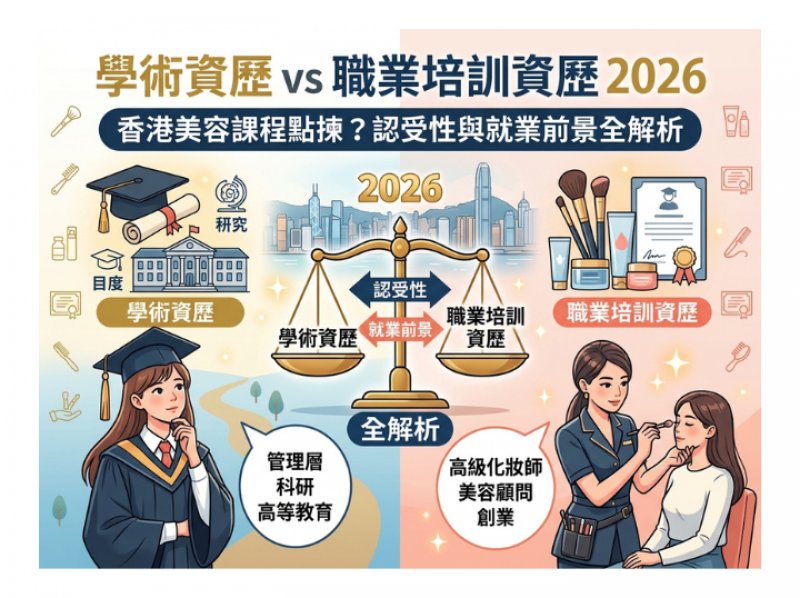
- Hong Kong beauty courses mainly fall into two qualification systems: Academic Qualifications (awarded by universities/post-secondary institutions, focused on theory and academic research) and Vocational/Professional Qualifications (awarded by professional training providers and international awarding bodies, focused on practical skills and industry application).
- Beauty is a "hands-on trade." Employers value practical skills and professional certifications the most when hiring. Vocational qualifications (such as VTCT/ITEC/HKQF) often have higher industry recognition and are more practical for employment and entrepreneurship.
- This article breaks down the differences between the two qualification systems, their recognition, career prospects, and provides course selection tips to help you choose the most suitable path based on your goals.
- LBEDU – Government‑registered institution (854) – adopts a dual‑track teaching model combining "academic theory + vocational practice." Courses cover HKQF local qualifications and VTCT/ITEC international certifications. Zero‑experience entry, graduates can work or start businesses.
- 1. Academic qualifications are awarded by institutions recognised by the University Grants Committee (UGC) or the Hong Kong Council for Accreditation of Academic and Vocational Qualifications (HKCAAVQ), including bachelor's degrees, associate degrees, and higher diplomas – focused on theoretical research and academic training.
- 2. Vocational qualifications are awarded by professional industry bodies or training providers, including VTCT, ITEC, IQA, and HKQF vocational qualifications – focused on practical skills, industry standards, and employability.
- 3. Over 70% of beauty industry job postings prioritise candidates with international vocational certifications (VTCT/ITEC). An academic degree is not a prerequisite – beauty is a skills‑driven industry.
- 4. Some courses combine both academic and vocational attributes, such as HKQF courses, which include both academic theory modules and practical vocational assessments – offering the best of both worlds.
- 5. Before choosing a course, clarify your personal goals: If you want to pursue research/teaching/management, consider academic qualifications. If you want to enter the industry quickly, work as a practitioner, or open a studio, vocational qualifications are the more direct path.
Academic vs Vocational Qualifications 2026|How to Choose a Beauty Course in Hong Kong?
Two Qualification Systems Compared – Recognition, Career Prospects, and How to Choose
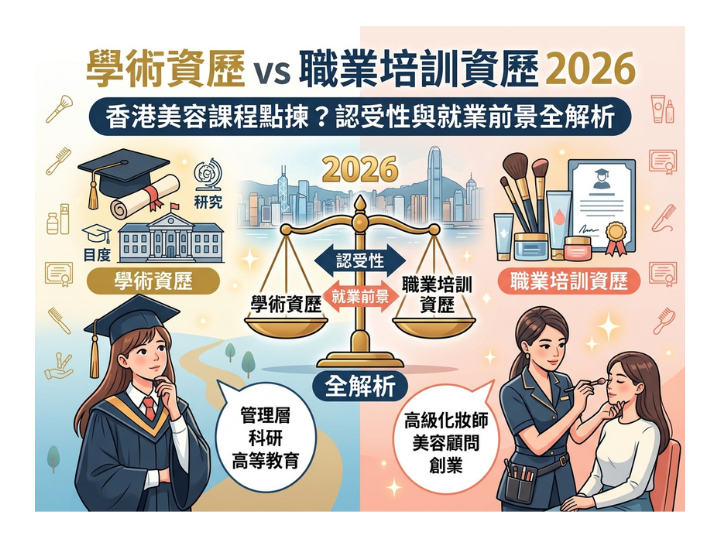
- Hong Kong beauty courses mainly fall into two qualification systems: Academic Qualifications (awarded by universities/post-secondary institutions, focused on theory and academic research) and Vocational/Professional Qualifications (awarded by professional training providers and international awarding bodies, focused on practical skills and industry application).
- Beauty is a "hands-on trade." Employers value practical skills and professional certifications the most when hiring. Vocational qualifications (such as VTCT/ITEC/HKQF) often have higher industry recognition and are more practical for employment and entrepreneurship.
- This article breaks down the differences between the two qualification systems, their recognition, career prospects, and provides course selection tips to help you choose the most suitable path based on your goals.
- LBEDU – Government‑registered institution (854) – adopts a dual‑track teaching model combining "academic theory + vocational practice." Courses cover HKQF local qualifications and VTCT/ITEC international certifications. Zero‑experience entry, graduates can work or start businesses.
1. Academic qualifications are awarded by institutions recognised by the University Grants Committee (UGC) or the Hong Kong Council for Accreditation of Academic and Vocational Qualifications (HKCAAVQ), including bachelor's degrees, associate degrees, and higher diplomas – focused on theoretical research and academic training.
2. Vocational qualifications are awarded by professional industry bodies or training providers, including VTCT, ITEC, IQA, and HKQF vocational qualifications – focused on practical skills, industry standards, and employability.
3. Over 70% of beauty industry job postings prioritise candidates with international vocational certifications (VTCT/ITEC). An academic degree is not a prerequisite – beauty is a skills‑driven industry.
4. Some courses combine both academic and vocational attributes, such as HKQF courses, which include both academic theory modules and practical vocational assessments – offering the best of both worlds.
5. Before choosing a course, clarify your personal goals: If you want to pursue research/teaching/management, consider academic qualifications. If you want to enter the industry quickly, work as a practitioner, or open a studio, vocational qualifications are the more direct path.
1. What Are Academic Qualifications? What Are Vocational Training Qualifications?
Many people get confused by the various "certificates," "diplomas," and "degrees" when choosing beauty courses. In fact, Hong Kong's qualifications system can be broadly divided into two categories: Academic Qualifications and Vocational Training Qualifications.
Academic qualifications are awarded by recognised higher education institutions, with a focus on academic theory and research.
Common Types:
- Bachelor's Degree
- Associate Degree
- Higher Diploma (some are academic‑oriented)
- Master's Degree
- PhD
Awarding Bodies:
- Hong Kong's eight public universities (HKU, CUHK, HKUST, etc.)
- Recognised private universities (e.g., Hang Seng University, Shue Yan University, etc.)
- Hong Kong post‑secondary colleges (e.g., IVE, HKDI associate degree programmes)
- Courses accredited by the Hong Kong Council for Accreditation of Academic and Vocational Qualifications (HKCAAVQ)
Key Characteristics:
- Emphasis on theoretical knowledge, academic research, and critical thinking
- Courses typically include many theory classes, essays, and research projects
- High recognition in academia and the civil service
- Longer duration (4 years for degrees, 2 years for associate degrees)
- Higher tuition fees
Vocational qualifications are awarded by professional industry bodies or training providers, with a focus on practical skills and industry application.
Common Types:
- International professional certifications: VTCT, ITEC, etc.
- Hong Kong Qualifications Framework (HKQF) vocational qualifications
- Industry association professional certifications
- Skills certificates, professional diplomas (vocational‑oriented)
Awarding Bodies:
- International professional awarding bodies (e.g., VTCT/ITEC, regulated by UK Ofqual)
- HKQF‑recognised training providers
- Professional industry associations (e.g., IQA International Qualification Assessment Alliance)
- Government‑registered professional training institutions
Key Characteristics:
- Emphasis on practical skills, industry standards, and employability
- Courses typically include extensive hands‑on practice, real‑life models, and skills assessments
- High recognition within the relevant industry – employers directly recognise them
- More flexible duration (from weeks to months)
- Lower tuition fees, better value for money
2. 7 Core Differences Between the Two Qualification Systems
For a clearer understanding, here's a detailed comparison of academic vs vocational qualifications across 7 dimensions:
| Dimension | Academic Qualifications | Vocational Training Qualifications |
|---|---|---|
| 1. Core Objective | Develop academic research ability, critical thinking, and theoretical knowledge systems | Develop practical skills, industry application ability, and employability |
| 2. Course Content | Many theory classes, lectures, essays, research projects, academic reports | Many practical sessions, real‑life practice, skills assessments, industry internships |
| 3. Assessment Methods | Examinations, essays, research reports, academic presentations | Practical assessments, portfolio review, clinical/internship performance, written exams (some) |
| 4. Duration | Longer: Associate degree 2 years, Bachelor's 4 years, Master's 1‑2 years | Flexible: Certificate 1‑3 months, Diploma 3‑6 months, Advanced 6‑12 months |
| 5. Tuition Range | Higher: Associate degree HK$30,000‑$80,000/year; Bachelor's HK$40,000‑$150,000/year | More affordable: Certificate HK$3,000‑$15,000; Diploma HK$15,000‑$40,000 |
| 6. Industry Recognition | High in academia, civil service, and large corporate management trainee programmes; but not essential for trades like beauty | Very high in beauty, hairdressing, nail, and other skills‑based industries – a primary hiring consideration for employers |
| 7. Career Paths | Academic research, education management, civil service, corporate management trainees | Frontline practitioners, professional technicians, freelancers, studio owners, industry trainers |
Key Differences Summary:
1. Theory vs Practice: Academic qualifications focus on theory; vocational training focuses on practice.
2. Long vs Short: Academic qualifications take longer; vocational training is flexible and allows faster entry.
3. General vs Specialised: Academic qualifications are broadly applicable but less precise within the industry; vocational training is targeted and highly industry‑recognised.
4. Research vs Application: Academic qualifications develop research skills; vocational training develops applied skills.
3. Which Qualification Is More Recognised in the Beauty Industry? Employer Hiring Preferences
Many people ask: "Do I need a degree to get a job in beauty?" The answer is: Absolutely not.
Beauty is a classic "hands‑on trade." When hiring, employers care most about your skills – whether you can serve clients directly – not whether you have a degree.
According to LBEDU's internal job board data for 2026:
- Over 72% of beauty‑related job postings explicitly listed "VTCT/ITEC/HKQF or equivalent international/professional certification preferred."
- Only 8% of job postings (mainly management roles at training institutions or academic research positions) required a bachelor's degree or higher.
- Over 65% of employers said they require on‑the‑spot practical tests during interviews – practical performance is the deciding factor.
- Skills directly impact service quality: Beauty is a service industry – a therapist's technique, skill, and experience directly determine client satisfaction. Employers need practitioners who can work immediately, not graduates with only theoretical knowledge.
- International certifications have unified standards: VTCT, ITEC, and similar certifications have strict assessment standards. Employers can immediately gauge a candidate's level of training from the certificate – far more informative than an unfamiliar degree title.
- The industry values apprenticeship and real‑world experience: Beauty has long been a "master‑apprentice" hands‑on tradition. Academic research is not the mainstream – practical experience and professional credentials are what matter.
- Entrepreneurship doesn't require a degree: Many study beauty to open studios or freelance. In these cases, professional certification and technical skill are what attract clients – a degree offers little help.
While the beauty industry overall favours vocational qualifications, there are scenarios where an academic qualification is beneficial:
- Beauty education management: Roles such as training centre principal, education director, curriculum development director – a degree is an advantage.
- Teaching at post‑secondary institutions: Lecturers in beauty programmes at IVE, HKDI, and similar institutions typically need a bachelor's degree or higher.
- Beauty‑related research: Dermatology research, product development, industry policy research – an academic background is essential.
- Civil service or large corporate training roles: Some government or large corporate training management positions require academic qualifications.
However, for the vast majority of people wanting to become beauty therapists, technicians, or studio owners, vocational qualifications are the more direct, practical, and cost‑effective choice.
4. HKQF – The Bridge Between Academic and Vocational Qualifications
When discussing qualifications in Hong Kong, you can't ignore the Hong Kong Qualifications Framework (HKQF). Many assume HKQF is only for vocational qualifications – but it actually covers both academic and vocational qualifications across seven levels, serving as a bridge between the two.
The Hong Kong Qualifications Framework is a seven‑level qualifications system covering academic, vocational, and continuing education sectors. Managed by the Qualifications Framework Secretariat under the Education Bureau, its purpose is to provide a unified recognition and articulation platform for Hong Kong qualifications.
| Level | Academic Equivalent | Vocational Equivalent | Examples |
|---|---|---|---|
| Level 1 | Certificate (Foundation) | Certificate (Foundation) | Foundation Skills Certificate |
| Level 2 | Certificate | Certificate | HKQF Level 2 Beauty Care Certificate |
| Level 3 | Diploma / Pre‑Associate Degree | Diploma | HKQF Level 3 Nail Technology Diploma |
| Level 4 | Higher Diploma / Associate Degree | Higher Diploma | VTCT Level 4 Laser Aesthetics (equivalent to HKQF Level 4) |
| Level 5 | Bachelor's Degree | Higher Diploma / Vocational Bachelor's | Vocational Bachelor's Degree |
| Level 6 | Master's Degree / Postgraduate Diploma | — | Master's Degree |
| Level 7 | PhD | — | PhD |
- Articulation between academic and vocational: Under HKQF, vocational qualifications can articulate with academic qualifications. For example, holding an HKQF Level 4 vocational diploma may allow entry into the second or third year of a university degree.
- Government‑recognised, subsidies available: HKQF‑recognised courses are eligible for CEF (Continuing Education Fund) subsidies – up to 80% reimbursement (capped at HK$25,000).
- Transparent qualifications: Each HKQF qualification has a clear "qualification description" outlining learning outcomes, assessment methods, and awarding bodies – giving both job seekers and employers clarity.
- Strong industry recognition: HKQF qualifications are officially recognised by the Hong Kong government, providing credibility for job applications, promotions, and entrepreneurship.
Common HKQF Beauty Courses:
- HKQF Level 2: Foundation Beauty Care Certificate
- HKQF Level 3: Nail Technology Diploma, Beauty Care Diploma
- HKQF Level 4: Semi‑Permanent Makeup Higher Diploma (some courses)
- VTCT/ITEC Level 3/4 courses are typically equivalent to HKQF Levels 3‑4
Tip: When choosing a beauty course, prioritise programmes that offer both HKQF local qualifications and VTCT/ITEC international certifications – this gives you access to CEF subsidies while also earning internationally recognised professional credentials.
5. International Vocational Certification Systems: VTCT / ITEC Explained
In addition to HKQF local qualifications, the beauty industry has several major international vocational certification systems. Here's a brief overview of their differences:
- Origin: UK – established over 50 years ago, one of the UK's largest vocational qualification awarding bodies.
- Regulation: Regulated by the UK Office of Qualifications and Examinations Regulation (Ofqual), with qualifications mapped to the UK Regulated Qualifications Framework (RQF).
- Features:
– Courses cover beauty, hairdressing, nail technology, makeup, massage, spa, and other full‑spectrum beauty fields
– Strict assessment standards balancing theory and practice
– Highly recognised in Hong Kong's beauty industry – one of the most widely accepted international certifications by employers
– Some courses are mapped to HKQF levels and eligible for CEF subsidies - Common Courses: VTCT Level 2/3 Beauty Care, Level 3 Nail Technology, Level 4 Laser Aesthetics, Level 3 Media & Stage Makeup.
- Origin: UK – established over 70 years ago, an internationally renowned therapy and beauty examination body.
- Regulation: Also regulated by UK Ofqual, now merged with VTCT under the same group.
- Features:
– Specialises in therapy‑oriented and care‑oriented courses such as beauty care, massage, aromatherapy, and electrotherapy
– Known for rigorous examination standards with high practical assessment requirements
– Highly recognised internationally (especially in Commonwealth countries)
– Many senior beauty therapists in Hong Kong hold ITEC certifications - Common Courses: ITEC Level 3 Beauty Care Diploma, Level 3 Massage Therapy, Level 4 Electrotherapy Aesthetics.
How to Choose Between These Certification Systems?
- Entry‑level / Quick entry: Choose VTCT Level 2/3 or ITEC Level 3 – high recognition, practical courses, reasonable fees.
- Advanced / Specialist skills: VTCT Level 4 (laser, semi‑permanent makeup, etc.) is a popular choice.
- High‑end / International development: After gaining experience, pursue IQA to elevate your professional standing.
- Local subsidies: Choose VTCT/ITEC courses mapped to HKQF levels to qualify for CEF subsidies.
6. How to Choose the Right Qualification Based on Your Personal Goals
After all this, what matters most is your own needs. Below are course selection recommendations based on different personal goals:
- Recommended qualification: VTCT/ITEC Level 2/3 Beauty Care Certificate (Vocational Training)
- Why: Practical courses, hands‑on focused, short duration (3‑6 months), highly recognised by employers – graduates can apply for jobs immediately.
- Additional advice: Choose courses also mapped to HKQF levels to apply for CEF subsidies and reduce tuition costs.
- Recommended qualification: VTCT Level 3/4 Specialist Skills Certificate (e.g., semi‑permanent makeup, laser, nail technology, SMP)
- Why: Specialist certification is key to attracting clients – clients prioritise professional credentials when choosing a practitioner; high‑level services (such as laser) require Level 4 certification for safe operation.
- Additional advice: Beyond technical certificates, consider IQA International Instructor Certification to offer training courses in the future and diversify income.
- Recommended qualification: First obtain VTCT/ITEC Level 3/4 specialist technical certification, then pursue IQA International Instructor Certification or VTCT Education & Training Certificate; long‑term, consider articulating to a degree.
- Why: To teach, you first need solid technical credentials, then teaching qualifications. To teach at post‑secondary institutions, a degree is essential.
- Additional advice: LBEDU's IQA Instructor Certification combined with the YWCA Community Teaching Internship programme allows you to gain real teaching experience.
- Recommended qualification: Bachelor's degree (Academic) + Specialist technical certification (Vocational)
- Why: Management roles typically have degree requirements, but beauty industry management also requires industry knowledge – having both makes you most competitive.
- Additional advice: You can start with vocational training to enter the industry, gain experience, and later articulate to a degree through HKQF – a more flexible pathway.
- Recommended qualification: Short‑term interest classes, workshops (formal qualification not required)
- Why: If it's just a personal interest, there's no need to spend time and money on professional certification – short workshops are sufficient.
- Additional advice: If you discover a deeper interest after the workshop, you can always enrol in a formal certificate course later.
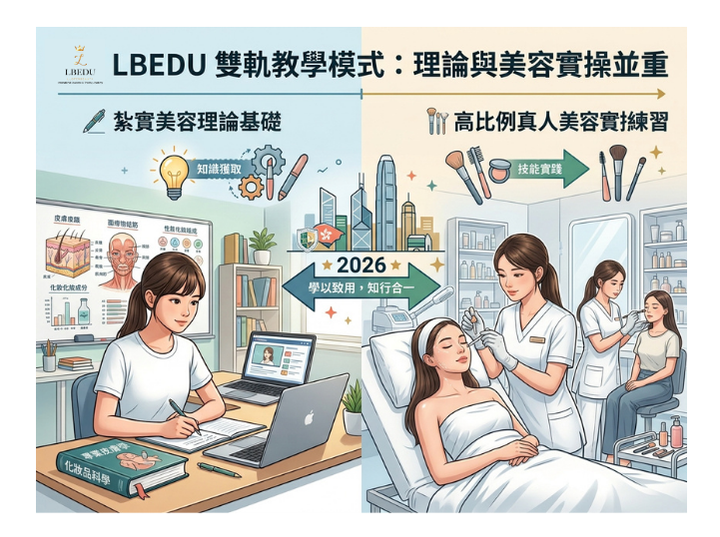
7. LBEDU Dual‑Track Teaching Model: Academic Theory + Vocational Practice
Many ask: "Is there a course that covers both academic theory and vocational practice?" The answer is: LBEDU's courses are designed exactly that way.
As a government‑registered post‑secondary institution (Registration No. 854), LBEDU adopts a dual‑track teaching model combining "academic theory + vocational practice" – ensuring students not only learn solid technical skills but also develop a comprehensive theoretical knowledge base for long‑term career growth.
- Optimal theory‑to‑practice ratio: Courses follow a 30% theory + 70% practice ratio – ensuring students understand the scientific principles behind the techniques (skin physiology, colour science, infection control) while getting extensive hands‑on practice.
- Dual qualification recognition: Most courses offer both HKQF local qualifications and VTCT/ITEC international certifications – students can earn two qualifications from one course, gaining access to CEF subsidies and internationally recognised credentials.
- Small even‑numbered classes with real‑life practice: Strict class size limits with even‑numbered pairing – students practice on each other as models, ensuring everyone gets sufficient real‑life practice time. This is the core of vocational training.
- Academic rigour + Vocational practicality: Theory components are written to academic standards, covering anatomy, physiology, dermatology, infection control, and other professional knowledge. Practical components are designed to meet industry standards and employer needs – graduates are ready to work immediately.
- Complete progression pathways: From entry‑level certificates (Level 2) to advanced diplomas (Level 4), and beyond to IQA International Instructor Certification – students can progress step by step. For those wanting to articulate to a degree, HKQF provides the articulation pathway.
Who Is This For?
- Zero‑experience beginners wanting to enter the industry with both solid skills and theoretical foundation
- Those seeking dual qualifications – international certification + local qualification
- Those wanting to apply for CEF Continuing Education Fund subsidies
- Those who may want to pursue instructor qualifications or articulate to a degree in the future
- Those who value teaching quality and small class sizes
If you'd like to learn more about LBEDU's course qualifications levels, class schedules, tuition fees, and CEF subsidy details, WhatsApp our education consultant to book a free one‑on‑one consultation.
8. Frequently Asked Questions
Conclusion
There is no absolute "better" between academic and vocational qualifications – what matters is whether they suit your personal goals.
For the vast majority wanting to enter the beauty industry, work as practitioners, or open studios, vocational qualifications (VTCT/ITEC/HKQF) are the more direct, practical, and cost‑effective choice – because beauty is a hands‑on trade where skill and professional credentials are what truly matter.
If you're interested in long‑term development in education management, post‑secondary teaching, or research, academic qualifications will be your pathway. The good news is that through HKQF, vocational and academic qualifications can articulate – you can start with vocational training, gain experience, and later decide whether to pursue a degree.
LBEDU has always maintained a dual‑track approach combining "academic theory + vocational practice" – ensuring students not only learn solid skills but also build a strong theoretical foundation, preparing them for various future possibilities.
Whichever path you choose, the most important thing is to select a school with recognised accreditation, quality teaching, and ample practical and internship opportunities – ensuring your tuition and time investment deliver the best return.
Further Reading
1. 2026 Hong Kong Beauty Job & School Selection Guide|70% of Jobs Require International Certificates – 4 High‑Employability School Comparison
2. CEF Continuing Education Fund Beauty Course Guide|HKQF‑Recognised Courses & Application Process
3. 2026 SMP Scalp Micropigmentation Course Guide|VTCT Level 4 Certification – Zero‑to‑Hero Career & Income Outlook
4. How to Become a Beauty Instructor? IQA International Instructor Qualification Guide|YWCA Community Teaching Internship
Comments (0)
No comments yet
Leave a Comment