- How to tell if a beauty school is genuine?|A genuine beauty school's core characteristic is "focus" – offering only beauty and medical aesthetics courses, without mixing cooking, security, real estate, insurance, or other unrelated courses. Faculty all come from the beauty industry, and facilities are dedicated to beauty training.
- What are common hidden fees at beauty schools?|Common hidden fees include material fees, equipment usage fees, exam registration fees, certificate fees, consumable fees (pigments, gels, masks), and product sales pressure. Always ask "what's included and what's not" and request a written fee breakdown.
- Are 2-3 day crash beauty courses useful?|Basically not. Beauty is a craft industry requiring adequate theory and extensive hands-on practice. Crash courses offer minimal practice time, leaving graduates unable to serve clients confidently. Choose courses with sufficient hours.
- Can beauty schools' "guaranteed employment" promises be trusted?|Be cautious. "Guaranteed employment" is often marketing hype with hidden conditions. Instead of promises, check the school's job placement office resources, partner employer count, employment rates, and job board update frequency.
- How to check if a school has sufficient teaching space?|Visit in person. Observe whether each class has 10 or fewer students, dedicated practical areas for different courses, sufficient equipment, and proper sanitation facilities. Crowded spaces signal quality concerns.
- What matters most in choosing a beauty school?|"Focus" is the core. A school offering only beauty and medical aesthetics courses concentrates all resources, expertise, and networks in beauty – delivering better teaching quality and job support. LBEDU is a government-registered school focused solely on beauty and medical aesthetics.
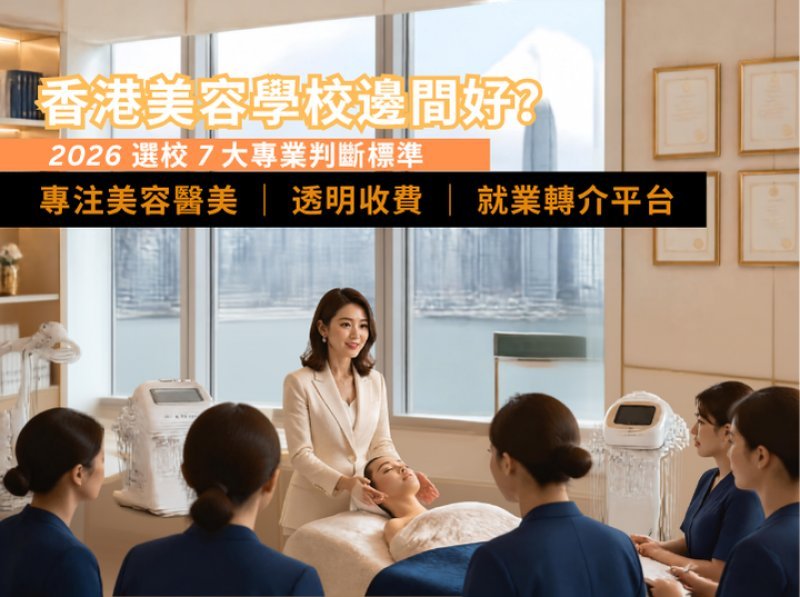
- Choosing a beauty school is the critical first step in transitioning to a beauty career. This guide provides 7 professional evaluation criteria: ① focus on beauty/medical aesthetics only (no cooking, security, or other courses); ② integrity and transparency (zero hidden fees, no forced product sales, public pass rates, clear refund policies); ③ adequate teaching space and facilities (10-student small classes, dedicated practical areas, sufficient equipment); ④ rich extracurricular activities (competitions, volunteer services, exhibitions, film internships); ⑤ job placement platform (dedicated job office, partner employers, internal job board); ⑥ sufficient course hours (no 2-3 day crash courses, industry-standard hours); ⑦ comprehensive learning support (library, online learning, video reviews, practice exam banks). LBEDU meets all 7 standards.
How to Choose a Beauty School in Hong Kong 2026|7 Professional Criteria – Beauty & Medical Aesthetics Focus, Transparent Fees, Career Referral Platform
- Focus Is the First Criterion: A good beauty school should only offer beauty and medical aesthetics-related courses, without mixing in unrelated vocational courses (such as culinary arts, security, real estate, etc.), so it can concentrate all resources on developing beauty talent.
- 7 Professional Criteria: (1) Focus on beauty and medical aesthetics (2) Honest and transparent (zero hidden fees / no hard-selling products / public pass rates / refund policy) (3) Sufficient teaching space and facilities (4) Rich post-course practical activities (5) Career referral platform (Career Office) (6) Sufficient course hours – reject crash courses (7) Comprehensive learning support (library / online learning / videos / question bank).
- Refuse Cost-Cutting: Quality schools do not compress teaching quality to control costs. Instead, they continuously expand space, optimise facilities, run activities, and build employment platforms to provide maximum support for students.
- LBEDU Government-Registered Institution (854): Focused on beauty and medical aesthetics education, small even-numbered classes with paired live-model practice, Career Office employment referral platform, library and online learning resources, zero-experience entry.
1. Why Is Choosing the Right Beauty School So Important?
Many people who want to switch to the beauty industry or learn a trade start by enrolling in a beauty course. But the market is flooded with beauty schools – advertisements are increasingly attractive, and prices vary widely. It's easy to fall into a trap:
- Discovering hidden fees after enrolment: Textbook fees, equipment usage fees, exam fees, product fees – the final cost can be double the advertised price.
- Crash courses that don't deliver: Claiming you can learn a full treatment in 2-3 days, but in reality you only learn the basics and don't dare take clients after graduation.
- Schools that offer everything: Beauty, culinary, security, real estate – all mixed together, with unprofessional faculty and insufficient facilities.
- No support after graduation: No career support, no post-course activities – students are left to figure out job hunting on their own.
- Cost-cutting at your expense: Cramming 15-20 people into a small classroom, long waits for practical practice, minimal hands-on time per person.
Choosing a good beauty school determines not only whether you learn real skills, but also whether you can successfully enter the industry and build a long-term career. Tuition is a one-time investment – the time and opportunity cost of choosing the wrong school is the biggest loss.
The following 7 professional criteria will help you systematically analyse whether a beauty school is worth enrolling in.
2. Criterion 1: Focus on Beauty and Medical Aesthetics – No Unrelated Vocational Courses
The core characteristic of a legitimate beauty school is focus. It should only offer beauty and medical aesthetics-related courses, such as: beauty therapy, facial treatments, nail art and eyelash extensions, keratin lash lifts, semi-permanent makeup, SMP scalp micropigmentation, laser aesthetics, HIFU, medical aesthetic device operation, makeup artistry, aromatherapy massage, and beauty instructor training.
It should not mix in culinary arts, baking, security, property management, real estate agency, insurance agency, accounting clerk, or other vocational training completely unrelated to beauty.
- Faculty Expertise: A beauty-only school has instructors who are all senior industry practitioners and registered assessors – far deeper teaching depth and industry insight than a "general training centre."
- Targeted Facilities: Beauty courses require professional treatment beds, equipment, and disinfection facilities. A beauty-focused school invests all resources in beauty facilities, not loose to kitchens or computer rooms.
- Industry Network: A beauty-focused school's partners are all beauty salons, medical aesthetics centres, makeup brands, and industry associations – graduate employment resources are more concentrated and precise.
- Teaching R&D: Continuously follows new beauty technologies, equipment, and trends, updating the syllabus in a timely manner – not using ten-year-old textbooks.
- Student Atmosphere: Classmates are all people who want to develop in the beauty industry – a more focused learning atmosphere where students can exchange ideas, practice together, and even start businesses together in the future.
3. Criterion 2: Honest and Transparent – 4 Touchstones to Identify an Ethical School
When choosing a beauty school, "honesty" is a very important but often overlooked criterion. An honest school will not use various means to conceal information or mislead students. The following 4 touchstones can help you quickly identify:
| Touchstone | Honest & Ethical School | School with Hidden Risks |
|---|---|---|
| 1. Tuition Transparency | Advertised price is the final price. Clearly states tuition, textbooks, exam and certificate fees in writing – zero hidden fees. | Advertised price is extremely low, then after class starts requires additional textbook purchases, equipment usage fees, exam and certificate fees. |
| 2. Product Selling Attitude | Teaching products and consumables are provided by the school. Product recommendations are purely voluntary and never linked to graduation or passing. | Constantly pushes own-brand products in class, claims you can't pass without buying, even forces purchase of high-priced startup packages. |
| 3. Exam Pass Rate | Publicly discloses真实可信 historical international exam pass rate data, proactively shares student certification results. | Never discloses data, or abuses "100% guaranteed pass" rhetoric to divert attention, with extremely harsh retake conditions. |
| 4. Refund Policy | Provides clear written refund policy compliant with Hong Kong consumer protection regulations, proactively informs before enrolment. | No written terms, verbal promises of "refund anytime" but denies later, rushes students to sign contracts quickly. |
4. Criterion 3: Teaching Space and Facilities – Don't Sacrifice Quality to Control Costs
Beauty is a practical industry. Whether teaching space is sufficient directly affects each student's hands-on practice opportunities and learning outcomes.
A good school continuously expands teaching space, dividing it into dedicated areas: facial treatment practice room, nail art dedicated table area, micropigmentation/laser treatment room, professional makeup demonstration area, theory classroom, disinfection area, and student lounge. Class sizes are reasonable (recommended under 10 students), equipment is sufficient, and the environment strictly meets beauty disinfection standards.
Some schools deliberately compress teaching space and facility investment to reduce operating costs, cramming 15-20 people into a small classroom. This leads to long queues for practical practice, greatly reduced live-model practice time, crowded environments with high hygiene risks. The tuition may seem cheaper, but after graduation you may need to spend extra on additional training because your skills are insufficient – the total cost is actually higher.
5. Criterion 4: Post-Course Practical Activities – Let Students Apply What They've Learned
Beauty is a practical industry. Skills learned in the classroom must be applied in real scenarios to truly master them. A good beauty school does not cut ties after graduation – it continuously seeks opportunities to organise various activities for graduates to participate in and apply their skills:
- On-campus Skills Competitions: Regularly holds nail art, makeup, and micropigmentation competitions – students improve skills and build their CV through competition.
- External Volunteer Services: Organises students to provide free beauty services at community centres, elderly homes, etc. – accumulating real interpersonal interaction and hands-on experience.
- Industry Exhibitions & Competitions: Leads students to Hong Kong and international beauty exhibitions – broadening horizons and understanding the latest industry trends.
- Film/Stage Makeup Internships: Arranges makeup students to participate in film shoots, stage plays, fashion shows, etc. – accumulating project-based practical experience.
- Graduation Portfolio Exhibition & Sharing Sessions: Holds portfolio exhibitions to attract potential employers, and invites successful graduate entrepreneurs to share business experience.
6. Criterion 5: Career Referral Platform (Career Office) – Helping Graduates Enter the Industry
For zero-experience career switchers, after graduation they often face difficulties finding jobs, not knowing how to write a CV, and lacking confidence. The "Career Office" is a dedicated department set up by the school that can greatly improve graduates' success rate in entering the industry.
- Dedicated Team Support: Has dedicated staff responsible for career referrals, not admissions consultants handling it part-time.
- Extensive Partner Network: Established long-term partnerships with numerous beauty salons, medical aesthetics centres, and makeup brands.
- Internal Recruitment Platform: Has a dedicated website or community job board, regularly updated with exclusive job vacancies.
- One-on-One Career Coaching: Provides personalised CV optimisation, interview simulations, and career planning.
- On-Campus Recruitment Fairs: Invites employers to conduct on-site interviews, allowing students to meet employers face-to-face.
7. Criterion 6: Sufficient Course Hours – Reject 2-3 Day Crash Courses, Give Students Time to Absorb
Many beauty courses on the market advertise "learn nail art in 2 days" or "become a micropigmentation artist in 3 days." But beauty is a hands-on trade – crash courses often lead to weak theoretical foundations, severely insufficient practical experience, inability to handle real clients, and even the risk of client disputes due to improper operation.
Below is a reasonable reference standard for professional beauty course hours:
| Course Type | Reasonable Minimum Hours | Core Content Covered |
|---|---|---|
| Introductory Beauty Therapy | 60 - 100 hours | Skin physiology, cleansing, moisturising, basic facial treatments, disinfection control |
| Nail Technology Course | 80 - 120 hours | Nail care, gel nails, nail art, extensions, foot care and removal |
| Eyelash Extension Course | 40 - 60 hours | Lash structure, classic extensions, YY lashes, keratin lash lift, hygiene standards |
| Semi-Permanent Makeup Course | 80 - 120 hours | Skin physiology, pigment science, brow/eye/lip procedures, live-model practice, colour touch-up techniques |
| Laser & Medical Aesthetic Devices | 60 - 100 hours | Optical principles, skin typing, device operation safety, contraindications and post-care |
| International Certification Diploma (VTCT/iTEC) | 150 - 300 hours | Complete theoretical system + extensive live-model practice + strict assessment + professional portfolio |
8. Criterion 7: Comprehensive Learning Support – Library / Online Learning / Videos / Question Bank
Classroom time is limited – you can't remember everything the instructor explains in one go. A professional beauty school should provide comprehensive post-course learning resources so students can revise, fill knowledge gaps, and self-improve:
- Library (Physical): Collects professional beauty books (dermatology, anatomy, equipment science), subscribes to industry journals, and provides a quiet study space.
- Online Learning Platform (LMS): Has a dedicated learning system where students can view electronic notes, submit assignments, and track progress anytime.
- Teaching Video Replay: Records classroom demonstrations into high-definition videos – students can slow down and rewatch technique details anytime.
- Online Exam Question Bank: Provides past international exam mock questions with instant explanations – helping students familiarise with exam pacing and greatly improving pass rates.
9. Comprehensive Checklist of the 7 Criteria
- [ ] Focus: Does the school only offer beauty and medical aesthetics courses, without mixing in unrelated vocational courses?
- [ ] Honesty & Transparency: Is tuition all-inclusive with zero hidden fees? No hard-selling? Clear refund terms?
- [ ] Space & Facilities: Have you visited in person? Small class sizes? Sufficient equipment and disinfection facilities?
- [ ] Post-Course Activities: Does the school regularly hold competitions, volunteer services, or exhibitions for students to practise?
- [ ] Career Support: Is there a dedicated Career Office? Are partner employer numbers and job board updates frequent?
- [ ] Sufficient Hours: Do the hours meet industry professional standards? Does it reject several-day crash courses?
- [ ] Learning Resources: Does it provide a physical library, online learning platform, video replay, and mock question bank?
Scoring Guide: Meeting 7 criteria = top-quality school; 5-6 = generally good; 3-4 = consider carefully; 0-2 = strongly advise against enrolling.
10. Frequently Asked Questions (FAQ)
Conclusion
Choosing a good beauty school is the first and most critical step on your beauty career path. A good school truly cares about students' learning and growth, not just earning tuition fees.
LBEDU Luster Beauty International Education and Training Academy (Government-Registered Institution No. 854) has always remained focused on beauty and medical aesthetics education, using small even-numbered classes with paired live-model practice, a Career Office employment referral platform, library and online learning resources, and continuously organises various post-course activities to ensure every student receives sufficient learning hours and comprehensive support.
Further Reading
1. Hong Kong Beauty School Ranking Comparison 2026|5 Major Academies' Strengths, Fees, Certifications & Job Support
2. Hong Kong Beauty Job & School Selection Guide 2026|70% of Jobs Require International Certificates – 4 High-Employability Schools Compared
3. Zero-to-Hero Beauty Career Switch Guide|5 Popular Specialisations Compared – Fees, Certificates, Income, ROI
4. TVB "News Perspective" Visits LBEDU|Interview with Vice Principal Lawrance Wong – Deconstructing Key Qualifications Framework Issues
Comments (0)
No comments yet
Leave a Comment