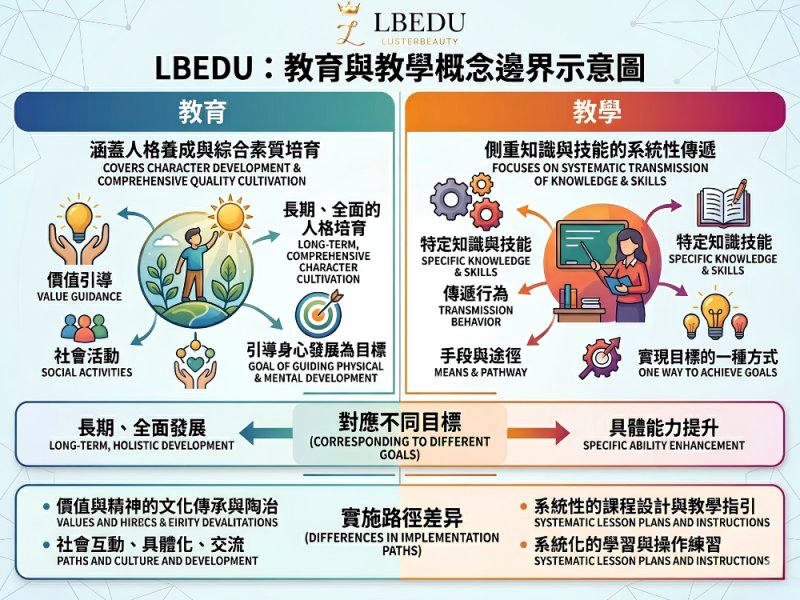
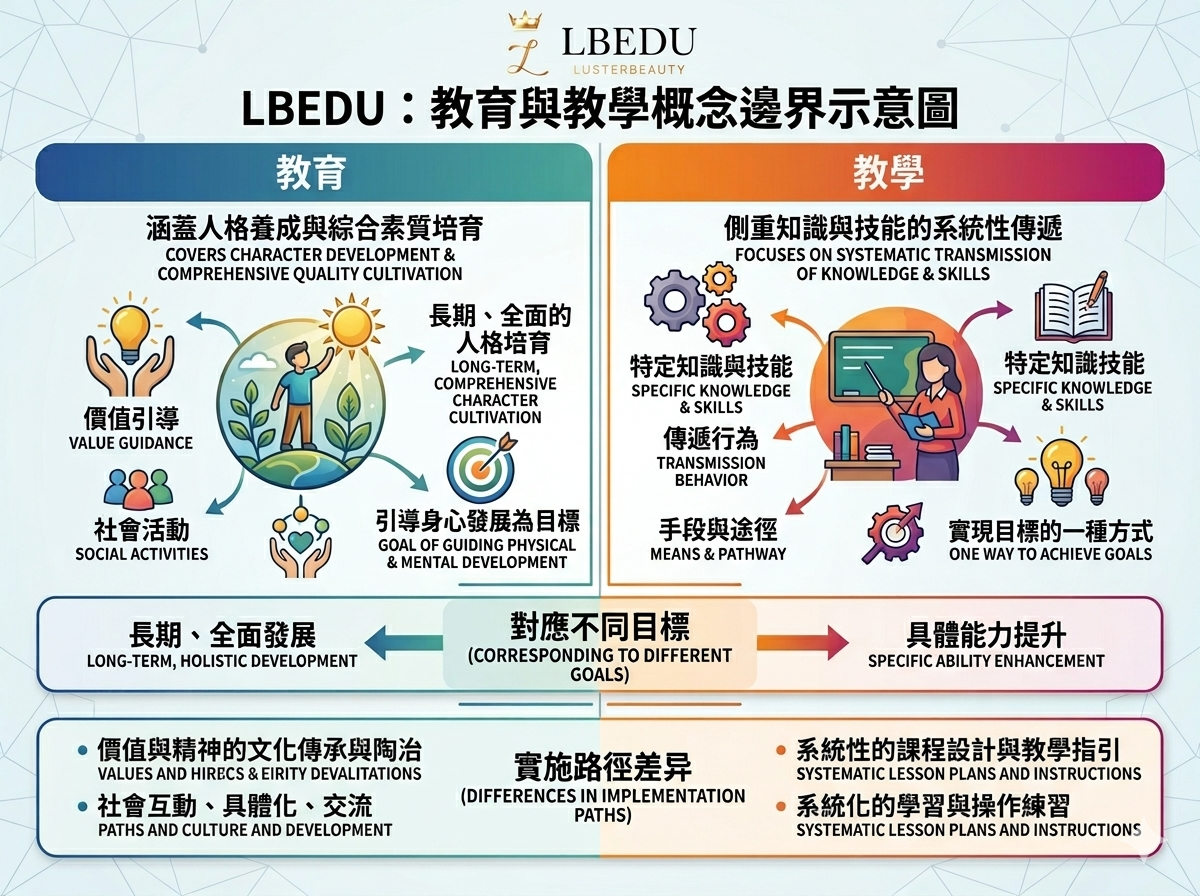
- ‧ Education vs Teaching differ: education covers character development; teaching focuses on knowledge/skill transmission
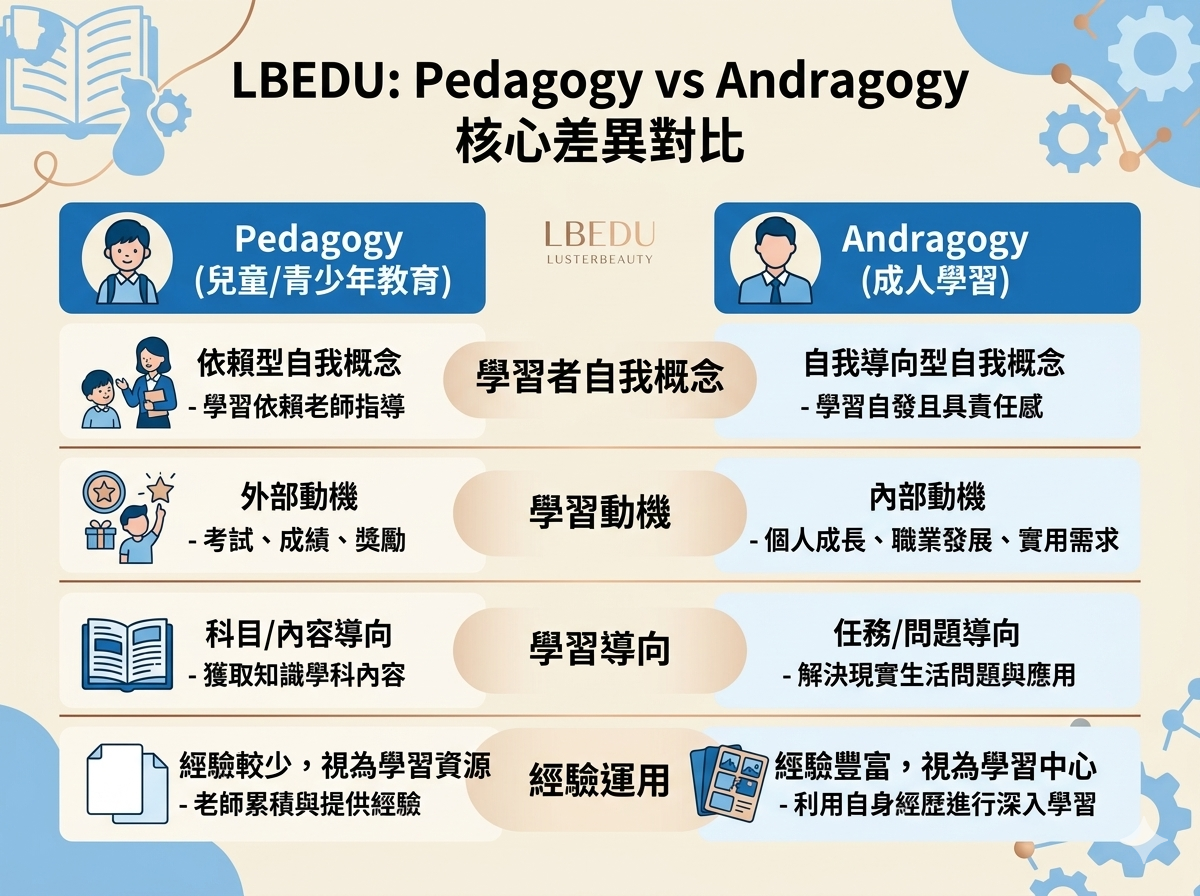
- ‧ Pedagogy applies to children/adolescents – teacher-led, passive reception – for formal schooling
- ‧ Andragogy applies to adult learners – self-directed, problem-oriented – for vocational training & CPD
- ‧ Beauty industry qualification training (VTCT ITEC / HKQF / IQA / CEF) is adult vocational education – should center on Andragogy
- ‧ Author recommends 2:8 to 3:7 ratio of Pedagogy to Andragogy class hours; 4:6 or 5:5 not advised
- ‧ Excessive Pedagogy reduces practice time,偏离 social training's "labor market alignment" purpose
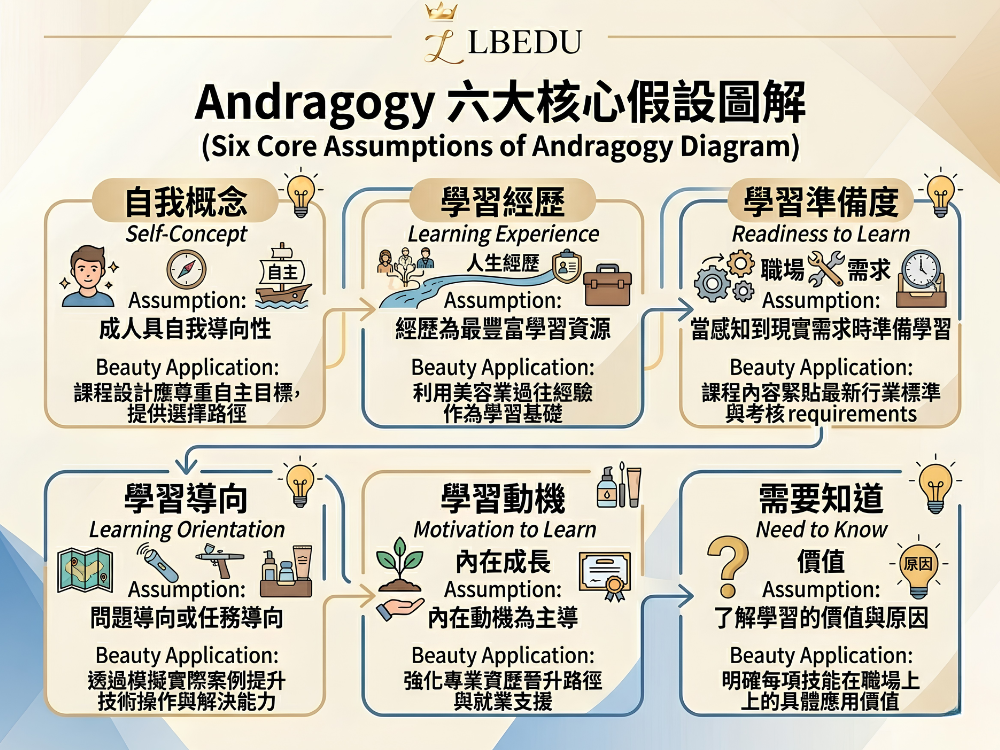
- ‧ Andragogy's six core assumptions: self-concept, learning experience, readiness, orientation, motivation, environment
- ‧ Practical weighting in qualification exams higher than theory – 2:8/3:7 ratio aligns with assessment standards
- ‧ Theory can be integrated into practice – "learning by doing" more effective than lecture-only
- ‧ Adult learners have limited time and clear goals – high practical training improves efficiency & employability
This article, written by Vice President Lawrance Wong, clarifies the conceptual boundaries between "Education" and "Teaching" based on pedagogical theory. Education covers character development and comprehensive quality cultivation, corresponding to formal schooling; teaching and training focus on systematic knowledge and skill transmission, corresponding to vocational qualifications and social training. The article deeply contrasts Pedagogy (for children/adolescents) and Andragogy (for adult learners), citing scholars including Gu Mingyuan, Ye Lan, Jiang Dayuan, and Malcolm Knowles. Based on years of practical experience in beauty industry qualification training, the author recommends a 2:8 to 3:7 ratio of Pedagogy to Andragogy class hours,不建议 4:6 or 5:5. Reasons include: beauty industry's skill-based nature requires practice as core; adult learners have limited time and clear goals; practical weighting in qualification exams exceeds theory (2:8/3:7 aligns with exam standards); theory can be integrated into practice through "learning by doing." The article also breaks down Andragogy's six core assumptions and poses reflective questions for training peers and learners, emphasizing a return to adult learning principles to design effective, practical training courses.
Education vs Teaching | Pedagogy vs Andragogy | Balancing Theory & Practice in Beauty Qualification Training
With Hong Kong’s industrial transformation and the popularisation of lifelong learning, pursuing professional skills certifications through VTCT Skills ITEC, LBEDU, IQA, and HKQF CEF courses has become a common path for working professionals to add value, change careers, or start businesses. The beauty industry is a major sector of Hong Kong’s labour market, and the demand for related qualification training and social education continues to grow. In the field of vocational training, the concepts of “education” and “teaching” are often confused. Many course designs unconsciously reference the operation models of formal schools, applying traditional academic education approaches to vocational skills training. This is a common reason why some learners feel a gap between their learning outcomes and expectations.
To clarify this issue, we must first objectively distinguish the conceptual boundaries — “Education” and “Teaching” are not the same category. This has long been discussed and agreed upon in educational theory. Professor Gu Mingyuan, Honorary President of the China Education Society, has clearly pointed out that education, teaching, and cultivation are distinct basic concepts in pedagogy; teaching is only one way to achieve educational goals and should never be equated with the complete concept of education. Professor Chen Guisheng of East China Normal University further analysed that in the Chinese context, “education” focuses on personality development, value guidance, and comprehensive quality cultivation, while “teaching” tends toward the systematic transmission of specific knowledge and skills. Their goals, boundaries, and implementation paths differ significantly.
Educational scholar Ye Lan provided a classic definition: “Education is a conscious social activity aimed at directly influencing the physical and mental development of people.” This corresponds to the formal education system from kindergarten to tertiary institutions, emphasising long-term, holistic personality and quality cultivation. Vocational education scholar Jiang Dayuan added a distinction between “education” and “training” in the vocational context: education emphasises guided quality development, while training focuses on practical skill learning corresponding to job roles. The latter is the core attribute of social training and vocational qualification courses.
Corresponding to Western pedagogical terminology, the three levels are similarly clear: Education covers comprehensive knowledge systems, values, and personality development, corresponding to formal academic education; Teaching refers specifically to the transmission of knowledge and skills, as a means to achieve educational or training goals; Training focuses on practical skill training for specific occupations, emphasising immediate application and job competency requirements.
In the Hong Kong context: traditional education corresponds to the formal education system of kindergartens, primary schools, secondary schools, post-secondary institutions, and universities. Its core is to impart general subject knowledge (such as Chinese, English, Mathematics, Social Sciences, Sciences, Physical Education, etc.) and to cultivate personality and comprehensive literacy. The learning process is systematic, compulsory, and standardised. Teaching and training, on the other hand, are skill-transmission activities arising from social life and labour market needs, targeting specific occupations or professional fields. Courses cover both theoretical foundations and practical operations, ultimately leading to industry qualification recognition and employability. They are common in vocational qualification training and social continuing education. The VTCT Skills ITEC, LBEDU, IQA, and HKQF CEF courses in the beauty industry essentially belong to the category of vocational teaching and social training, fundamentally different in design logic from formal academic education.
In the academic system of pedagogy, there are two classic theories corresponding to different groups, matching the two scenarios above: Pedagogy (the teaching of children) and Andragogy (the study of adult learning).
1. Definitions and Origins of the Two Teaching Methods
1.1 Pedagogy
Pedagogy comes from the Greek words “paidos” (child) and “agogos” (to lead), meaning “the method of leading a child”. This system matured with the development of formal schooling. Its core target group is children and adolescents, corresponding to general and subject education from kindergarten to university. Its core assumption is that learners do not yet have sufficient knowledge base or judgment, so teachers must lead the course progress, set learning goals, and arrange content, with learners mainly receiving passively. Standardised curricula, standardised tests, and class-based teaching are typical products of Pedagogy. This method has irreplaceable value in general education and basic knowledge dissemination.
1.2 Andragogy
Andragogy also comes from Greek: “aner” (adult) and “agogos” (to lead), specifically studying the patterns and methods of adult learning. The concept was first proposed by German educators and later systematised by American scholar Malcolm Knowles in the 1960s, becoming the core theory recognised in international adult education and vocational training. Andragogy applies to adult vocational qualification training, social continuing education, and professional skills upgrading. It recognises that adult learners have independent judgment, rich life experience, and clear practical needs. Teaching should be learner-centred and problem-solving oriented, not one-way knowledge transmission. Beauty industry training in Hong Kong, as well as VTCT Skills ITEC, LBEDU, IQA, and HKQF CEF courses, belong precisely to the category of adult vocational teaching and align highly with Andragogy's theoretical framework.
2. Application of the Two Methods in Beauty Industry Training
Beauty training combines theoretical foundations (such as skin physiology, hygiene standards, qualification assessment criteria) with extensive practical operations (such as comprehensive beauty instructor, education and training development, internal and external quality assurance, salon management, marketing strategies, lash extension, facial treatments, waxing, equipment operation, makeup styling, stage and special effects makeup, body painting, laser and IPL, high-energy beauty devices, beauty and wellness, nail and hand/foot care, nail art, semi-permanent makeup, LED lashes, keratin lash lifting, aromatherapy, massage therapy, camouflage art and pigment reconstruction, professional beauty consultant, medical aesthetics consultant, microneedling, chemical peels). The ultimate goal is to help learners obtain recognised qualifications and develop employment and entrepreneurial abilities. The two teaching methods show different suitability and outcomes in this context:
If beauty training follows the Pedagogy approach, courses typically feature “theory-based lecture with supplementary practice”, “uniform progress and standardised learning pace”, and “teacher-led class with passive student reception”. For example, spending many hours on written concepts and memorising knowledge points with a uniform pace. This model has the advantage of clear structure and completeness, but for adult learners with work experience and clear goals, it can easily disconnect from real needs and lack practical application.
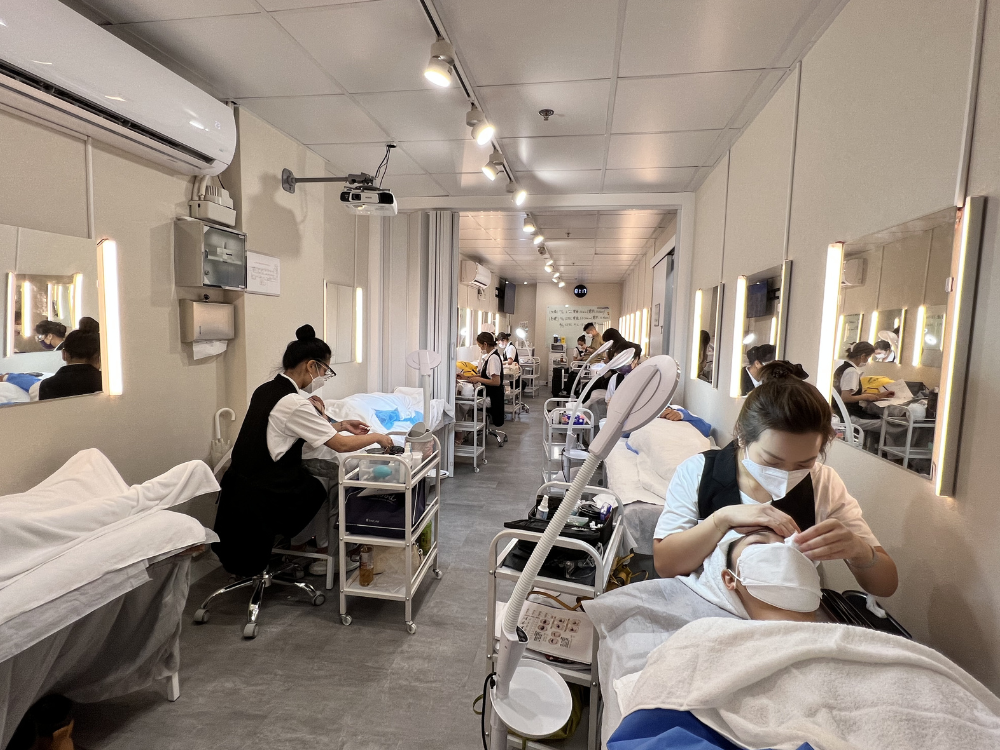
If beauty training follows the Andragogy approach, it centres on learners' employment, certification, and entrepreneurial needs, integrating theoretical knowledge into practical tasks. For instance, when explaining disinfection and hygiene standards, simultaneously conducting hands-on tool sterilisation training; when teaching eye-shape design theory, accompanying it with real client case simulations. Courses simultaneously align with VTCT Skills ITEC, LBEDU, IQA, and HKQF CEF assessment standards, ensuring every practice step corresponds directly to final qualification recognition and workplace application, better fitting the social training attribute of “delivering qualified talent to the labour market”.
Author's View: Proposed Theory-Practice Ratio for Beauty Qualification Training
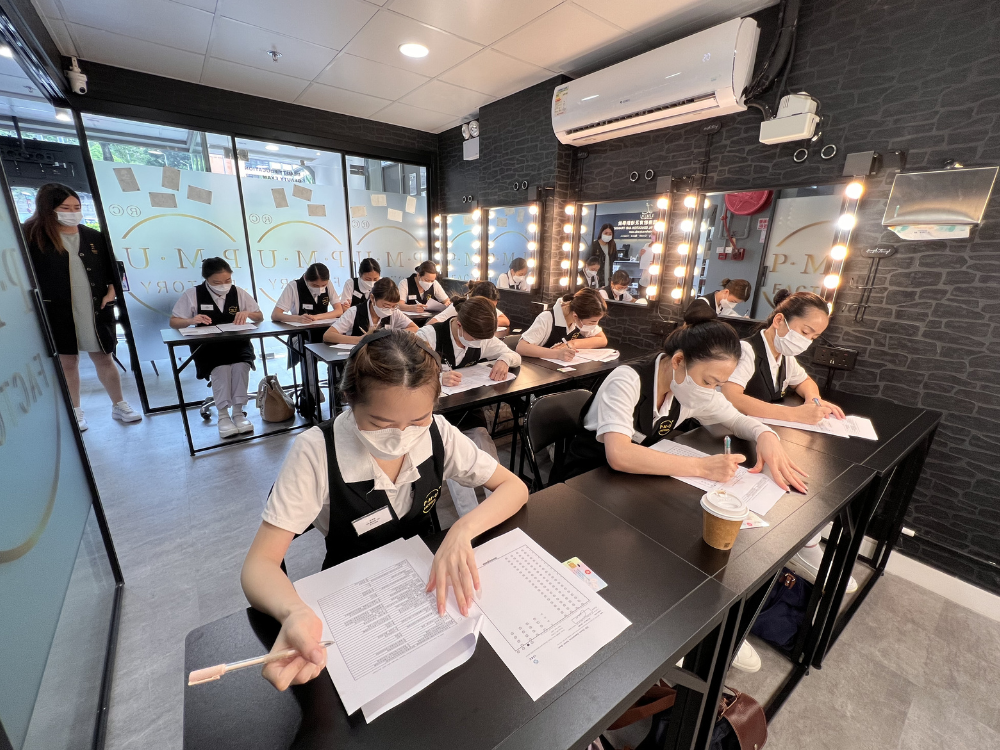
Based on years of observation and practical experience in beauty qualification training, the Vice Principal believes that in vocational teaching and social training, the two methods are not equal and there is no “50:50” optimal split. Considering the skill-based nature of the beauty industry, the learning characteristics of adult learners, and the requirements of qualification assessments, the recommended ratio of Pedagogy to Andragogy class time is between 2:8 and 3:7. Ratios of 4:6 or even 5:5 are not advisable.
It must be stressed that Pedagogy and Andragogy are not absolute opposites in qualification training, nor should Pedagogy be completely abandoned. Basic theory, safety standards, and fundamental principles still need to be clearly taught to students. The key is to include Pedagogy at an appropriate proportion, letting theory teaching play a supporting and guiding role while Andragogy-based practical training remains the main body and core, complementing each other.
Why 2:8 / 3:7 is More Suitable for Beauty Qualification Training
- (1) Industry nature determines skill as core — Most beauty industry jobs and qualification assessments ultimately require hands-on operation and practical execution. Pedagogy provides the foundation for basic theory, safety standards, and principles; the rest of the class time should be allocated to Andragogy-based practical tasks, case studies, and problem-solving.
- (2) Matches adult learners' time constraints and goals — Adult learners generally have limited time and clear objectives. A high proportion of Andragogy task-oriented teaching ensures every minute contributes directly to skill improvement and assessment requirements, yielding higher learning efficiency.
- (3) Aligns with qualification assessment weightings — In VTCT Skills ITEC, HKQF, and IQA beauty qualification assessments, practical operation scores typically carry higher weight than written theory exams. A 2:8 to 3:7 ratio synchronises classroom training pace with assessment standards.
- (4) Theory can be integrated into practice, no need for large separate blocks — During Andragogy practical tasks, instructors can demonstrate and explain theory simultaneously. The “learning by doing” approach achieves better retention than one-way theoretical lectures.
- (5) Objective evidence from assessment design — In our assessment standards, the distribution of total marks between theory and practice generally follows a 2:8 or 3:7 ratio. A 5:5 ratio would conflict with the essence of vocational skill assessment, which is “competency-based evidence”.
Why 4:6 / 5:5 Ratios are Not Recommended
The core issue is that when Pedagogy accounts for 40% or more, practical training time is significantly compressed, directly leading to insufficient technical practice. First, classroom control returns to one-way teacher lecture, and students revert to passive reception, contradicting the adult learning principles of autonomy and task orientation. Second, technical skills require sufficient practice to form stable abilities; insufficient practice results in “understanding and remembering but unable to perform well”, so graduates cannot quickly enter the workforce, defeating the purpose of vocational training. Third, the closer the ratio gets to 50:50, the more the course shifts toward “academic education”, deviating from social training’s mission of “connecting to the labour market and cultivating practical talent”.
3. Andragogy's Six Core Assumptions and Their Application to Beauty Training
Knowles' six core assumptions of adult learning align highly with the attributes of Hong Kong beauty training and VTCT Skills ITEC, LBEDU, IQA, and HKQF CEF courses, serving as important references for designing quality teaching:
- 1. Self-concept: Adults learn voluntarily. Teaching should respect learners' autonomous goals and provide flexible study paths, not impose uniform pace.
- 2. Experience: Use existing experience as a learning foundation. Quality teaching connects professional skills with students' prior experience to improve efficiency.
- 3. Readiness to learn: Closely tied to real work needs. Course content must align with industry standards and assessment requirements, avoiding impractical theory.
- 4. Orientation to learning: Problem-oriented and task-oriented. Use specific tasks to structure the course, with theory as a supporting tool, following the principle of “learn then use immediately”.
- 5. Motivation to learn: Driven primarily by internal motivation. Teaching can strengthen this through clear qualification pathways, employment support, and graduate success stories.
- 6. Learning environment: Emphasise mutual respect and time flexibility. Offer flexible class schedules and create an inclusive, interactive atmosphere.
Reflection Questions for the Industry and Learners
For training industry peers:
When designing VTCT Skills ITEC, LBEDU, IQA, and HKQF CEF beauty courses, do we focus more on “vocational teaching and social training” or unconsciously draw from traditional “school education” thinking? Comparing Pedagogy and Andragogy, do you agree with the 2:8 to 3:7 ratio proposal? What is the current theory-practice ratio of our courses? In a hands-on industry like beauty, how can we balance theory and practice to truly achieve application of learning?
For learners:
What is your core goal in taking a beauty course – qualification, employment, or entrepreneurship? Does the current classroom model match your needs as an adult learner? Looking at your past learning experiences, which teaching method – theory-focused or practice-task-focused – better helps you master professional beauty skills? When choosing a training institution, aside from accreditation and fees, do you consider whether its teaching philosophy and theory-practice ratio are suitable for adult vocational training?
Conclusion
Objectively, Pedagogy and Andragogy are not inherently superior or inferior; they correspond to different learner groups and application scenarios. Education, teaching, and training are not opposites but concepts with different levels and emphases. Pedagogy underpins the formal education system and serves the function of general education. Andragogy is a scientific guide for vocational qualification training and social continuing education, addressing the labour market's skill upgrade needs.
The VTCT Skills ITEC, LBEDU, IQA, and HKQF CEF qualification training in the beauty industry belongs to the latter – vocational teaching oriented toward social needs, qualification standards, and employment/entrepreneurship goals. Again, Pedagogy and Andragogy are not absolute opposites in qualification training, nor should Pedagogy be completely abandoned. On the contrary, it should exist at an appropriate ratio, with theory teaching as support and guidance, and practical training as the main body and core. Only by clearly understanding the differences between the two domains, returning to the objective laws of adult learning, and referencing the objective evidence from assessment design (2:8 or 3:7, 4:6 acceptable, 5:5 unsuitable), can we design truly effective, industry-relevant training courses. This will maximise the value of government CEF policy support and give every learner a real return on their study investment.
Sources
Gu Mingyuan (ed.): Dictionary of Education, and related discussions on basic pedagogical concepts: education, teaching, and cultivation are distinct pedagogical categories; teaching is one path to achieving educational goals.
Chen Guisheng: Principles of Education, academic analysis of the conceptual boundaries between “education” and “teaching”.
Ye Lan: Introduction to Education, classic definition: “Education is a conscious social activity aimed at directly influencing the physical and mental development of people.”
Jiang Dayuan: Research on vocational education, distinguishing between “competency-oriented education” and “job-corresponding training”.
Malcolm Knowles: The Adult Learner: The Definitive Classic in Adult Education and Human Resource Development – six core assumptions of Andragogy.
Hong Kong Qualifications Framework Secretariat and Continuing Education Fund Office official public documents: HKQF levels and CEF course standards.
VTCT, ITEC & IQA official syllabi: theory vs practical score weightings for various beauty qualification levels.
Comments (0)
No comments yet
Leave a Comment