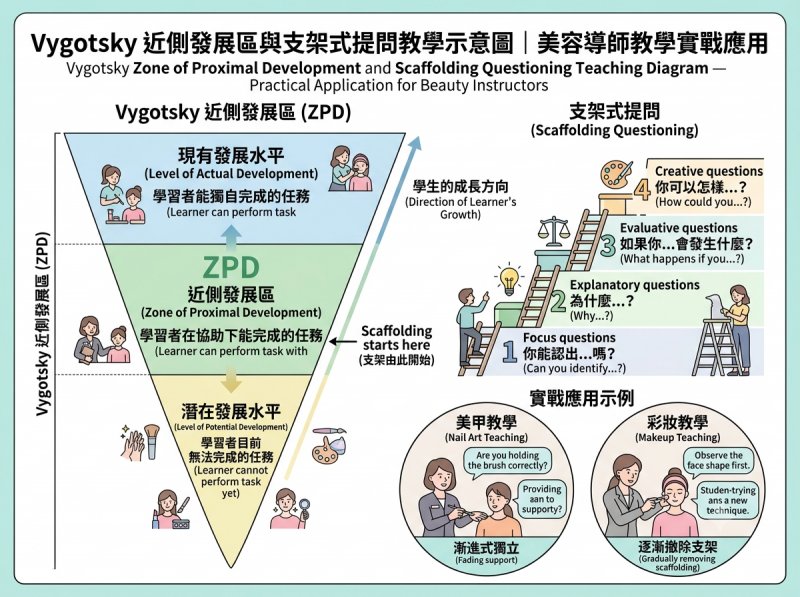
- ‧ ZPD is the ability range where students "struggle alone but master with instructor guidance"
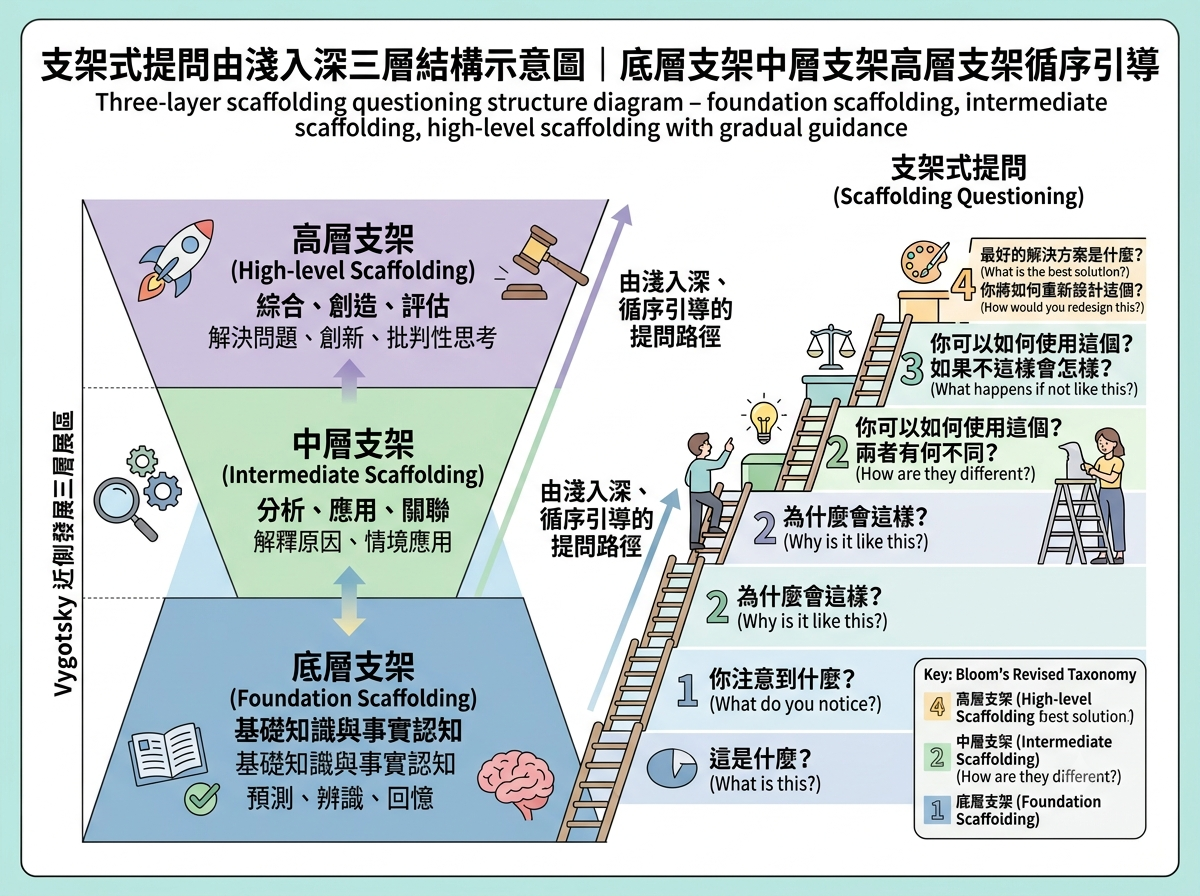
- ‧ Scaffolding questioning progresses from foundation → intermediate → high-level with gradual removal of support
- ‧ Three beauty class applications: equipment operation, complaint handling, group case studies
- ‧ Aligns with Andragogy adult learning principles to avoid student discouragement
- ‧ Supports differentiated instruction for both new and experienced learners
- ‧ Common pitfalls: yes/no questions, too difficult from the start, giving answers too quickly
- ‧ Can be integrated into salon training lesson plans under ADDIE implementation phase
Vygotsky's Zone of Proximal Development (ZPD) is a key theory for beauty instructors to enhance teaching effectiveness, dividing student ability into three layers: independent, proximal (needs guidance), and unable. Instructors use scaffolding questioning from foundation to high level to guide students through beauty practical challenges like equipment operation and complaint handling. Compared to traditional one-way teaching, it better aligns with adult learning principles and differentiated instruction. The article provides three practical beauty class examples and real student testimonials for immediate application.
Understanding Vygotsky's Zone of Proximal Development in 1 Minute | Scaffolding Questioning for Beauty Training
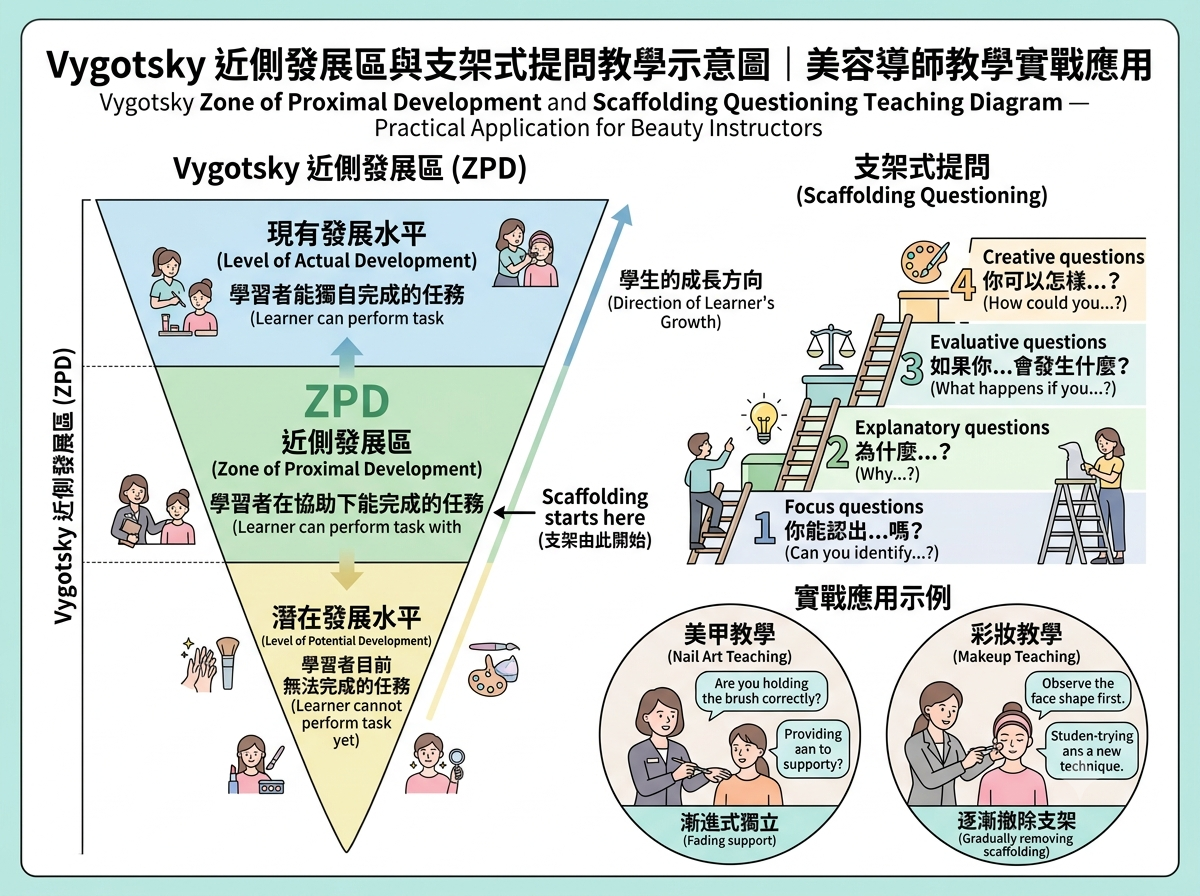
Want your beauty students to stop passively listening and start actively thinking through skincare and client‑related challenges? The core method is Vygotsky's Zone of Proximal Development (ZPD) combined with scaffolding questioning. In simple terms: the ZPD is the ability gap where a student "can't quite figure it out alone, but can master it with the instructor's step‑by‑step questioning guidance." Through layered, open‑ended questions that build thinking scaffolds, this approach works across all beauty classroom scenarios – equipment demonstrations, complaint role‑plays, and group case discussions. (Vygotsky, 1978)
Many students who've completed this module say they used to find educational theory abstract and hard to grasp, but after learning about ZPD and scaffolding questioning, they realised it can be directly applied to daily practice.
1. What is Vygotsky's Zone of Proximal Development (ZPD)?
At the core of Vygotsky's sociocultural constructivism, student abilities are divided into two levels:
- Independent Ability Zone: Tasks students can complete successfully on their own without any assistance – e.g., basic skincare procedures, standard client consultations;
- Potential Development Zone (Zone of Proximal Development): Tasks that feel overwhelming alone, but can be solved through the instructor's step‑by‑step guidance and peer discussion;
The gap between these two is the "sweet spot" for effective teaching – and where scaffolding questioning comes into play.
ZPD = Zone of Proximal Development
Proposed by psychologist Lev Vygotsky – a core concept in constructivism.
- Can Do Alone (Current Ability)
Skills students can perform independently, without any help.
Example: A beginner can do basic makeup removal; an experienced aesthetician can perform basic skin analysis. - ZPD – Zone of Proximal Development (The Teaching Sweet Spot)
Tasks students get stuck on when alone, but can solve through step‑by‑step questioning, demonstration, and gentle guidance from the instructor.
This gap is the ZPD – the area where the most progress happens. - Cannot Do Yet (Beyond Current Ability)
No matter how the instructor explains, the foundational gap is too wide. Forcing it only leads to frustration and giving up.
Imagine a student can adjust basic device energy settings (can do alone), but doesn't yet know how to adjust parameters when the client shows facial redness:
- Asking them to handle a sensitive‑skin client alone → beyond ZPD, student panics
- Instructor uses layered scaffolding questions, step by step → right in the ZPD, student learns successfully
- Beginner student: "Before, when the instructor asked complex treatment protocol questions, I had no idea how to answer. Turns out those questions were beyond my ZPD. With layered questioning, I could finally follow along."
- Experienced aesthetician: "I thought I could handle every scenario. But when my instructor used layered questioning to dig deep into complaint analysis, I realised there was a whole layer of knowledge sitting right in my ZPD."
- Shy, quiet student: "The gradual, simpler questions all stayed within my ZPD – I wasn't immediately stumped, which gave me the confidence to finally speak up."
ZPD is exactly that zone where "you can't do it alone, but you can learn it with a little guidance." Scaffolding questioning is designed specifically to target each learner's ZPD – not too easy to be pointless, not too hard to crush confidence.
"When I first started, I had no idea what the Zone of Proximal Development was – I thought it was just abstract theory from a textbook. Then my instructor used layered questioning during device demonstrations – from basic skin analysis to adjusting energy levels step by step. I realised that many problems weren't that I didn't know at all – I just lacked the step‑by‑step thinking prompts. That's my ZPD, and scaffolding questioning helped me cross each hurdle."
2. What is Beauty‑Specific Scaffolding Questioning?
Scaffolding is a temporary thinking tool the instructor sets up. Instead of closed "yes/no" questions, use progressively deeper open‑ended questions, gradually removing the supports until the student can independently analyse and solve real‑world salon scenarios.
Common scaffolding types in beauty teaching: Scenario‑guided questioning, procedural follow‑up questions, client‑condition analogy questions, and salon‑case reflection questions.
"I've been working in skin management and thought I could handle most situations. But when my instructor used layered scaffolding questions to dig deep into complaint root causes, I realised I'd never actually thought through the underlying issues. Before, when instructors gave me answers directly, I'd forget them quickly. Now, through self‑discovery via questioning, I remember so much better – and I can independently break down problems when I'm back in the salon."
3. 3 Practical Scaffolding Questioning Examples (Ready for In‑House Training)
- Lower Scaffold (Foundation): After a patch test shows the client's face is red, what's the first thing you should do?
- Middle Scaffold (Extension): Why should you prioritise lowering the device energy rather than continuing treatment?
- Higher Scaffold (Fading): In the future, when you're working alone and a sensitive‑skin client comes in, how would you plan the full treatment protocol?
- Foundation Question: A client complains of burning discomfort after treatment – what's your first reassuring response?
- Extension Question: How can you use questioning to uncover the real cause of the burning without escalating the client's negative emotions?
- Independent Thinking Question: If the same complaint keeps happening every month, what training adjustments would you recommend to the salon?
- In groups, discuss real salon challenges, exchange ideas through layered questioning, and refine improvement plans together.
"I used to be terrified of speaking in class. Before, the instructor would throw out high‑level questions and I'd have no idea how to answer – I'd just look down. But with scaffolding questioning, each question was progressively easier. Every small question was within my ZPD and I could actually answer. I'm no longer afraid to share my thoughts, and I even participate in group discussions now."
4. Advantages of Scaffolding Questioning vs Traditional Lecture
- Aligns with Andragogy (adult learning) principles – respects learners' self‑esteem, prevents the shame of not knowing an answer;
- Directly tied to students' own salon experience – theory never feels detached from practice;
- Integrates perfectly into the "Implementation" phase of the ADDIE instructional design model as a standard classroom activity;
- Supports differentiated instruction – learners at different levels can all benefit at their own pace.
5. Common Pitfalls When Using Scaffolding Questioning
- Over‑relying on yes/no questions – lacks depth, doesn't build thinking scaffolds;
- Jumping straight to questions beyond students' ZPD – students give up immediately;
- Revealing the answer too quickly – not giving students time to process and organise their own thoughts.
"I've seen other instructors who jump straight to complex operational questions and the whole class goes silent. After learning about ZPD, I understand that you can't start with high‑difficulty questions – you need to follow the learners' ability level with layered questions to get everyone engaged."
Frequently Asked Questions
Conclusion
Whether in certification courses or in‑house salon training, layered scaffolding questioning dramatically improves student engagement and retention. Many students who've completed the module say that what used to feel like dry educational theory became genuinely useful when applied to real beauty scenarios.
Need a complete beauty lesson questioning template or layered questioning samples? Reach out to us – we'll share more constructivism and differentiated instruction content in future posts.
References
Vygotsky, L. S. (1978). Mind in society: The development of higher psychological processes. Harvard University Press.
LBEDU Luster Beauty International Education and Training Institute (Government Registered Institution 854) – Tutor Team (Lawrance WONG - Vice Principal)
IQA International Qualification Assessment Alliance – Instructor Certification Teaching Competency Standards
Hong Kong Qualifications Framework (HKQF) – Beauty Instructor Certificate Competency Standards
Comments (0)
No comments yet
Leave a Comment