Semi‑Permanent Makeup Pigment Safety 2026|FDA Certification Truth, Pigment Classification, and Scientific Breakdown of Why Pigments Turn Red or Grey

Do PMU pigments have FDA certification? Why do they turn red or grey? Are pigment ingredients safe? Everything explained in one article.
Vice Principal Lawrance Wong, IQA International Qualification Assessment Alliance Executive Team, VTCT Level 4 Certified Instructor Team

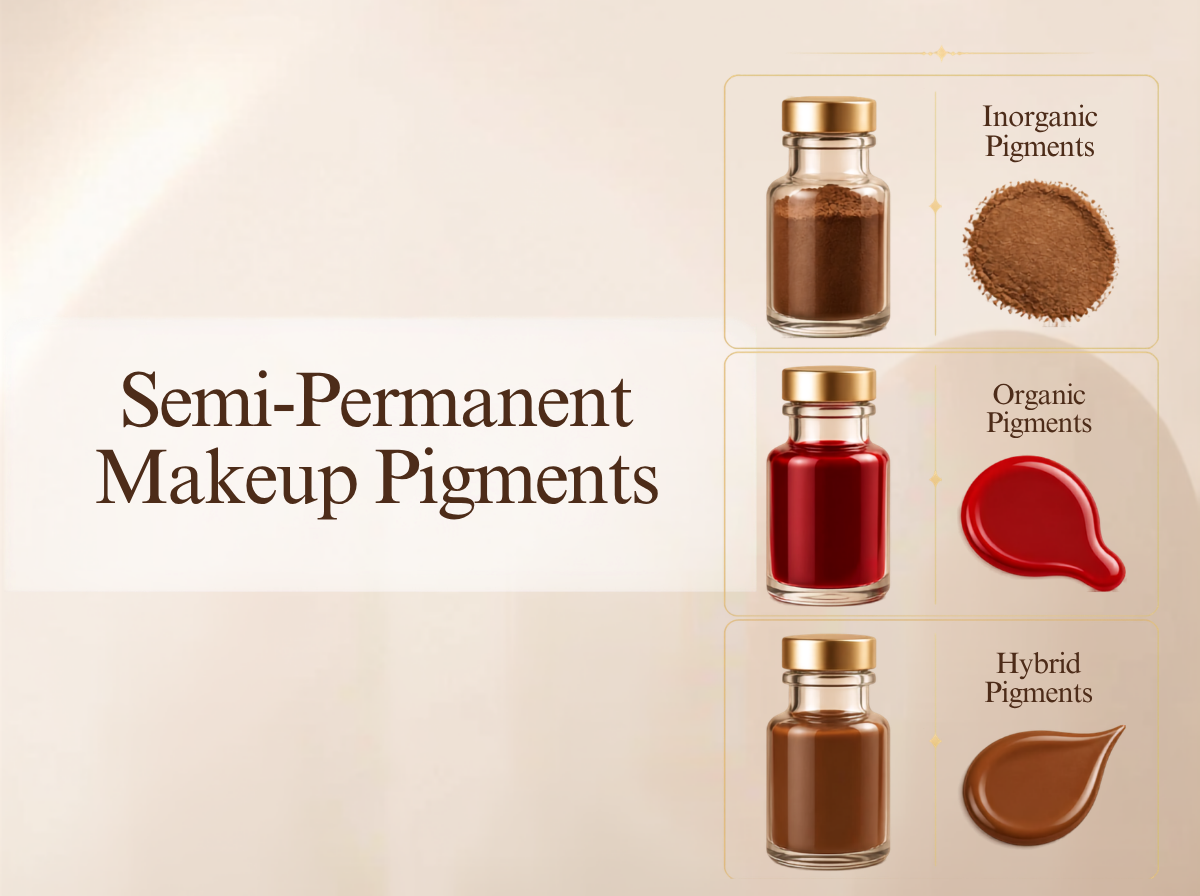
Three types of semi-permanent pigments comparison chart – inorganic, organic and hybrid pigments – characteristics and suitable applications

Figure 1: Pigment Classification Comparison Chart.
Want to master professional PMU color theory and earn international certification?
Government‑registered institution LBEDU offers comprehensive VTCT Level 3/4 international diploma courses – WhatsApp us now for course details.
WhatsApp Free Consultation

1. PMU Pigment Safety: Why Is This the Consumer's Biggest Concern?

Semi‑permanent makeup (PMU) – including microblading, powder brows, eyeliner, lip blush, and scalp micropigmentation (SMP) – involves implanting pigments into the superficial layers of the skin for long‑term color. Since the pigment is "implanted into the body," its safety is naturally the consumer's biggest and most legitimate concern.

In recent years, controversies surrounding PMU pigments have frequently surfaced:

  • Some low‑cost pigments contain heavy metals (such as mercury, cadmium, lead) that may remain in the body and affect health.
  • Some pigments have been found to be contaminated with microorganisms, leading to post‑treatment infections.
  • Many consumers experience unwanted color changes after treatment – turning red, blue, or grey – affecting the aesthetic outcome.
  • Many pigments on the market are falsely marketed as "FDA‑certified" or "natural plant‑based" when they are not.

As a consumer, you don't need to be a chemist – but you should understand: What are pigments made of? Is there any authoritative body that certifies pigment safety? Why do colors change after treatment? How should a professional technician choose and use pigments? This article will comprehensively address these questions from both scientific and regulatory perspectives.

2. Do Pigments Have FDA Certification? – The Truth About FDA Regulation and MoCRA

This is the most frequently misrepresented topic – and one of the most common marketing tactics used in the industry. Many pigment brands and PMU studios claim they use "FDA‑certified pigments," giving consumers the false impression that the products have been endorsed by a U.S. regulatory authority as "absolutely safe." The truth is: The U.S. FDA has never approved any color additive for use in tattoos or semi‑permanent makeup injections.

The FDA's Official Position

According to the U.S. Food and Drug Administration's official "Tattoos & Permanent Makeup: Fact Sheet," the FDA states: Color additives used in tattoo inks are subject to premarket approval under the Federal Food, Drug, and Cosmetic Act. However, due to other public health priorities and a previous lack of evidence of safety problems associated with these color additives, the FDA has not traditionally regulated tattoo ink pigments.

In other words: The FDA has the authority to regulate tattoo/PMU pigments but has never approved any color additive for tattoo/PMU injection. "Not exercising regulatory authority" does not mean "approving safety" – it simply means the FDA has not prioritized this area in the past.

The MoCRA: A New Regulatory Landscape After 2022

In December 2022, the U.S. passed the Modernization of Cosmetics Regulation Act (MoCRA), which has a significant impact on the PMU pigment industry:

MoCRA Requirement Specific Content Significance for the Pigment Industry
Facility Registration Pigment manufacturing facilities must register with the FDA Strengthens traceability at the source, combats unlicensed facilities
Product Listing Each pigment product must be listed in the FDA system with ingredient information Ingredient transparency – consumers can look up information
Label Contact Information Labels must display a §606‑compliant contact URL Consumers can file complaints and inquiries
Safety Documentation Manufacturers must maintain product safety records Manufacturers are responsible for safety – cannot rely solely on marketing
Responsible Person System Each product must have a "responsible person" who bears legal liability for safety Clear accountability
Adverse Event Reporting Serious adverse events must be reported to the FDA Establishes a safety monitoring mechanism

Important reminder: MoCRA is a "registration system" and "traceability system" – not an "approval system." Even if a pigment completes MoCRA registration and product listing, it does not mean the FDA has certified it as safe. It simply means the manufacturer has fulfilled its registration and disclosure obligations. The EU REACH regulation explicitly bans over 1,300 ingredients – making REACH compliance a more substantive safety standard than claims of "FDA certification."

3. Three Pigment Classifications: Inorganic, Organic, and Hybrid – Which Projects Do They Suit?

The most fundamental classification of PMU pigments is based on the "source and chemical nature of the colorant (pigment)":

Dimension Inorganic Pigments Organic Pigments Hybrid Pigments
Main Ingredients Iron oxide, titanium dioxide, zinc oxide Carbon black, phthalocyanine, azo compounds Inorganic + organic blends
Color Performance Natural, soft, matte finish Vibrant, saturated, rich color Balances natural and vibrant
Stability / Retention Highest, long (3‑5 years) Lower, shorter (1‑3 years) High, medium (2‑4 years)
Allergy Rate Very low Slightly higher Low
Suitable Projects / Market Share Brows, eyeliners, SMP (20%) Lips, intense black eyeliners (5%) Almost all projects (75% mainstream)

4. Pigment Ingredients Explained: From Iron Oxide to Carbon Black – What Role Does Each Ingredient Play?

A professional PMU pigment contains three main components: colorant (10‑30%), carrier (60‑80%), and additives (5‑10%).

  • Iron Oxide (CI 77491/77492/77499): Accounts for 65% of the market. Provides brown, black, red, and yellow base tones. Excellent biocompatibility.
  • Titanium Dioxide (CI 77891): White pigment used for brightening and adjusting opacity.
  • Carbon Black (CI 77266): Fine particles providing rich black color, commonly used for eyeliners and SMP.
  • Ultramarine, Phthalocyanine, Azo compounds: Provide blue‑purple tones, stable blue‑green shades, and vibrant lip colors respectively.
  • Carriers and Additives: Glycerin, purified water, alcohol, propylene glycol – suspend and moisturize; preservatives, dispersants, and pH adjusters ensure quality stability.

Fitzpatrick six skin types and pigment color matching reference chart – Type I to Type VI skin characteristics and recommended warm/cool tones

Figure 2: Color Shift Mechanics and Fitzpatrick Skin Typing Guide.

5. Why Do Pigments Turn Red or Grey After PMU? – Scientific Explanation of Oxidation and the Tyndall Effect

(A) Why Pigments Turn Red/Orange

  1. Oxidation: Fe₃O₄ (black iron oxide) undergoes chemical reactions with oxygen and moisture in the skin, converting to Fe₂O₃ (reddish‑brown ferric oxide).
  2. Cool Tones Metabolize First: Fine cool‑tone particles like carbon black are metabolized and cleared first, leaving behind larger particles of warm iron oxide.
  3. UV Exposure and Individual Skin Tone: UV accelerates oxidation; Fitzpatrick Type I‑III fair skin has a pink undertone – using warm pigments amplifies the redness.

(B) Why Pigments Turn Grey/Blue

  1. Tyndall Effect: Pigment implanted too deep into the dermis causes light scattering through the tissue, resulting in a blue‑grey appearance.
  2. Skin Tone and Color Matching Errors: Fitzpatrick Type V‑VI darker skin using cool tones, combined with the skin's natural undertone, easily turns grey. Oily skin with faster metabolism also tends toward cooler tones.

6. How to Prevent Color Shift? 5 Key Steps for Professional Technicians

  • Accurately assess Fitzpatrick Skin Type: Fair skin → cool tones/grey‑brown; darker skin → warm tones/dark brown.
  • Strictly control implant depth: Target the upper papillary layer between the epidermis and dermis to prevent the Tyndall Effect.
  • Apply complementary color theory in mixing: Use color‑correcting pigments to neutralize underlying tones.
  • Strictly select EU REACH/MoCRA‑compliant pigments: Avoid cheap, untraceable products.
  • Provide thorough post‑treatment care instructions: Emphasize strict sun protection to slow oxidation.

7. LBEDU's Semi‑Permanent Makeup Course – Pigment Safety Training

At LBEDU Luster Beauty Institute, our VTCT Level 3/4 semi‑permanent courses place "Pigment Safety and Skin Color Theory" at the core of the curriculum:

  1. Strictly selected internationally compliant pigments: We use only high‑purity pigments that meet EU REACH standards.
  2. Exclusive Fitzpatrick practical matching drills: Training students to accurately identify skin undertones.
  3. Depth‑control needle training: Dual‑quality assurance through practice on synthetic skin and real‑life models.

8. Frequently Asked Questions

Q1: Do PMU pigments have FDA certification?
A: No. The FDA has never approved any color additive for tattoos or semi‑permanent injection. Claims of "FDA‑certified pigments" are marketing hype. EU REACH compliance is a more meaningful safety standard.
Q2: If my brows turn red, does that definitely mean the technician was unskilled?
A: Not necessarily. Iron oxide naturally oxidizes over time due to physical and chemical laws. However, if the technician failed to match the pigment to the Fitzpatrick skin type or used low‑quality pigments, those are human factors.
Q3: What can be done about grey or blue discoloration?
A: For mild cases caused by the Tyndall Effect, warm/corrective pigments can be used to neutralize the tone. For more severe cases, it's recommended to first use a picosecond laser to remove the old pigment before redoing the procedure.

9. Conclusion & Further Reading

Semi‑permanent makeup is a discipline that combines science and aesthetics. Understanding pigment safety, chemical composition, and skin optical reactions is essential for every professional PMU technician.

Further Reading

  • 2026 SMP Scalp Micropigmentation Course Guide|VTCT Level 4 Certification – Zero‑to‑Hero Career & Income Outlook
  • ITEC Level 4 Laser Exam Guide 2026|99.5% Pass Rate – Theory, Practical & Oral Exam Breakdown
  • How to Choose a Beauty School in Hong Kong 2026|8 Practical Factors & Shortlist – Essential Reading for Career Switchers
#PMUPigmentSafety #FDACertificationTruth #MoCRA #PigmentIngredients #IronOxide #TyndallEffect #BrowsTurningRed #BrowsTurningGrey #FitzpatrickSkinTyping #VTCTCertification #LBEDU

References & Authoritative Sources

U.S. FDA Tattoos & Permanent Makeup Guidelines & Modernization of Cosmetics Regulation Act (MoCRA)

European Union REACH Regulation (EC) No 1907/2006 on Chemical Substances in Pigments

LBEDU Luster Beauty International Education and Training Institute – PMU Technology Research Group Teaching Data