
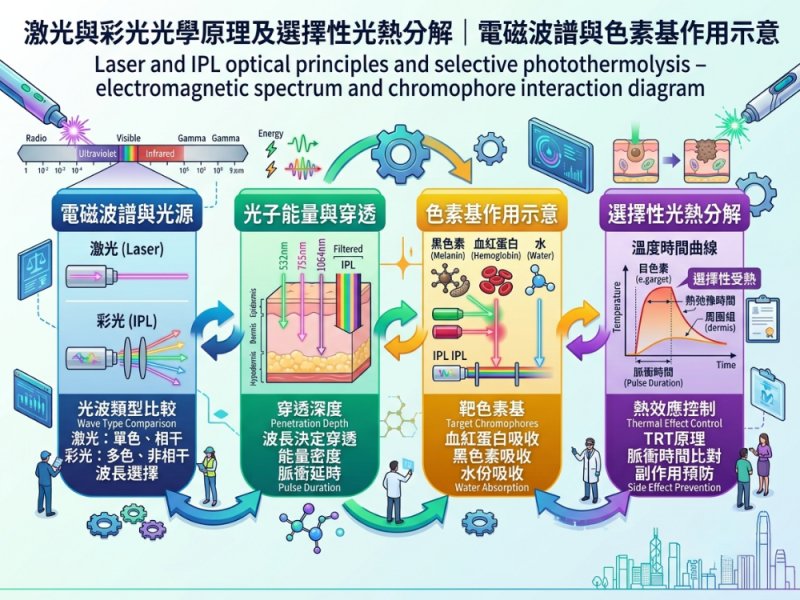
- ‧ Hong Kong beauty laser and IPL services regulated by Occupational Safety and Health Ordinance (Cap. 509)
- ‧ Aligned with HKQF Level 4 three core competency units (106887L4, 106888L4, 106889L4)
- ‧ Fully matches ITEC Level 4 Laser and Intense Pulsed Light Treatments course requirements
- ‧ Laser features three core characteristics: monochromaticity, high coherence, collimation
- ‧ IPL uses broad-spectrum light, fundamentally different from laser in spectrum, coherence and application
- ‧ Selective photothermolysis theory is the core foundation of beauty laser and IPL treatments
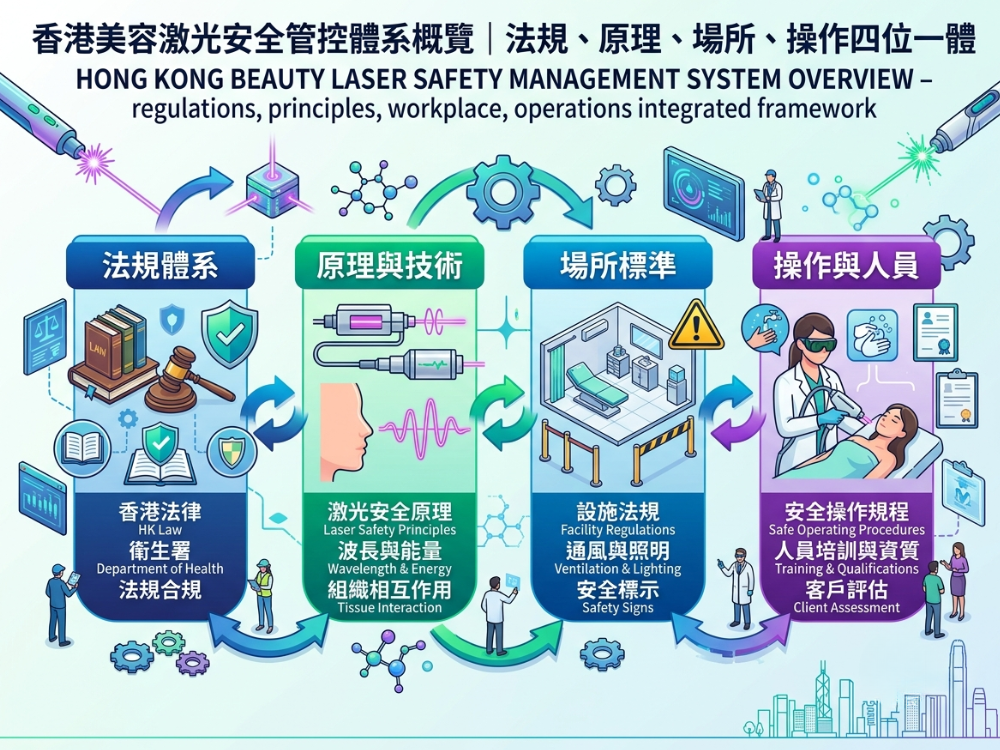
- ‧ Safety management requires integrated framework of regulations, science, workplace and clinical operations
This article systematically integrates Hong Kong local occupational safety regulations, international laser safety standards, photophysics fundamentals and clinical risk management frameworks, fully aligned with HKQF Level 4 three core competency units (106887L4, 106888L4, 106889L4) and ITEC Level 4 Laser and Intense Pulsed Light Treatments course requirements. Covers statutory regulations including the Occupational Safety and Health Ordinance, optical principles of laser and IPL with selective photothermolysis theory, roles and responsibilities including Laser Safety Officer, controlled area environmental safety requirements, and full clinical operation protocols from pre-treatment assessment to post-treatment care.
Hong Kong Medical Beauty Laser & IPL Safety Management: Regulatory Basis, Duties, and Optical Fundamentals
With the rapid technological upgrade of Hong Kong's beauty industry, laser and intense pulsed light (IPL) treatments have become mainstream services, and consumers' concern for treatment efficacy and safety has grown correspondingly. Aligned with the Hong Kong Qualifications Framework (HKQF) Level 4 competency standard "Principles and Risks of Laser and IPL", and the core learning points of the VTCT ITEC Level 4 Diploma in Laser and Intense Pulsed Light Treatments and the ITEC VTCT Level 4 Advanced Diploma in Laser, IPL and Pulsed Light Operations, beauty practitioners in Hong Kong must establish a four‑pillar safety management mindset – "Regulatory Compliance – Scientific Principles – Facility Management – Clinical Operation" – rather than merely mastering equipment handling.
This article systematically integrates local Hong Kong occupational safety regulations, international laser safety standards, photophysics fundamentals, and clinical risk management frameworks. It fully addresses the teaching requirements of the three core HKQF competency units (106887L4, 106888L4, 106889L4), and perfectly matches the knowledge structure of ITEC Level 4 examinations, providing a systematic academic reference and practice guide for in‑service beauty practitioners and students in Hong Kong.
1. Regulatory Framework and Standards for Hong Kong Beauty Optical Services
Beauty laser and IPL equipment are high‑risk optical devices; their supply, use, and maintenance are subject to multiple layers of regulations and standards, forming the top‑level basis for safety management and a core learning requirement for ITEC Level 4.
As a UK‑based qualification system, ITEC courses generally reference UK domestic regulations such as the Management of Health and Safety at Work Regulations 1999 (MHSWR 1999). However, when practising in Hong Kong, the following local statutory ordinances must be complied with:
- Occupational Safety and Health Ordinance (Cap. 509): The core principal legislation for occupational safety and health in Hong Kong, covering all beauty centres and medical aesthetic premises. Section 15, "Risk Assessment", corresponds to the UK MHSWR 1999 Regulation 3, mandating employers to conduct systematic risk assessments of work procedures, equipment, and the working environment, identifying potential hazards of laser/IPL operations to employees and clients, and implementing appropriate control measures; assessments must be reviewed periodically.
- Occupational Safety and Health Regulation (Cap. 509A): Further specifies environmental, facility, and operational safety requirements for workplaces, providing detailed rules for implementing risk assessments.
- Machinery and Plant Equipment Safety Regulation (Cap. 59I): Regulates the design, supply, maintenance, operation, and repair of work equipment, requiring laser/IPL devices to meet safety standards, be operated by trained and competent personnel, and undergo regular inspection and maintenance.
- Electricity Ordinance (Cap. 406): Governs the installation, maintenance, and safe use of electrical equipment, ensuring the electrical safety of laser devices complies with Hong Kong standards.
- IEC 62471 International Standard: Specifies the photobiological safety of lamps and light sources, assessing potential harm of different wavelengths to skin and eyes – a key reference for IPL equipment safety evaluation.
- Laser Hazard Classification Standard: Classifies lasers from Class 1 to Class 4 based on output energy and hazard level. Class 4 lasers have sufficient energy to ignite materials and produce hazardous fumes, requiring the strictest control measures during operation.
- BS EN 60601 Series Standards: General requirements for the safety of medical electrical equipment; it is recommended that laser facilities appoint a Laser Safety Officer (LSO) to oversee the implementation and supervision of the entire safety system.
- Electrical and Mechanical Services Department (EMSD) – "Safety Guide for Laser Products": Specifies classification, labelling, supply, and use requirements for laser products, aligned with IEC 60825, and clearly suggests the duties of a Laser Safety Officer.
- Occupational Safety and Health Council (OSHC) – "Laser Safety" Guide: Provides practical operational guidelines on controlling laser hazards in the workplace, selecting protective equipment, staff training, and conducting risk assessments.
- Department of Health – Medical Device Administrative Control System: Medical‑grade laser devices are subject to regulatory control; serious adverse events must be reported through the established mechanism to protect consumer rights.
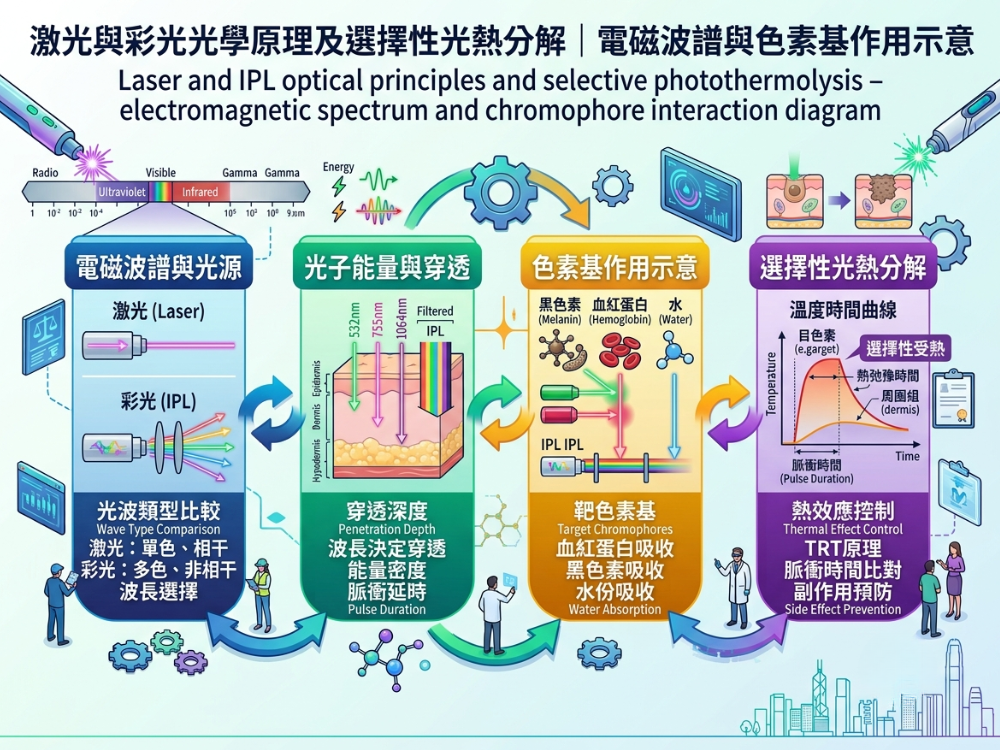
- Laser and IPL optical principles and selective photothermolysis – electromagnetic spectrum and chromophore interaction diagram
2. Photophysics Fundamentals and Mechanism of Action for Laser and IPL Treatments
The prerequisite for safety management is a solid grasp of optical principles. Only by understanding the biological effects of different wavelengths can one accurately select parameters and avoid operational risks. This section corresponds to the HKQF competency units "Aesthetic Optical Principles" and "Basic Laser and IPL Theory", and is a core foundation for ITEC Level 4.
Light is a form of electromagnetic wave, divided into different bands by wavelength, each with distinct skin effects and risks:
- Visible light: wavelength 400–700nm, visible to the human eye; different wavelengths correspond to different colours.
- Ultraviolet (UV): wavelength shorter than 400nm, high energy; prolonged exposure can cause skin damage. UVA is used for skin examination, while UVC is used for instrument disinfection.
- Infrared (IR): wavelength longer than 700nm, mainly thermal effects; near‑infrared penetrates deeper, while far‑infrared is often used for thermal comfort treatments.
Wavelength directly determines penetration depth and target specificity – a core basis for selecting devices and parameters, and key to the effectiveness of laser hair removal, IPL pigmentation treatment, etc.
Laser (Light Amplification by Stimulated Emission of Radiation) is produced through three elements: excitation source, gain medium, and resonant cavity. It possesses three core characteristics: monochromaticity (single wavelength), high coherence (phase‑aligned waveforms), and collimation (parallel beam with minimal divergence).
Based on the gain medium, commonly used lasers in Hong Kong's beauty industry include:
- Gas lasers: e.g., CO₂ laser (10600nm), used for skin resurfacing, wrinkle reduction, and improving atrophic scars.
- Solid‑state/crystal lasers: e.g., Nd:YAG (1064nm), Alexandrite (755nm), used for hair removal, pigmentation, and tattoo removal.
- Diode lasers: e.g., 808nm diode laser, the mainstream device for hair removal in Hong Kong.
Intense Pulsed Light (IPL) is produced by a xenon flashlamp generating a broad spectrum, then filtered to select target bands. It differs fundamentally from lasers:
| Aspect | IPL | Laser |
|---|---|---|
| Spectral nature | Broadband, multi‑wavelength | Single wavelength, monochromatic |
| Coherence | Low coherence | High coherence |
| Beam characteristics | Divergent | Collimated |
| Typical applications | Simultaneously improve multiple superficial skin issues; suitable for large areas | Precise targeting of specific chromophores; higher intensity |
IPL treatments are generally milder and less painful, but are less targeted for deep pigmentation or deep hair follicles compared to lasers. Both have their own indications, and they are the two most common optical treatments in Hong Kong's beauty market.
The core of laser and IPL aesthetic treatments is built upon the theory of Selective Photothermolysis. This concept was first systematically proposed by Anderson and Parrish in 1983 in the academic literature, and remains the fundamental theory for cosmetic laser and IPL treatments: by matching the target's absorption wavelength, setting appropriate pulse duration and fluence, light energy is selectively absorbed by the target chromophore and converted to heat, destroying the target structure without damaging surrounding normal tissue.
The three main chromophores in skin are:
- Melanin: located in hair, epidermis, and pigmented lesions; absorbs light energy and generates heat for hair removal and pigment reduction.
- Haemoglobin: located in microvessels; absorbs light energy to coagulate vessel walls, improving redness and telangiectasia.
- Water: widely present in skin cells; absorbs light energy to stimulate collagen production, achieving skin rejuvenation and tightening.
The key to treatment is that the pulse duration must be shorter than the target's thermal relaxation time to prevent heat diffusion and collateral damage – a core principle in device parameter settings.
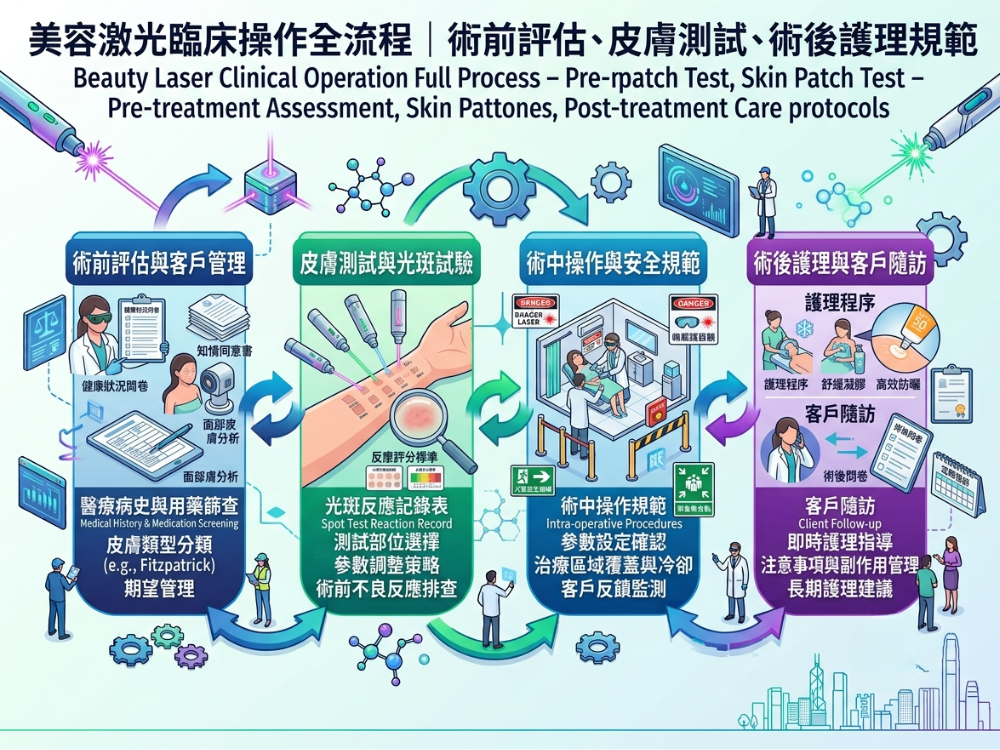
- Full clinical operation process for aesthetic lasers – pre‑assessment, patch test, post‑care protocol
3. Safety Management Structure and Duties for Hong Kong Aesthetic Optical Facilities
Regulations and principles ultimately materialise in facility management. Clear role responsibilities, standardised documentation, and environmental controls are the core barriers to preventing risks. This section corresponds to the HKQF competency unit "Risks and Precautions of Laser and IPL" and is a core requirement for the ITEC Level 4 safety module.
- Employer/Operator: Bears ultimate safety responsibility, ensuring the facility complies with Hong Kong occupational safety regulations, provides adequate staff training and protective equipment, and maintains third‑party liability insurance.
- Laser Safety Officer (LSO): Responsible for formulating facility safety rules, supervising controlled area operations, reviewing equipment maintenance records, and handling safety incidents.
- Laser Protection Adviser (LPA): Responsible for initial site risk assessment, selection of protective equipment, and staff safety training.
- Authorised Operator: Only personnel who have completed recognised training and are registered may operate the equipment; they are responsible for operational safety and client monitoring during treatments.
- Local Rules: Site‑specific safety operating procedures, including an authorised user register listing personnel permitted to operate the equipment.
- Equipment Fault Log: Records equipment anomalies, signed by the discoverer, and countersigned by the LSO confirming resolution.
- Treatment Records and Informed Consent Forms: Detailed records of client skin condition, treatment parameters, and post‑treatment response, along with signed informed consent.
- Risk Assessment Reports: Periodically updated risk assessments for the site and operations, with corresponding improvement measures.
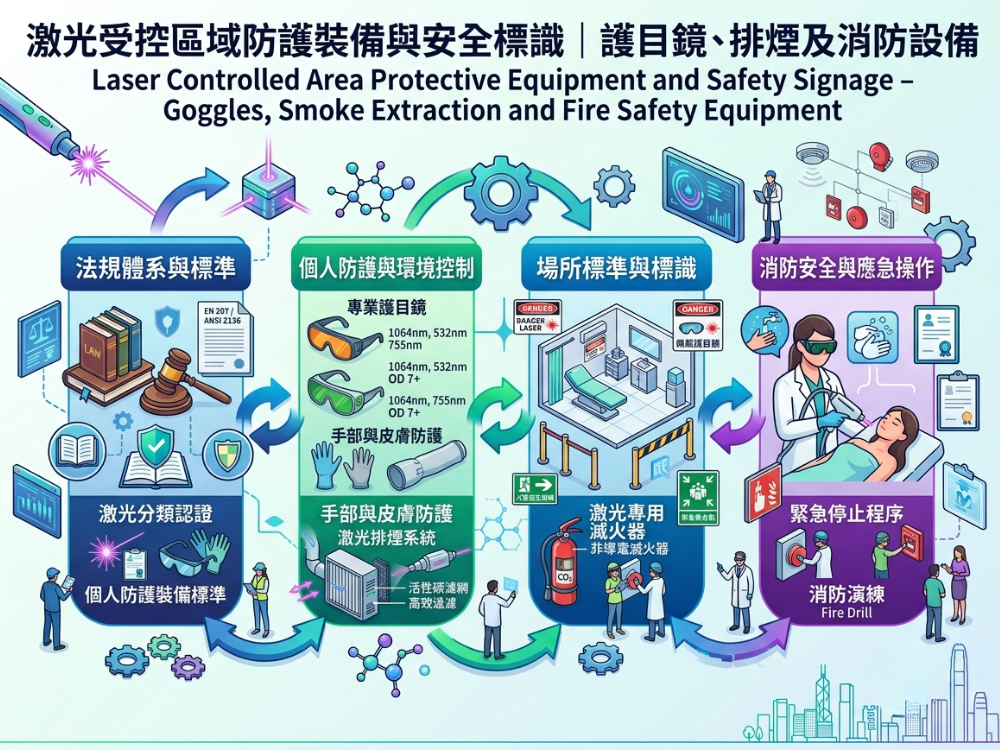
- Warning Signs: During treatment, a laser hazard warning sign must be posted at the entrance of the controlled area at eye level, warning unauthorised personnel not to enter.
- Optical Protection: Windows must be fitted with opaque fire‑resistant curtains; mirrors and highly reflective items (e.g., glass) are prohibited inside to prevent accidental injuries from reflected light.
- Fire Safety: Carbon dioxide fire extinguishers must be available; flammable materials removed; fire escape routes kept clear.
- Ventilation and Smoke Extraction: For lasers that vaporise tissue (e.g., CO₂ laser), smoke extraction devices must be installed to prevent operators from inhaling hazardous fumes and viral particles.
- Goggles must be selected according to the wavelength of the device, using Optical Density (OD) as the attenuation indicator – higher OD values offer greater protection.
- Operators and clients use different goggles: clients wear full‑coverage opaque goggles for maximum protection; operators' goggles balance protection and visibility to allow observation of the treatment area.
- Before each shot, confirm that all persons present are wearing appropriate eye protection and remind the client to keep eyes closed.
- Equipment Testing and Maintenance: Portable laser/IPL devices must undergo regular safety testing to ensure electrical safety and stable output; maintenance must be carried out by supplier‑approved personnel with complete records kept.
- Adverse Event Reporting: In case of serious skin burns, eye discomfort, or other adverse events, the operator must report to the relevant regulatory body as per guidelines and initiate internal investigation and improvement measures.
4. Full‑Process Clinical Risk Assessment and Safe Operation Standards
The clinical side is the final link in safety management. A full‑process standard from pre‑assessment to post‑care directly determines treatment safety and outcomes, and is the most concerning part for Hong Kong consumers.
- Skin Type Assessment: Using the Fitzpatrick skin type scale (I–VI), darker skin types (V, VI) have higher melanin content, increasing the risk of thermal burns; therefore, device and energy selection must be cautious. IPL is not suitable for dark skin types.
- Contraindication Screening: Pregnant or breastfeeding women, those on photosensitising medications, uncontrolled diabetes, keloid‑prone individuals, active skin infections/inflammation, and those with immune system disorders should not undergo optical treatments or should postpone them.
- Lifestyle Confirmation: Confirm that the client has not had excessive sun exposure, used photosensitising agents (e.g., retinoids), or undergone recent chemical peels within 4 weeks, to reduce the risk of post‑inflammatory hyperpigmentation and burns.
- Explain treatment principles, expected results, possible side effects, and post‑care instructions in plain language, avoiding exaggeration of effects.
- Do not use medical diagnostic terminology; do not claim that treatments can cure skin diseases. If suspected pathological skin conditions (e.g., nevus of Ota, seborrheic keratosis) are observed, advise the client to consult a registered medical practitioner first.
- Only proceed with treatment after the client has fully understood and signed the treatment consent form.
- Perform a patch test on an inconspicuous area 48–72 hours before the full treatment to observe skin reaction and determine safe parameter ranges.
- Remove all metal accessories from both client and operator before treatment; confirm proper goggle placement.
- Strictly follow device instructions for setting fluence, pulse duration, frequency, etc., and adjust dynamically based on the client's immediate response.
- Monitor the client throughout; if severe discomfort, abnormal whitening, or blistering occurs, stop immediately and manage symptomatically.
- Immediately apply soothing cooling measures, moisturising and repair products, and sunscreen of SPF 30 or higher.
- Clearly inform the client of post‑care instructions for the next 72 hours: avoid hot water washing, avoid high‑temperature environments, no exfoliation, and strict sun protection.
- Remind the client that mild redness and dryness are normal; if persistent swelling, blistering, or pigment changes occur, contact the centre immediately for follow‑up.
Frequently Asked Questions
References
I. Hong Kong SAR Legislation and Subsidiary Regulations: Occupational Safety and Health Ordinance (Cap. 509), Occupational Safety and Health Regulation (Cap. 509A), Machinery and Plant Equipment Safety Regulation (Cap. 59I), Electricity Ordinance (Cap. 406)
II. Practical Guidance from Hong Kong Official Bodies: EMSD "Safety Guide for Laser Products", OSHC "Laser Safety" Guide, Department of Health "Medical Device Administrative Control System"
III. Qualifications Framework and Syllabus Documents: Hong Kong Beauty Industry "Specification of Competency Standards" (Principles and Risks of Laser and IPL, Level 4, units 106887L4, 106888L4, 106889L4); VTCT Skills (ITEC) Level 4 Diploma in Laser and Intense Pulsed Light Treatments syllabus; Hong Kong Qualifications Framework (HKQF) Level 4 qualification standard description
IV. International Safety Standards: IEC 62471:2006, IEC 60825-1:2014, BS EN 60601-1:2006
V. Academic and Industry Reference Books: Hill, P. & Owens, P. (2011). Milady’s Aesthetician Series: Lasers & Light Therapy. Milady; Raulin, C. & Karsai, S. (2010). Laser and IPL Technology in Dermatology and Aesthetic Medicine. Springer; Anderson, R. R. & Parrish, J. A. (1983). Selective photothermolysis. Science, 220(4596), 524-527.
Conclusion
The safety management of laser and IPL equipment in Hong Kong is a multi‑dimensional system: regulatory standards provide the top‑level foundation, optical principles are the scientific basis, facility management forms the execution framework, and clinical operation is the key to practical implementation. All four are indispensable, together building a full‑chain safety guarantee from equipment supply to client service.
Corresponding to the competency requirements of HKQF Level 4 and the core learning points of ITEC Level 4 international professional certification, local practitioners must not only be proficient in operating equipment but also establish a comprehensive safety knowledge system. Only then can they provide professional, compliant, and high‑quality aesthetic optical services while ensuring the safety of both themselves and their clients, thereby promoting the overall professional development of Hong Kong's beauty industry.
Comments (0)
No comments yet
Leave a Comment