- ‧ Students from diverse backgrounds including statistics, logistics, F&B, design, accounting, libraries, e-commerce
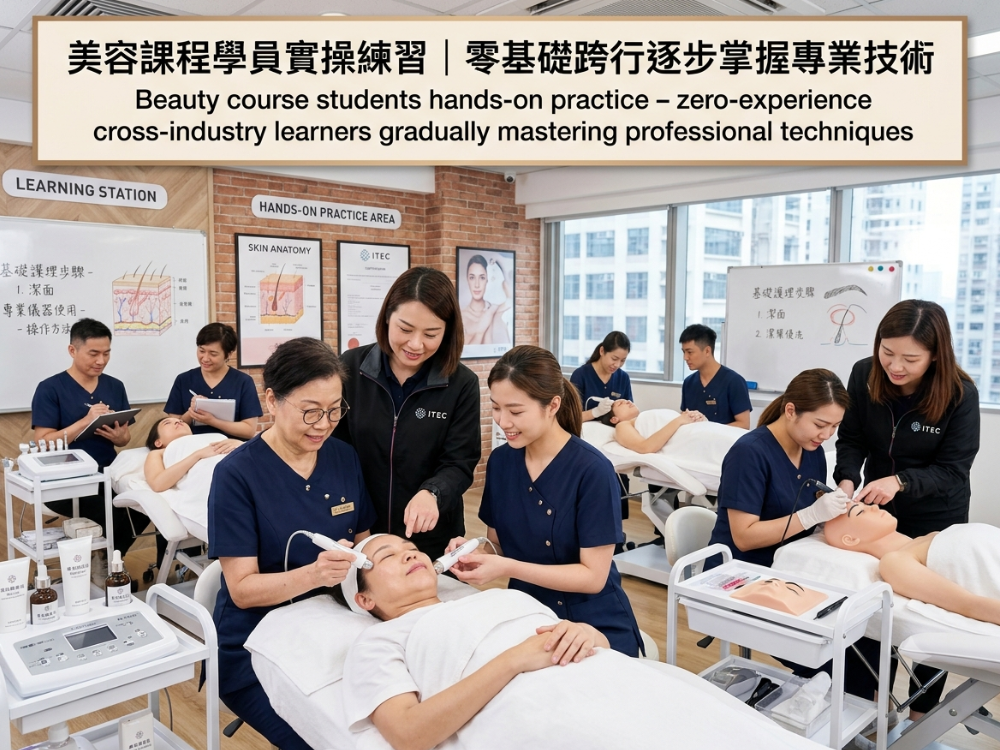
- ‧ Enrolled in VTCT ITEC Level 2-4 international certification courses aligned with IQA qualification framework
- ‧ Key consensus: never rush into full-time career switch immediately after course completion
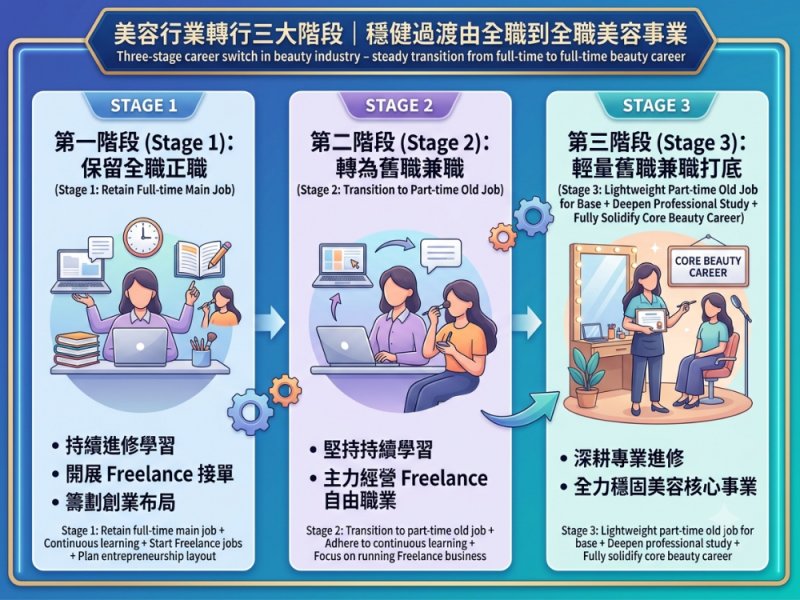
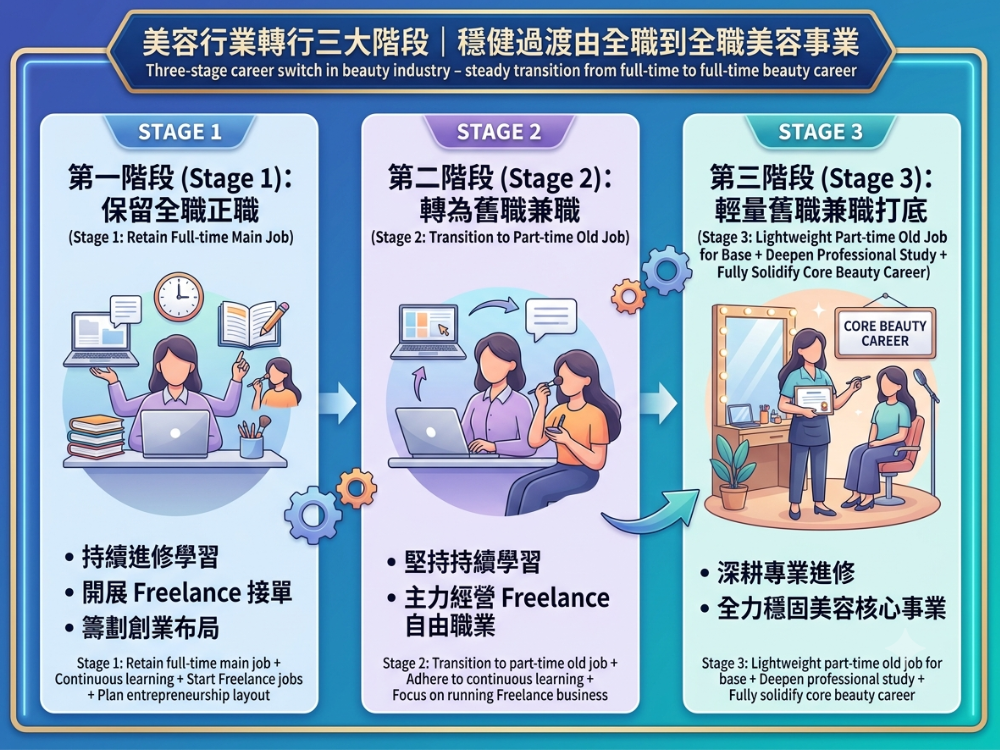
- ‧ Three-stage transition: retain full-time → switch to part-time → light part-time with full focus on beauty
- ‧ Starting at 30+ is never too late – life experience and communication maturity are unique advantages
- ‧ Freelance clients start from friends and family network, expanding through word-of-mouth referrals
- ‧ Cross-industry skills (design, sales, accounting, administration) can integrate into beauty industry as advantages
Students from diverse backgrounds including statistics, logistics, F&B, design, accounting, libraries and e-commerce, led by President Wong Cho Yi and Vice President Wong King Lun, gathered to discuss career transition plans after completing VTCT ITEC Level 2-4 international certification courses. The consensus: never rush into full-time career switch. Follow three progressive stages: retain full-time while studying and freelancing, then switch to part-time while focusing on beauty services, finally light part-time with full dedication to beauty. Starting at 30+ is never too late – cross-industry skills can integrate into beauty as unique advantages. Career switch is about stability, not speed.
Switch Careers Right After Beauty School? A Solid Transition Roadmap & Cross‑Industry Student Insights
One evening after class, a group of students gathered for a casual chat, which soon turned into a lively brainstorming session. The relaxed meetup was led by Principal Joie WONG Cho Yi and Vice Principal Lawrance WONG King Lun from Luster Beauty International Education and Training Academy (LBEDU), joined by senior instructors Pauly TSE Shuk Ying, Joyce MAK Mei Yi, Evelyn WONG Ching Wai, and Winny CHAU Tsz York, who engaged in an open dialogue with current students.

The students came from diverse backgrounds: statistical assistants, logistics and warehouse coordinators, fast‑food service staff, graphic designers, product packaging designers, news editors, accounting assistants, library administrators, and online store salespeople. They are currently pursuing various internationally recognised beauty qualifications, including the VTCT Skills ITEC suite:
- VTCT Skills (ITEC) Level 2 Certificate for Beauty Specialists 603/4074/5
- VTCT Skills (ITEC) Level 3 Certificate in Eyelash Extensions 603/4050/2
- VTCT Skills (ITEC) Level 3 Diploma in Nail Technology 603/4040/X
- VTCT Skills (ITEC) Level 3 Diploma in Fashion, Theatre and Media Make‑up 603/4049/6
- VTCT Skills (ITEC) Level 3 Diploma in Holistic Massage 603/4097/6
- VTCT Skills (ITEC) Level 3 Award in Massage using Pre‑Blended Aromatherapy Oils 603/4066/6
- VTCT Skills (ITEC) Level 4 Award in Micro‑Pigmentation Treatment 603/4083/6
- VTCT Skills (ITEC) Level 4 Award in Scalp Micropigmentation Treatments 610/1642/1
- VTCT Skills (ITEC) Level 4 Diploma in Laser and Intense Pulsed Light Treatments 500/1212/5
In addition to the international qualifications above, students can first build a solid foundation through HKQF‑accredited Continuing Education Fund (CEF) courses, before progressing to VTCT/ITEC and IQA international certifications. Below are our popular HKQF CEF courses (all registered on the Qualifications Register):
- HKQF – Nail Technology Certificate (QF Level 3) 25/000362/L3
- HKQF – Semi‑Permanent Micropigmentation Certificate (QF Level 3) 25/000363/L3
- HKQF – Beauty Teaching and Training Certificate (QF Level 3) 24/000474/L3
- HKQF – Eyelash Extension, Lash Lift and Brow/Lash Tinting Certificate (QF Level 3) 24/000475/L3
- HKQF – Make‑up Techniques Certificate (QF Level 2) 24/000473/L2
Typically, students start with the above HKQF CEF courses, then proceed to study or assess VTCT/ITEC and IQA International Qualifications Assessment Alliance, progressively elevating their expertise and building a solid ladder for career switching or entrepreneurship.

All courses are also recognised under the IQA International Qualification Assessment Alliance framework, progressing from foundation to advanced specialisations, building a solid professional foundation for entering the industry.
As the conversation flowed, students shared their work stories and their motivations for joining the beauty industry. The discussion naturally converged on the most pressing question: After completing the full beauty course and obtaining international certifications, do you have to quit your current job and switch to full‑time beauty work immediately?
A common concern emerged: many are used to a stable monthly salary, and their living expenses and spending habits are tied to that fixed income. Suddenly quitting would cut off their income, making it impossible to cover daily costs instantly, causing financial stress and anxiety. Many students are in their mid‑30s, at a career crossroads where they must be prudent—they want stability but also a chance to move into a more promising field, yet they hesitate to take risks. This fear keeps them from making the leap, following the principle: “Only move when you have income; never quit without a safety net.”
To address these genuine concerns, the principal and instructors delved deep during the brainstorming session. Combining industry realities and real‑world transition experiences from past students, they outlined three stable transition stages—a step‑by‑step, secure path that avoids risky resignations, protects your income baseline, and gradually establishes you in the beauty sector.
Why Cross‑Industry Professionals Choose Beauty
The students came from diverse roles—administrative, frontline service, design, editorial, and online marketing. Their reasons for leaving familiar fields to study beauty were similar: old industries felt rigid, with limited promotion prospects and little room for personal growth. In contrast, beauty offers multiple career paths—frontline therapist, trainer, salon manager, or even starting your own studio. It provides flexibility, professional skincare and bodywork skills, and enhances personal grooming and confidence—offering immense potential.
Some also mentioned a longer‑term consideration: many administrative, data, design, and clerical roles are facing increasing automation from AI, raising concerns about future career space. Beauty, on the other hand, is hands‑on, personalised service—relying on touch, one‑on‑one communication, and customised solutions—which AI cannot easily replace, making it a more sustainable profession. Of course, this is secondary; the main drivers are industry prospects and personal interest.
More importantly, the skills they already possess—copywriting, design, accounting, data analysis, inventory management, customer sales, and document organisation—can be seamlessly integrated into beauty. Combined with VTCT/ITEC/IQA qualifications, these become valuable assets, so you don’t start from zero; cross‑industry adaptability is high.
Core Consensus: Don’t Rush into Full‑Time Beauty Right After Graduation
The principal and instructors emphasised: obtaining qualifications and mastering skills only means you’re eligible to enter the industry—it doesn’t mean you’re ready to switch to full‑time immediately.
- You’re used to a stable monthly salary, with all living expenses, daily consumption, and fixed costs relying on that regular income. Suddenly losing that paycheck, when your beauty income hasn’t stabilised, makes it nearly impossible to cover all expenses.
- Beyond financial strain, anxiety and insecurity will creep in—worrying about unstable income, insufficient clients, and slow business. This emotional toll can undermine your confidence and even lead to giving up.
- Instead of taking a risky leap, transition gradually—secure your baseline income first, then progressively shift your career focus.
Three Stable Transition Stages
- Stay in your current full‑time role to maintain the stable income you’re accustomed to, preserving your existing spending patterns and lifestyle—no disruption to daily finances, giving you peace of mind.
- Use evenings and weekends to deepen your beauty knowledge, practical techniques, and customer service skills, preparing for VTCT/ITEC and IQA exams, while also learning industry essentials like cooling‑off periods and contract refund policies.
- At the same time, start taking on freelance work from friends and family, slowly building a client base and reputation. If you plan to start your own business, begin budgeting, scouting locations, and considering future studio rental—laying the groundwork early.
- Once your beauty skills are proficient and your freelance income becomes more stable, move to the transition phase.
- Shift your full‑time job to a part‑time role, reducing hours while retaining a portion of stable income as a financial safety net—no risk of income gaps, and expenses remain manageable, reducing anxiety.
- Keep up with professional development, staying updated on new techniques and industry regulations. Dedicate most of your time to beauty services, expanding your client network, gaining frontline experience, and understanding market operations.
- In this final mature phase, keep only a very light part‑time role in your old job—just as supplemental income, no longer consuming your main time and energy.
- Continue advancing your qualifications while fully committing to your beauty career.
- Whether you join a large beauty organisation as a full‑time senior therapist, move into management, or finally rent a studio to start your own business, you’ll have built up enough clients, experience, and capital.
- At this point, your beauty income comfortably covers all living expenses—often exceeding your previous salary—freeing you from reliance on a fixed paycheck. You’ll feel secure and confident, without the panic and worry of a rushed career change, completing a smooth and successful transition.
Freelancer to Entrepreneur – 5 Key Considerations
- Sole proprietorship (unlimited liability), limited company, or partnership? Initially, consider renting a shared beauty room to save on renovation and long‑term lease pressure. Once your client base is stable, then think about leasing your own space.
- Register your business before opening. Specialised services like laser and micropigmentation require corresponding Level 3/4 qualifications. Strongly recommend public liability and professional indemnity insurance to protect yourself and your clients—avoid losing everything you’ve earned from a single accident.
- Split your budget into “one‑time” (renovation, equipment, stock) and “monthly fixed” (rent, utilities, insurance). Always set aside at least 3‑6 months of personal and business operating expenses, so you won’t be affected if initial client volume fluctuates.
- Use a simple booking app to reduce errors and record client preferences to increase repeat visits. Clarify your unique selling points (e.g., specialise in a specific service) and focus on sharing your work and reviews on social media. Don’t try to do everything, which can dilute your image.
- Don’t compromise your technique just to take on more orders—quality over quantity. Set aside time daily for rest and continuous learning; your skill is your core competitive advantage. Also maintain good relations with your former employer—if initial income falls short, you can always take on short‑term part‑time work as a backup.
In summary: The freelancer phase is the perfect “testing the waters” period. Use low‑cost methods to validate the market, build enough clients, savings, and confidence before officially opening your shop—that’s how you achieve steady success.
Frequently Asked Questions
Closing Words from the Evening Gathering
Principal Joyce Wong, Vice Principal Kenneth Wong, along with Ivy Tse, May Mak, Jingwei Huang, and Zara Chow, encouraged all students: every past work experience is your unique advantage—designers have an eye for aesthetics, administrators excel at promotion, accountants are skilled at financial planning, and salespeople know how to nurture customer relationships. Combined with VTCT, ITEC, and IQA qualifications, these traits will help you stand out faster in the beauty industry.
Career transition is never about speed—it’s about steadiness. We understand that you’re used to stable income and fixed spending, and in your 30s, you have more life considerations. Facing an unfamiliar industry can naturally cause anxiety, so please don’t make impulsive decisions. Follow the three stages step by step: secure your income, hone your skills, build a clientele, and finally make the full transition—without any income gaps, balancing all living expenses comfortably. With confidence and ease, you can gradually turn beauty into a stable, long‑term career that truly belongs to you.
Comments (0)
No comments yet
Leave a Comment