- 1. Core insight: Good technique ≠ good teaching. Beautician = "can do"; educator = "can teach, assess, ensure learning" — two distinct professional competencies.
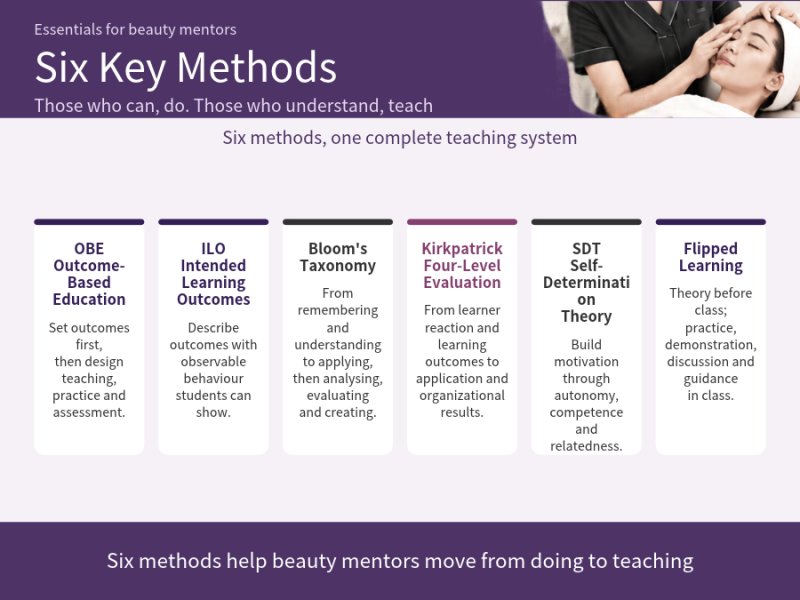
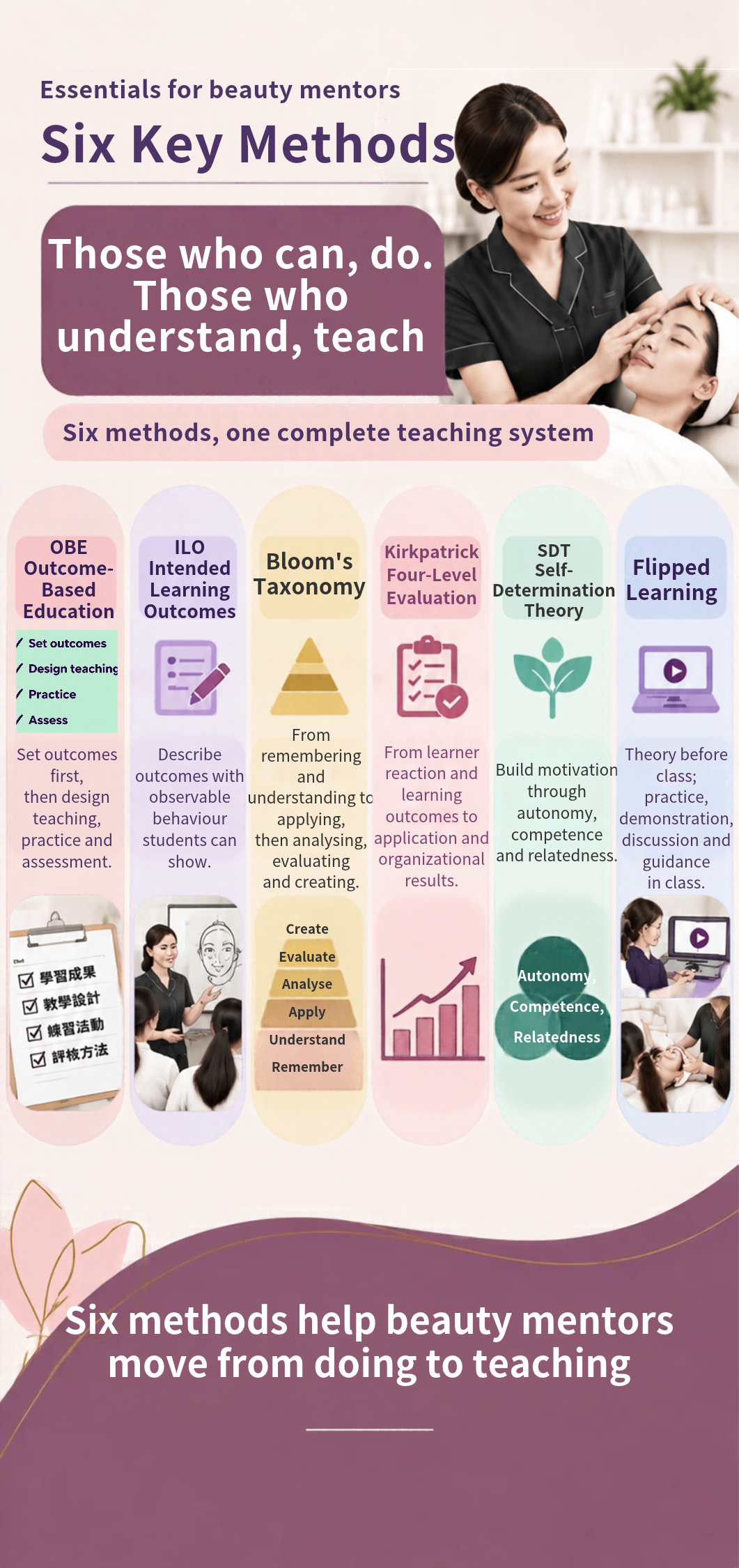
- 2. Six pedagogy pillars: OBE (outcome-based education), ILO (intended learning outcomes), Bloom's taxonomy (cognitive/affective), Kirkpatrick 4-level evaluation, SDT (self-determination theory), flipped learning.
- 3. OBE core: backward design from learning outcomes; standard for iTEC/VTCT international qualifications; define graduate capability first, then content, activities, assessment.
- 4. Professional assessment: formative + summative assessment, rubric criteria with clear Pass/Refer boundaries, replacing subjective "looks OK" judgement.
- 5. Educator qualification: VTCT Skills iTEC Level 5 DET — awarded by UK iTEC, EQF Level 5 (equivalent to HK higher diploma years), recognised in 50+ countries, includes teaching practice.
- 6. Career paths: full/part-time educator, corporate trainer, course director; salary: part-time HK$300-600/lesson, full-time HK$16,800-20,000/month, senior/course director HK$23,000-28,000/month.
- 7. DET highlight: includes teaching practice — teach real learners with mentor observation and instant feedback; work-ready upon graduation, not just theory.
Beauty educator pedagogy: OBE, ILO, Bloom, Kirkpatrick, SDT, flipped. Lesson planning, demo, rubric, safety. iTEC L5 DET (EQF L5) with practice. Careers: educator, trainer, director. HK$18-28k.
Good Technique ≠ Good Teaching | Essential Pedagogy Knowledge for Beauty Educators
Key Takeaways
- Core insight: Good technique ≠ good teaching. A beauty therapist and a beauty educator are two different professional competencies — the former “can do”, the latter “can teach, assess accurately and ensure learners learn”
- Six pedagogy pillars: OBE (Outcome-Based Education), ILO (Intended Learning Outcomes) levels, Bloom’s Taxonomy (cognitive/affective domains), Kirkpatrick Four-Level Evaluation Model, SDT (Self-Determination Theory), Flipped Learning
- Common misconception: Many senior beauticians assume “I’ve been doing it, that’s enough”, yet faced with absolute beginners they don’t know where to start, can’t design assessments, and can’t manage learning differences
- Educator qualification: The iTEC Level 5 Diploma in Education and Training (DET) is the industry-recognised entry qualification for educators
- Career transition: Moving from frontline beautician to educator offers stable pay, a better working environment and school holidays — the golden career fallback in the beauty industry
- LBEDU advantage: Government-registered institute (854), VTCT/iTEC official awarding and assessment centre; pedagogy courses taught by tutors holding DET and other teaching qualifications
1. Good Technique ≠ Good Teaching — Why Many Senior Beauticians Can’t Teach
There is a very common phenomenon in the beauty industry: many therapists with ten or eight years of experience and excellent technique have clients queuing up for their services — but when asked to teach as educators, they are full of questions: they don’t know where to start, don’t know how to assess learners, and don’t know how to handle the differences between beginners and experienced learners.
This isn’t because senior beauticians aren’t good enough — it’s because “can do” and “can teach” are fundamentally two different professional competencies. Just as a good chef doesn’t necessarily know how to run a cooking class, and a good doctor doesn’t necessarily know how to be a medical school professor — technique and teaching are two separate professions.
2. The Difference Between a Beauty Therapist and a Beauty Educator — From “Can Do” to “Can Teach”
Many people assume a beauty educator is simply “someone who teaches beauticians how to work”, but in fact an educator and a frontline therapist are two different professional roles. Here is a detailed comparison:
| Comparison | Frontline Beauty Therapist | Beauty Educator |
|---|---|---|
| Core competency | Doing it yourself and serving clients well | Teaching effectively, assessing accurately, ensuring learners learn |
| Knowledge structure | Beauty techniques, product knowledge, customer service | Beauty techniques + pedagogy + curriculum design + assessment + learning psychology |
| Work output | Each client’s service results | Each learner’s learning outcomes |
| Assessment method | Client satisfaction, repeat business | Learner pass rates, employment rates, course evaluation |
| Required qualifications | International beauty certificates (e.g. iTEC Level 3/4) | Beauty certificate + education and training qualification (e.g. iTEC L5 DET) |
| Career development | Senior therapist, in-house trainer, branch manager | Educator, course director, principal |
| Physical demands | Long hours standing and hands-on work — high physical toll | Mostly lecturing, demonstration and marking — lower physical burden |
Why is the beauty educator the golden career fallback in the beauty industry?
As therapists gain seniority, the physical toll of long hours standing and hands-on work grows. Transitioning to teaching lets you keep your ten-plus years of technical experience while moving into a classroom environment with lower physical burden, stable pay and school holidays. Many senior therapists reach a certain stage and consider the move — and earning your educator qualification is the first step of that transition.
3. The Six Pedagogy Frameworks Every Beauty Educator Must Know
The iTEC Level 5 DET course covers six pedagogy theories that are examinable and the most useful in real teaching. Here is each one, broken down:
Practical application: To design a “semi-permanent brows unit”, OBE first states clearly: upon completing this unit, learners are able to independently perform a safe brow design and treatment (including consultation, sanitisation, procedure and aftercare) — then works backwards to plan what each lesson teaches.
Correct wording: “Learners are able to accurately draw three brow designs and complete ombré brow strokes on a practice model” (this is an ILO)
Layering principle: A unit’s ILOs should cover three domains — Knowledge, Skills and Attitudes — for the outcomes to be complete.
① Remember — state pigment types
② Understand — explain why a skin patch test is required
③ Apply — select a suitable brow shape for a client
④ Analyse — analyse why red brows change colour
⑤ Evaluate — evaluate the safety risks of an operating procedure
⑥ Create — design a brand-new teaching unit
Affective domain: from receiving, responding and valuing to internalising — for example, cultivating learners’ professional attitude of “safety first”.
Why it matters: ILOs at beginner level mostly stay at “Remember/Understand”, while advanced and educator-level courses must reach “Analyse/Evaluate/Create”.
Level 2 Learning: What did learners learn? Assessed through examinations and practical assessments.
Level 3 Behaviour: Do graduates apply what they learned at work? Follow up on graduates’ practical performance.
Level 4 Results: What real impact does it have on the organisation/market? For example, graduate employment rates, lower client complaint rates, higher turnover.
Why it matters: Many educators only reach Level 1 (questionnaire satisfaction), but professional education only counts as truly effective when it reaches Levels 3 and 4.
Practical application:
- Autonomy: let learners choose practice items and express their own learning goals
- Competence: design practice that is challenging but not too difficult, with timely feedback and encouragement
- Relatedness: build classroom community, mutual learner support, and educator care
LBEDU places special emphasis on this theory in its DET teaching, because many beauty education learners are working professionals studying part-time, making motivation management especially important.
Practical application: For example, when teaching laser principles, learners watch a 15-minute video on wavelengths before class, then use class time to practise setting parameters directly on the machine, with the educator guiding each learner.
4. How Is Pedagogy Applied in Practice? — Lesson Planning, Assessment and Learner Management
Theory aside, how do you actually use it in real teaching? A professional beauty educator’s daily work revolves around three things: writing lesson plans, teaching and assessing.
A complete lesson plan should include: unit name, ILO learning outcomes, teaching content outline, materials/equipment list, teaching activities (lecture/demonstration/practice/discussion), time allocation, assessment methods, safety notes and homework. Don’t think of lesson plans as “paperwork for inspection” — the process of writing one is how the educator organises the thinking for the whole class.
Beauty is a hands-on craft, so demonstration matters. Professional demonstration has a method: first complete the procedure once to show learners the full picture, then break it down slowly step by step, then learners practise while the educator guides each one. This is the “I do, We do, You do” model in education — the educator demonstrates, we do it together, you do it yourself.
Assessment is not “just giving a grade”. Professional assessment includes Formative Assessment (in-progress assessment with feedback during class practice) and Summative Assessment (final examinations/practical exams). Use rubric marking guides that clearly state the criteria for each movement, so marking is fair and consistent.
Every class has fast and slow learners. Professional educators design extension challenges for fast learners (e.g. harder case studies) and extra coaching and practice opportunities for slower learners — rather than measuring everyone with the same ruler. This is “differentiated instruction”.
Beauty teaching involves machine operation, live models and chemical products — safety always comes first. Educators must design risk assessment forms, ensure learners have sufficient guidance before operating machines, and establish incident response mechanisms. This is a key focus of the iTEC L5 DET course.
5. What Does the VTCT iTEC L5 DET Course Cover?
To become a beauty educator, the VTCT Skills iTEC Level 5 DET is the internationally recognised professional educator qualification. The course covers the following key areas:
| Item | VTCT Skills iTEC Level 5 Diploma in Education and Training (DET) |
|---|---|
| Awarding body | VTCT Skills iTEC International, UK |
| Qualification level | Regulated Qualifications Framework (RQF) + European Qualifications Framework (EQF) Level 5 — equivalent to Hong Kong Higher Diploma/Associate Degree years |
| Recognition | Internationally recognised (50+ countries worldwide) |
| Course focus | Pedagogy, curriculum design, assessment, professional practice — including teaching practice |
| Who it suits | Those seeking internationally recognised educator status, planning overseas careers, or teaching international certification courses |
| Entry requirements | Usually relevant international beauty certificates (e.g. iTEC Level 3/4) + industry experience |
Why choose the iTEC L5 DET?
If you want to teach iTEC/VTCT internationally recognised courses or have the opportunity to teach overseas, the iTEC L5 DET’s international recognition is exceptionally high. Many LBEDU graduates find their career paths widen after earning it.
6. Career Prospects and Income of Beauty Educators
Hong Kong’s beauty education industry keeps expanding, and demand for professional educators continues to rise. After earning your educator qualification, here are the main career directions:
Government-registered colleges and internationally certified training providers all need full-time beauty educators to teach beauty diploma courses, prepare lessons, assess and support learners. Pay is generally more stable than frontline therapists, with comprehensive leave and retirement benefits.
Many senior therapists start as part-time educators during the transition, keeping some frontline work while building teaching experience. Part-time educators are paid per class with flexible hours.
Large beauty groups, equipment companies and product distributors need in-house training educators for new staff training, product knowledge training and technique upgrade training. This direction usually pays higher.
Starting as an educator, you can advance to course director (course planning, quality assurance) and then to principal level. This is the management path of the beauty education industry.
Beauty Educator Income Reference (Hong Kong Market)
Entry-level part-time educator: HK$300-$600/class
Full-time beauty educator: HK$18,000-$28,000/month
Senior educator / course director: HK$28,000-$45,000/month
(Figures are for reference only; actual amounts vary by institution, qualifications, experience and course type.)
7. Frequently Asked Questions (FAQ)
8. Summary: From “Can Do” to “Can Teach” — The Evolution Path of a Beautician
Doing beauty well is one profession; teaching beauty well is another. “Good technique doesn’t mean you can teach” is not a put-down of senior beauticians — it reminds us that teaching itself requires systematic study.
OBE (Outcome-Based Education), ILO (Intended Learning Outcomes), Bloom’s Taxonomy (cognitive/affective domains), Kirkpatrick Four-Level Evaluation, SDT (Self-Determination Theory) and Flipped Learning — these six pedagogy pillars are not ivory-tower theory but practical tools used daily in lesson planning, teaching and assessment. Once you master them, you evolve from “a beautician who does well” into “an educator who teaches well”.
If you’ve worked in beauty for several years, feel the physical strain of frontline work beginning to build, and want a longer-term career path, earning an iTEC Level 5 DET is a transition route well worth considering.
Technique is a skill; teaching is a profession — LBEDU walks with you from beautician to educator
Further Reading
1. Laser Courses — Light Licence iTEC Level 4 Laser and Intense Pulsed Light Diploma | LBEDU Government-Registered Institute
2. Tattoo Licence Course — Semi-Permanent Makeup iTEC Level 4 Diploma | LBEDU
3. Hong Kong Beauty Course Complete Guide | Government-Registered Institute Courses, CEF Funding, International Certification, Career Prospects
4. Semi-Permanent Makeup Safety Guidelines | Absolute and Relative Contraindications, Infection Control, MRSA and Hepatitis Prevention
5. How Long Does It Take to Learn Beauty from Scratch? | The Complete Path from Beginner to International Certification
About LBEDU Luster Beauty International Education & Training Institute
Founded in 2013, LBEDU is a government-registered institute in Hong Kong (Registration No. 854), specialising in beauty education and international professional qualification training. The institute holds one of the most complete international qualification recognition matrices in Hong Kong:
- Government-registered institute in Hong Kong (854)
- QF Star Training Provider for two consecutive terms
- CEF Continuing Education Fund recognised institution
- VTCT/ITEC UK official awarding and assessment centre (EQF Level 5)
- JECA Japan Eyelash Certification School (first in Hong Kong, Macau and mainland China)
- Twice shortlisted for the IQA Annual Outstanding Academy (2019 and 2026) — the only one in Hong Kong
Shop C, G/F, Wing Shing Building, 21-35 Castle Peak Road, Kowloon, Hong Kong
(852) 9548 8600
Feel free to contact our student advisors for details on the iTEC Level 5 DET course, intake dates, tuition fees and funding applications.
lbacademy.com.hk
Comments (0)
No comments yet
Leave a Comment