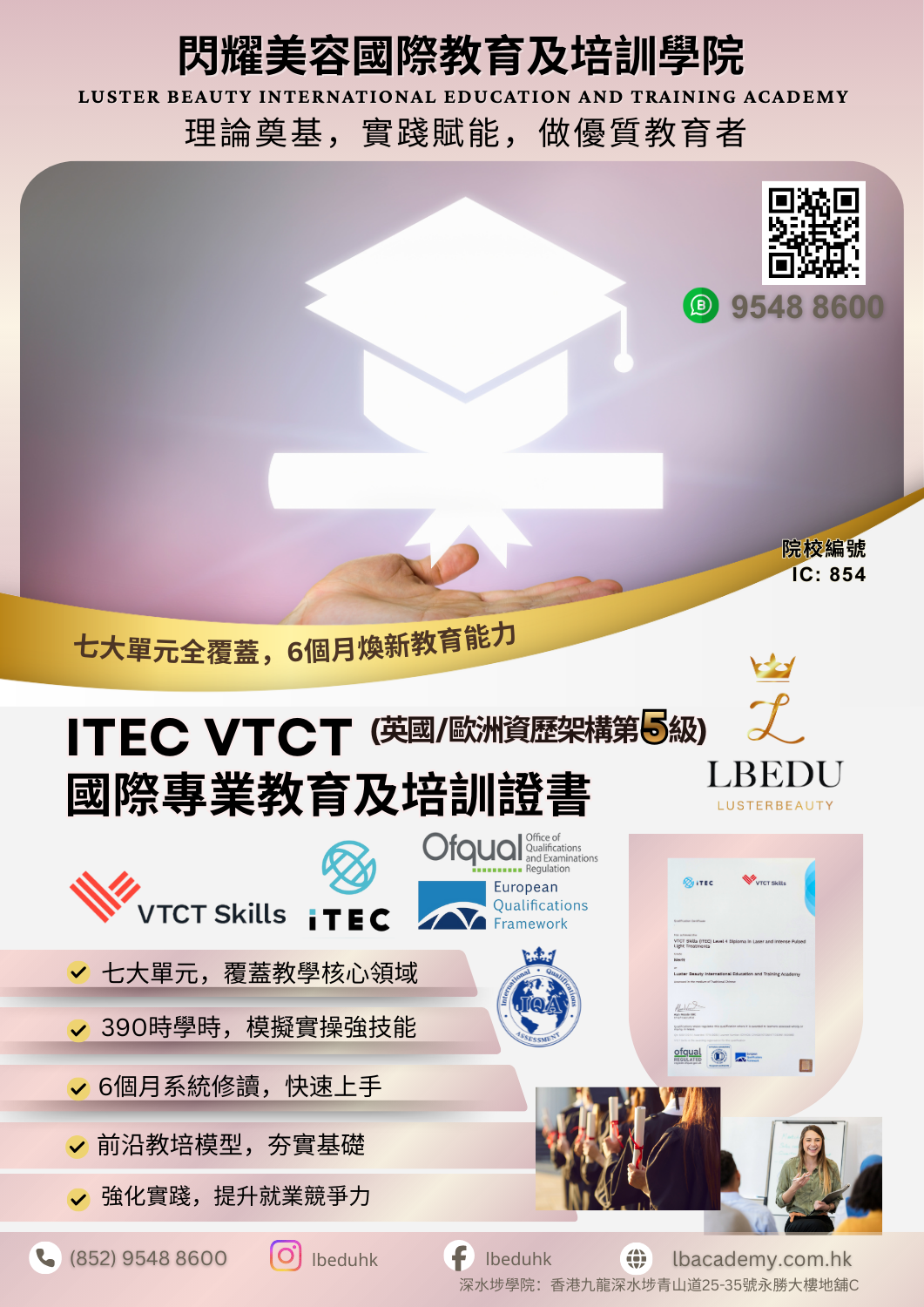
VTCT Skills ITEC Level 5 Diploma in Education and Training Teacher Class (RQF EQF Level 5) DET (For all vocational industry)
Note: Our school is a government-registered institution and a government Labour Department-approved vocational referral agency. We can provide job referrals and teaching opportunities (e.g., course assistant, beauty therapist, laser therapist, etc.) to students with excellent academic results, offering more career development paths for our graduates.
[Objective]
- - Compulsory Unit 1: Wider professional practice and development in education and training
The aim of this unit is to provide you with the knowledge, understanding and skills relating to wider professional practice in education and training. You will learn about professionalism and professional values in education and training, the policy context of education and training, the impact of being accountable to stakeholders and external bodies, and the organisational context of education and training. You will also understand how to contribute to the quality improvement and quality assurance arrangements of an organisation.
- - Compulsory Unit 2: Teaching, learning and assessment in education and training
The aim of this unit is to provide you with the knowledge, understanding and skills relating to teaching, learning and assessment in education and training. You will understand the role and responsibilities of a teacher in education and training, agree individual learning goals and planning, as well as delivering and assessing inclusive teaching and learning. You will learn how to create and maintain an inclusive learning environment and evaluate your own practice.
- - Compulsory Unit 3: Developing teaching, learning and assessment in education and training
The aim of this unit is to provide you with the knowledge, understanding and skills relating to developing teaching, learning and assessment in education and training. It includes investigating practice in own area of specialism, applying theories, principles and models of learning, communication and assessment in relation to planning, delivering and assessing inclusive teaching and learning. It also involves applying theories of behaviour management in creating and maintaining an inclusive learning environment and applying theories and models of reflection to evaluate own practice.
- - Compulsory Unit 4: Theories, principles and models in education and training
The aim of this unit is to provide you with the knowledge and understanding of theories, principles and models applied to education and training. You will learn about the application of theories, principles and models of learning, communication and assessment in education and training. You will also cover the application of theories and models of curriculum development within your own area of specialism, and the application of theories and models of reflection and evaluation of your own practice.
- - Elective Unit 5: Inclusive practice
The aim of this unit is to develop your knowledge and understanding of inclusive practice. You will learn about factors influencing learning, and legislation relating to inclusive practice. You will also cover the roles and responsibilities relating to inclusive practice, how to create and maintain an inclusive learning environment and how to evaluate own inclusive practice.
- - Elective Unit 6: Teaching in a specialist area
The aim of this unit is to enable you to understand and use inclusive teaching and learning approaches to meet the needs of learners. This includes how to create a learning environment that engages and motivates learners, and the planning, delivery and evaluation of inclusive teaching and learning. You are required to deliver a microteaching session and to evaluate your own delivery practice.
- - Elective Unit 7: Developing, using and organising resources in a specialist area
The aim of this unit is to provide you with the knowledge, understanding and skills relating to developing teaching, learning and assessment in education and training. It includes investigating practice in own area of specialism, applying theories, principles and models of learning, communication and assessment in relation to planning, delivering and assessing inclusive teaching and learning. It also involves applying theories of behaviour management in creating and maintaining an inclusive learning environment and applying theories and models of reflection to evaluate own practice.
[Learning Hours]
[Course Duration]
[Entry Requirements]
- - 16 years old and above
- - Fluent in Cantonese, Mandarin or English
[Course Syllabus]
1) Teaching, learning and assessment in education and training
- - Be able to use initial and diagnostic assessment to agree individual learning goals with learners
- - Be able to create and maintain a safe, inclusive teaching and learning environment
- - Be able to deliver inclusive teaching and learning
- - Be able to assess learning in education and training
- - Be able to implement expectations of the minimum core in planning, delivering and assessing inclusive teaching and learning
- - Understand roles, responsibilities and relationships in education and training
- - Be able to plan inclusive teaching and learning
- - Be able to evaluate own practice in planning, delivering and assessing inclusive teaching and learning
2) Developing teaching, learning and assessment in education and training
- - Be able to apply theories of behaviour management to creating and maintaining a safe, inclusive teaching and learning environment
- - Be able to apply theories, principles and models of learning and communication to delivering inclusive teaching and learning
- - Be able to apply theories, models and principles of assessment to assessing learning in education and training
- - Be able to implement expectations of the minimum core in planning, delivering and assessing inclusive teaching and learning
3) Theories, principles and models in education and training
- - Understand the application of theories, principles and models of learning in education and training
- - Understand the application of theories, principles and models of communication in education and training
- - Understand the application of theories, principles and models of assessment in education and training
- - Understand the application of theories and models of curriculum development within own area of specialism
- - Understand the application of theories and models of reflection and evaluation to reviewing own practice
4) Wider professional practice and development in education and training
- - Understand professionalism and the influence of professional values in education and training
- - Understand the policy context of education and training
- - Understand the impact of accountability to stakeholders and external bodies on education and training
- - Understand the organisational context of education and training
- - Be able to contribute to the quality improvement and quality assurance arrangements of an organisation
5) Inclusive practice
- - Understand factors which influence learning
- - Understand the impact of policy and regulatory frameworks on inclusive practice
- - Understand roles and responsibilities relating to inclusive practice
- - Understand how to create and maintain an inclusive learning environment
- - Understand how to evaluate own inclusive practice
6) Teaching in a specialist area
- - Understand the aims and philosophy of education and training in a specialist area
- - Understand the aims and structure of key qualifications and learning programmes available to learners in a specialist area
- - Understand principles of inclusive teaching and learning and key curriculum issues in a specialist area
- - Understand how to use resources for inclusive teaching and learning in a specialist area
- - Be able to work with others within a specialist area to develop own practice
- - Be able to evaluate, improve and update own knowledge and skills in a specialist area
7) Developing, using and organising resources in a specialist area
- - Understand the purpose and use of resources in own specialist area
- - Be able to develop and use inclusive resources in own specialist area
- - Understand how to organise and enable access to resources
- - Understand legal requirements and responsibilities relating to the development and use of resources
- - Be able to evaluate own practice in relation to development and use of resources in own specialist area
[Examination Requirements]
- - Candidates must have 70% attendance in order to take the examination
- - Candidates must submit all homework
[Mock and Final Examination]
- iTEC Examination - Theory & Practical
[Graduation Requirments]
- Must obtain at least 60% to pass the exam
[Examination Fee]
[Student's privileges]
- - Free online consultation, wholesale discounts for international beauty brands, participation in our graduation ceremony (with graduation gown and cap), participation in international beauty competitions overseas, overseas study tours, rental of rooms and beds for beauty treatments
[Course Certificate]
- - LBEDU Academy Level 4 CERTIFICATE in Education and Training
- - VTCT (ITEC) Level 4 CERTIFICATE in Education and Training
- - VTCT (iTEC) Level 4 CERTIFICATE in Education and Training
[Recognition]
- - VTCT (iTEC) / LBEDU Academy
[#1 Pathway to other recognized qualifications] (Click below the course name for details)
- - CITY & GUILDS IVQ ADVANCED DIPLOMA in Teaching, Training and Assessing Learning 8106 (IVQ)
- - BHL Certificate in Education and Training Level 3
- - BHL Certificate in Education and Training Level 5
- - IFBC Certificate in (Skill?) Instructor (完成課程後,可申請成為IFBC副會長。)
- - SISA Certificate in (Skill?) Instructor (完成課程後,可申請成為SISA副會長。)
- - GPF Certificate in (Skill?) Instructor (完成課程後,可申請成為GPF副會長。)
- - IAEA Certificate in Education and Training Makeup CPD.
- - IAEA Certificate in Education and Training Makeup REG.