Hong Kong Qualifications Framework (HKQF):
A Comprehensive Guide to Qualification Levels, Recognition, and International Alignment
What is a Qualifications Framework?
A Qualifications Framework is a systematic framework for assessing, classifying, and recognizing different levels of learning outcomes and professional skills. It provides clear standards for academic, vocational, and continuing education, ensuring the quality and recognition of qualifications.
Approval and Recognition of a Qualifications Framework
- The approval and recognition of a qualifications framework typically involve multiple stakeholders, including local education bureaus, accreditation authorities, or relevant government agencies. However, specific procedures and processes may vary by country and region.
- Generally, the development of a qualifications framework should be a broad participatory process, involving industry experts, educational institutions, employers, government agencies, etc. These bodies and experts jointly develop standards to ensure the framework covers the required skills, knowledge, and training.
- Upon completion of its development, the qualifications framework usually needs to be submitted to the relevant bodies for review and approval. This may include local education bureaus, accreditation authorities, professional licensing bodies, or other related government agencies.
- If the qualifications framework is approved after review, it may be recognized as a reference standard for guiding education, training, and professional development in the relevant field.
Recognition of Qualifications Frameworks
The recognition of a qualifications framework refers to whether it has been reviewed and approved by relevant authorities and is widely accepted and recognized. This typically depends on the following factors:
- Government Agency Recognition: Whether the qualifications framework has received formal approval from local education bureaus, accreditation authorities, or other relevant government agencies. Government recognition is usually a prerequisite for a qualifications framework to be widely accepted in a country or region.
- Involvement of Professional Industry Bodies: Whether professional industry bodies were involved and supportive during the development process of the framework. This helps ensure the framework meets the actual needs of the corresponding industry, enhancing its recognition.
- Employer and Corporate Recognition: Whether the qualifications framework is widely recognized by employers and corporations and is seen as a reference standard for evaluating and recruiting talent.
- Involvement of Professional Certification Bodies: Some qualifications frameworks may require the support and recognition of corresponding professional certification bodies to increase their professionalism and credibility.
- Adoption by Training and Educational Institutions: Whether the qualifications framework is adopted by training and educational institutions and incorporated into relevant courses and training programs.
In summary, a qualifications framework recognized by government agencies, professional industry bodies, employers, and educational institutions has higher recognition and credibility. This helps ensure the framework can effectively guide professional development and training in the relevant field.
Purpose of Establishing the Qualifications Framework
The primary purpose of establishing the Qualifications Framework is to promote lifelong learning, with the aim of continuously enhancing the quality, professional standards, and competitiveness of Hong Kong's workforce in an increasingly globalized and knowledge-based economy.
The above purpose will be achieved through the following means:
- Establishing clear and objective standards for qualifications in academic, vocational, and continuing education and training sectors;
- Ensuring the quality of qualifications obtained by learners and the corresponding learning programs; and
- Bridging the relevance between learning outcomes and industry needs.
Legal Framework
The Accreditation of Academic and Vocational Qualifications Ordinance (Chapter 592 of the Laws of Hong Kong), enacted by the Legislative Council in 2007, provides the legal framework for establishing the Qualifications Framework and its related quality assurance mechanism. The ordinance came into full operation on May 5, 2008, marking the official implementation of the Hong Kong Qualifications Framework.
Governance and Administration
The Education Bureau of the Hong Kong Special Administrative Region Government is responsible for formulating policies, strategies, and development directions for the Qualifications Framework. The Qualifications Framework (QF) Secretariat (the Secretariat) was established under the Education Bureau in June 2009 as its executive arm, responsible for constructing, implementing, and promoting the Qualifications Framework.
Qualifications Levels
Within the Hong Kong Qualifications Framework, each qualification is assigned a level indicating its positioning relative to other qualifications in the framework. The level of each qualification is determined based on a set of Generic Level Descriptors. The Generic Level Descriptors describe the expected attainment standards for each level from 1 to 7 across four domains:
- Knowledge and Intellectual Skills
- Process
- Autonomy and Accountability
- Communication, Information and Communication Technology, and Numeracy
Qualifications Credits
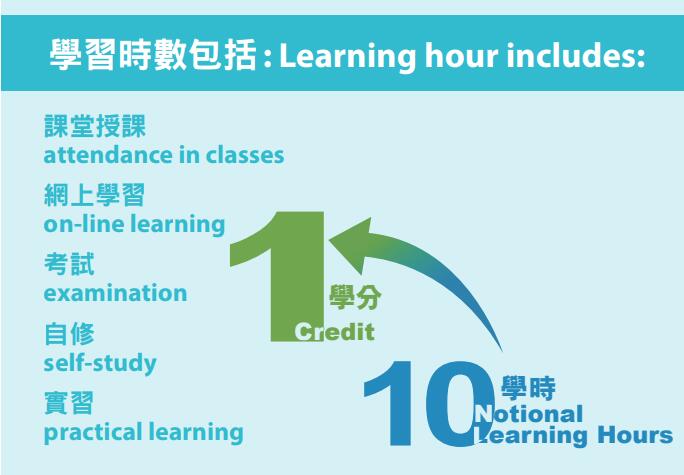
Qualifications Credits measure the volume of learning of a qualification and serve as the "common currency" of the Qualifications Framework. Through Qualifications Credits, learners can understand the effort and time required to complete the learning and achieve the associated qualification's learning outcomes.
Qualifications Credits represent learning hours (i.e., notional hours). Under the Qualifications Framework, one credit is equivalent to ten notional hours. The calculation of notional hours considers the time a typical learner might need across all learning modes, including attending classes, tutorials, laboratory sessions, workshops, self-study in the library or at home, and assessment or examinations.
Qualifications Titles
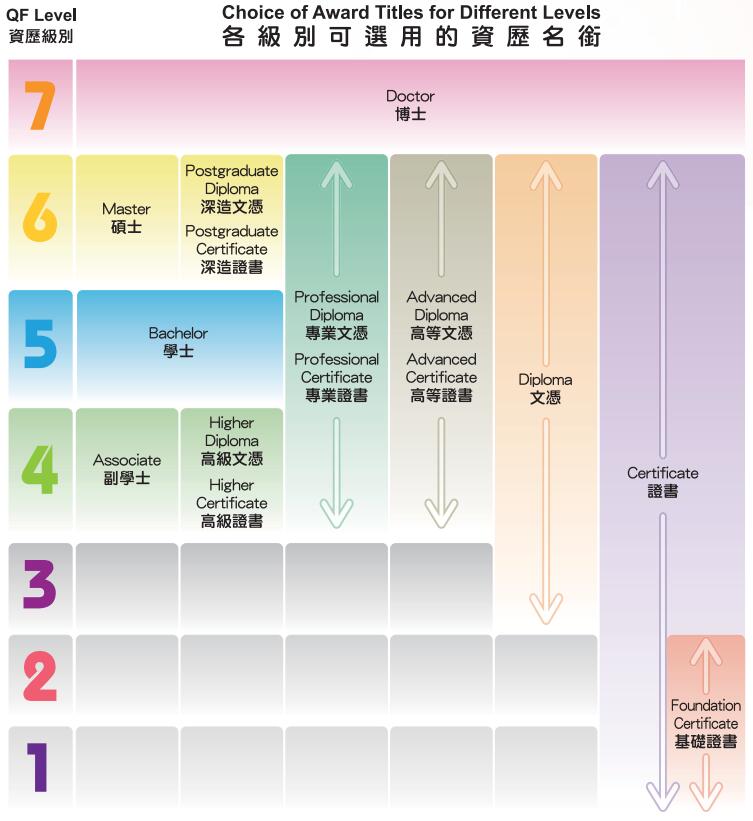
The Qualifications Titles plan aims to standardize the use of titles for qualifications recognized under the Qualifications Framework. This enhances the transparency of qualifications, reflects their level, and distinguishes between different courses and qualifications based on their level and credit value.
Credit Accumulation and Transfer
To further support learners' progression pathways, the Education Bureau actively encourages education and training institutions to develop their "Credit Accumulation and Transfer" (CAT) systems. It has also produced a booklet titled Credit Accumulation and Transfer: Policy, Principles and Application Guidelines for reference by interested education and training institutions.
What are the Differences Between Levels in the Qualifications Framework?
Certificate and diploma programs are often divided into different levels. What exactly differentiates these levels? The Qualifications Framework levels 1-7 constitute a set of indicators used to assess and classify individuals' professional proficiency. The following is an introduction to each level:
QF Level 1️⃣
Demonstrates general and foundational knowledge applicable to a limited range of learning or work areas. Uses basic intellectual skills in familiar, personal, or everyday contexts.
QF Level 2️⃣
Applies basic factual or practical knowledge within a learning or work area. Uses a variety of intellectual skills in familiar contexts.
QF Level 3️⃣
Applies a broad range of practical and theoretical knowledge within a specific learning or work area. Uses a variety of intellectual skills, primarily in familiar but occasionally unfamiliar contexts.
QF Level 4️⃣
Applies a broad knowledge base and some specialized knowledge within a learning or work area. Uses a variety of intellectual skills relevant to a subject area, including specialized abilities.
QF Level 5️⃣
Demonstrates deep specialized technical or theoretical knowledge within a learning or work area. Uses a range of specialized intellectual skills to support established work.
QF Level 6️⃣
Demonstrates mastery of a systematic body of knowledge, some of which is at the forefront of a learning or professional practice area. Uses highly specialized technical, research, or scholarly abilities.
QF Level 7️⃣
Demonstrates a comprehensive understanding of a body of knowledge at the forefront of the field, with a critical perspective on its related theories and concepts. Makes a significant and original contribution to the broader relationships within a discipline or across disciplines.
The certificate and diploma programs we offer have different course contents for different levels. Before enrolling in a course, learners can visit our website to learn about the course content for different levels and then select the appropriate course based on their own proficiency and needs!
International Cooperation and Recognition of the Hong Kong Qualifications Framework (HKQF)
HKQF and EU/UK Qualifications Comparison Table
The table below shows the correspondence between the Hong Kong Qualifications Framework (HKQF) and the European Qualifications Framework (EQF) and UK qualifications. This reality check confirms the level-to-level matching described in paragraph 6.13:
| HKQF Level | Hong Kong Qualification | European & UK Qualification | EQF Level |
|---|---|---|---|
| 7 |
Doctoral Degree
|
Third Cycle Higher Education (UK Doctoral Degree)
|
8 |
| 6 |
Master's Degree
|
Second Cycle Higher Education (UK Master's Degree)
|
7 |
| 5 |
Bachelor's Degree
|
First Cycle Higher Education (UK Honours Bachelor's Degree)
|
6 |
| 4 |
Associate Degree/Higher Diploma
|
Short Cycle within First Cycle Higher Education (UK Foundation Degree, Higher National Diploma)
|
5 |
| 3 |
Hong Kong Diploma of Secondary Education (HKDSE)
Hong Kong Advanced Level Examination (HKALE)
Diploma of Applied Education (DAE)
Vocational Education Diploma
Health Care Personnel Diploma
|
Secondary education graduation qualification allowing access to higher education
(UK GCE A Level, QCF Level 3 Vocational Qualification/Scottish Highers)
|
4 |
| 2 |
Hong Kong Certificate of Education Examination (HKCEE) (until 2011)
Trade Certificate
|
UK GCSE Grades A–C
QCF Level 2 Vocational Qualification
|
3 |
| 1 |
Completion of Secondary 3
Foundation Certificate
|
QCF Level 1 Vocational Qualification
QCF Level 1 Foundation Skills
|
2 |
Table: Hong Kong Qualifications Framework (HKQF) Comparison with European Qualifications Framework (EQF) and UK Qualifications
European Countries
The HKQF has been referenced with the qualifications frameworks of several European countries, including Ireland, Scotland, and New Zealand. These collaborations aim to facilitate mutual recognition and articulation of qualifications, providing more international opportunities for learners in Hong Kong.
- HKQF Referencing Document with the European Qualifications Framework (2016) Link | by HKQF Hong Kong Qualifications Framework Link
- HKQF Referencing Document with the Irish National Framework of Qualifications (2016) Link | by QQI Quality and Qualifications Ireland Link
- HKQF Referencing Document with the Scottish Credit and Qualifications Framework (2017) Link | by SCQF Scottish Credit and Qualifications Framework Link
Australia, Korea, and Singapore
The HKQF deepened cooperation with these countries in 2019. Particularly with Singapore, a joint working group was formed to study how to reference the qualification levels of the two places, further promoting mutual recognition of qualifications.
Guangdong Province
The HKQF served as a reference model to assist Guangdong Province in establishing its local qualification levels. This indicates the potential for cooperation between Hong Kong and Mainland China in qualification recognition, particularly regarding talent mobility within the Greater Bay Area.
- Signing Ceremony for the Letter of Intent on Cooperation between Guangdong and Hong Kong to Strengthen Exchange and Mutual Recognition of Professional Standards and Qualifications (2011) Link
- Signing Ceremony for the Letter of Intent on Cooperation between Guangdong and Hong Kong on the Qualifications Framework in the Greater Bay Area (2019) Link
Sources
- QF Secretariat and Accreditation Authority: Quality Assurance Mechanism - The Cornerstone of QF - QF and QA Marching Towards Internationalization Together - Hong Kong Qualifications Framework - QF in Action
- HKCAAVQ_AR20-21
- Diverse Pathways in the Learning Journey: HKQF Shapes Clear Progression Pathways - GoodSchool