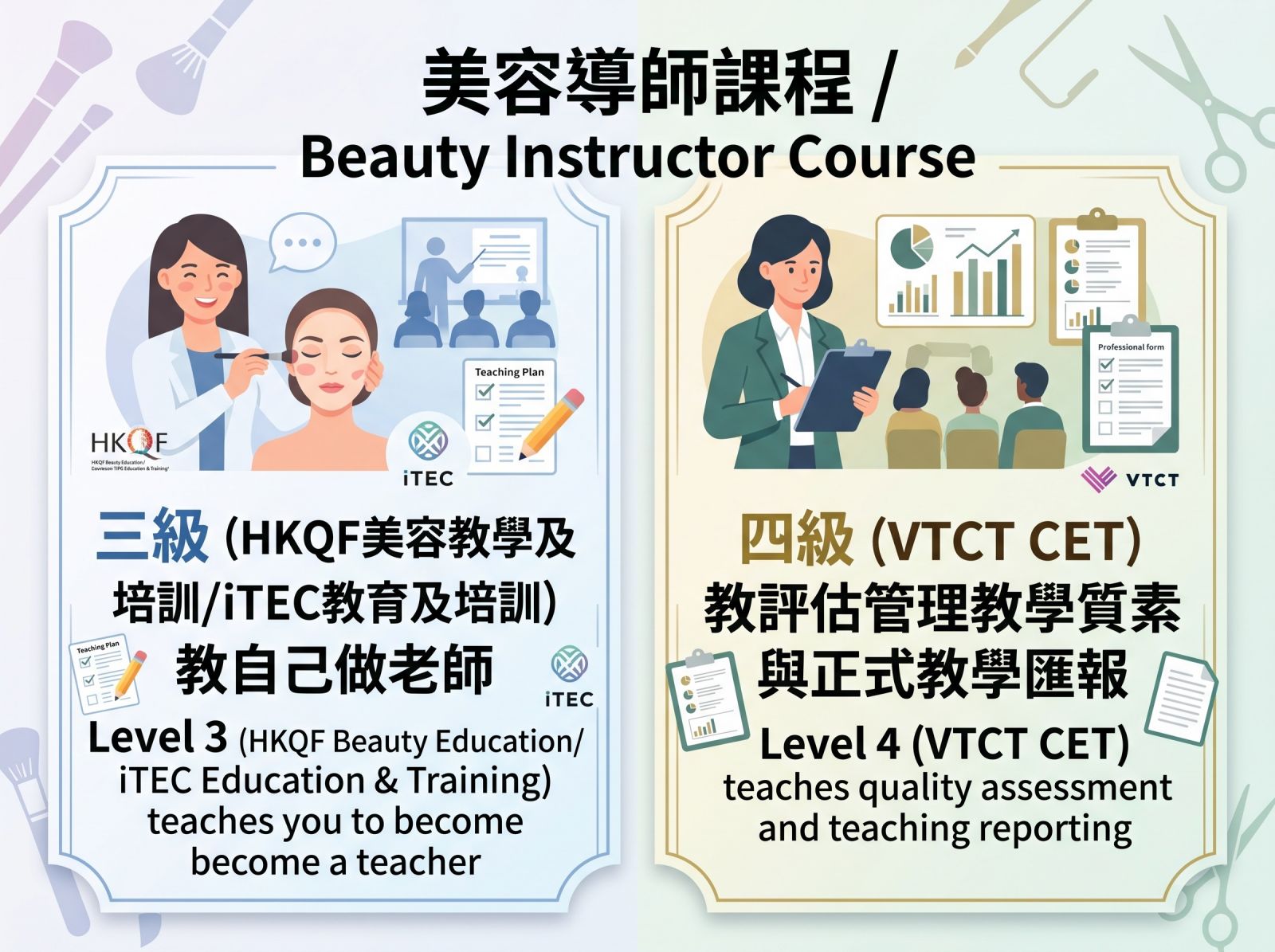
- How to transition from beauty therapist to instructor?|Level 3 instructor courses (HKQF Level 3 Beauty Education / iTEC Level 3 Education & Training) teach you to "become a teacher and vocational training instructor" – covering school roles, course design, classroom management, teaching techniques, learner psychology, assessment, and teaching reflection.
- What are the two Level 3 options?|Two internationally recognized Level 3 qualifications: ①HKQF Level 3 Beauty Education – QF Level 3, eligible for CEF funding; ②iTEC Level 3 Education & Training – Ofqual-regulated international qualification, no CEF funding, suitable for overseas development.
- What are the five core teaching capability areas?|①Course design and content development; ②Classroom management and teaching techniques (including school role awareness); ③Professional ethics and learner psychology; ④Learner assessment and communication; ⑤Teaching records and reflection.
- What does Level 4 (VTCT CET) cover?|Teaches "assessing and managing teaching quality, plus informal and formal teaching reporting" – three core areas: ①assessment standards (courses/teachers/students/exams); ②quality assurance (IQA/EQA); ③teaching reporting (informal + formal observation reports) and advanced teaching capabilities.
- What's the key difference between Level 3 and Level 4?|Level 3 teaches you to "become a teacher"; Level 4 teaches you to "assess teaching quality and write teaching reports." If you don't know how to teach, how can you assess others' teaching performance?
- Can I skip Level 3 and go straight to Level 4?|Not recommended. Level 4 doesn't cover school roles, classroom management, teaching techniques, or learner psychology. Skipping Level 3 leads to "can write assessment standards but can't actually teach" problems. Complete Level 3 foundation first, then Level 4 – the true professional pathway.
- Beauty therapists transitioning to instructors need to understand Level 3 vs Level 4 positioning. Level 3 (HKQF Level 3 Beauty Education / iTEC Level 3 Education & Training) teaches you to "become a teacher" – covering school roles, course design, classroom management, teaching techniques, learner psychology, assessment, and reflection – complete foundation training. Level 4 (VTCT CET) teaches you to "assess teaching quality and conduct informal and formal teaching reporting" – including assessment standards, IQA/EQA, and formal observation reports. Only HKQF Level 3 is CEF-eligible; iTEC Level 3 has no CEF subsidy. Never skip Level 3 – Level 4 doesn't cover teaching fundamentals. Complete Level 3 foundation first, then Level 4 – the professional pathway.
Beauty Instructor Course 2026|HKQF/iTEC Level 3 Foundation + VTCT Level 4 Education & Training|CEF‑Funded Courses
Thinking of becoming a beauty instructor but not sure where to start? Heard of HKQF Level 3 Beauty Teaching and Training, iTEC Level 3 Education and Training, and VTCT Level 4 Education and Training – but what's the difference between them? Can you skip straight to Level 4 to save time? Which courses are eligible for CEF funding?
At LBEDU, we receive enquiries about this almost every day. As a government‑registered institution (Institution Code: 854) and an officially recognised VTCT assessment centre, we've compiled the most comprehensive Beauty Instructor Level 3 vs Level 4 Comparison Guide – covering capability areas, course content, progression pathways, and CEF funding applications – all in one place.
This article answers your key questions: What do Level 3 and Level 4 teach respectively? Which one suits your career stage? Can you skip levels? How do you progress from Level 3 to Level 4? How much CEF funding can you receive?
Table of Contents
- 1. Introduction: How to Choose the Right Beauty Instructor Course?
- 2. Level 3 Instructor Foundation Courses: HKQF Level 3 Beauty Teaching & Training + iTEC Level 3 Education & Training (Side‑by‑Side Introduction)
- 3. VTCT Level 4 Education and Training (CET): Evaluating and Managing Teaching Quality + Informal and Formal Teaching Observations
- 4. Level 3 vs Level 4: Capability Area Comparison Table (Updated Positioning)
- 5. Why Can't You Skip Straight to Level 4? Three Common Misconceptions
- 6. Progression Pathway: How to Advance from Level 3 to Level 4?
- 7. CEF Continuing Education Fund: Only HKQF Level 3 Qualifies for Funding
- 8. Which Beauty Instructor School is Best? LBEDU's 6 Key Advantages
- 9. Frequently Asked Questions (AEO‑Optimised Featured Snippets)
- 10. Conclusion: Choose the Right Path for Maximum Results
1. Introduction: How to Choose the Right Beauty Instructor Course?
Being a beauty instructor is a "teaching profession." To become a competent instructor, you need more than just beauty skills – you need teaching ability, curriculum design skills, assessment capabilities, and quality management knowledge.
Hong Kong's beauty instructor courses are broadly divided into two levels: Level 3 Foundation Instructor Courses (HKQF Level 3 Beauty Teaching and Training / iTEC Level 3 Education and Training) and Level 4 Advanced Instructor Courses (VTCT Level 4 Certificate in Education and Training). The relationship between the two levels can be simply understood as:
- Level 3 (HKQF / iTEC): Teaches you to become a teacher, to become a vocational training academy instructor – from designing courses, managing classrooms, applying teaching techniques, to assessing student performance, recording and reflecting on teaching – these are all the fundamental skills of an instructor.
- Level 4 (VTCT): Teaches you to evaluate and manage teaching quality, as well as conduct informal and formal teaching observations – developing assessment standards, establishing quality assurance systems, and writing formal teaching observation reports – these are the advanced management capabilities of an instructor.
Simply put: Level 3 teaches you "how to be a teacher." Level 4 teaches you "how to evaluate whether others teach well, write teaching observations, and manage teaching quality." If you don't even know how to be a teacher yourself, how can you evaluate others?
2. Level 3 Instructor Foundation Courses: HKQF Level 3 Beauty Teaching & Training + iTEC Level 3 Education & Training (Side‑by‑Side Introduction)
Many people think Level 3 is just an "entry certificate" with simple content. But the reality is: Level 3 is the "teaching fundamentals boot camp" for all beauty instructors, teaching you from zero to become a competent teacher, to become a vocational training academy instructor, covering all the foundational skills required.
LBEDU offers two internationally recognised Level 3 instructor foundation qualifications – students can choose according to their individual needs:
- Awarding Body: Hong Kong Qualifications Framework (HKQF) recognised
- Biggest Advantage: Eligible for government Continuing Education Fund (CEF) subsidy, significantly reducing tuition costs
- Course Focus: Specifically designed for the beauty industry – teaching cases and practical assessments are all aligned with real beauty, nail, lash, micropigmentation, and medical aesthetics classrooms
- Suitable For: Practitioners who want to use CEF funding for further study and plan to develop their careers in Hong Kong's beauty education industry
- Awarding Body: iTEC (International Therapy Examination Council), regulated by UK Ofqual, internationally recognised
- Course Focus: Internationally applicable education and training foundation qualification covering teaching principles, classroom management, learner assessment, and other core competencies
- Suitable For: Practitioners who want to gain an international qualification, plan to develop overseas or immigrate, or whose organisation specifically requires iTEC qualifications
- Note: iTEC Level 3 Education and Training is not eligible for government Continuing Education Fund subsidy
Whether you choose HKQF or iTEC, Level 3 courses will equip you with the following essential fundamental skills for being a teacher:
- Curriculum Design – how to design a complete teaching framework based on learner levels and course objectives
- Assessment Design – how to design fair, effective, and practical learner assessment methods
- Course Content Development – how to transform professional techniques into systematic, layered teaching content
- Course Content Referencing – how to find authoritative sources for teaching content, ensuring accuracy and professionalism
- Lesson Plan Writing – how to write detailed lesson plans for each session
- Classroom Management Skills – how to maintain order, handle learner disruptions, and control teaching pace
- Teaching Methods Theory – understanding different teaching methodologies (lecture, demonstration, group discussion, case teaching, etc.)
- Practical Teaching Skills – how to apply different teaching techniques to help learners understand and absorb easily
- Teaching Aids Application – how to effectively use mannequins, nail tips, teaching models, PPTs, and other tools to enhance teaching effectiveness
- School Roles and Responsibilities – understanding the operational structure of beauty training institutions, the instructor's role and position within the school, and collaborative responsibilities with other departments (admissions, administration, assessment) – recognising that an instructor is not just "teaching" but is the frontline gatekeeper of teaching quality
- Instructor Professional Ethics – ethics, codes of conduct, confidentiality principles, and teacher‑student boundaries expected of professional instructors
- Learner Psychology and Encouragement‑Based Teaching – how to understand the psychology of zero‑experience learners and use encouragement to boost motivation
- Classroom Performance Assessment – how to observe and evaluate learners' performance during the teaching process
- Diagnostic Interviews – how to diagnose learners' learning difficulties and needs through one‑on‑one interviews
- Interview Techniques – how to conduct effective learner interviews to gather feedback and solve problems
- Questionnaire Design – how to design effective learner satisfaction and learning outcome questionnaires
- Teaching Journal – how to document the teaching process as a basis for continuous improvement
- Teaching Reflection – how to reflect on your own teaching performance and continuously improve teaching quality
Summary: Level 3 courses (whether HKQF or iTEC) teach you "how to be a teacher, to become a vocational training academy instructor" – from understanding the school's role, designing courses, managing classrooms, and teaching techniques, to assessing learners and reflecting on teaching – these are all the foundational skills for entering the profession.
Every capability in these five areas is something a competent instructor uses daily. Without this foundation, jumping straight to Level 4 is like trying to run before you've learned to walk.
Funding Note: Of the two Level 3 courses above, only HKQF Level 3 Beauty Teaching and Training (QF Level 3) is eligible for government Continuing Education Fund (CEF) subsidy. The iTEC Level 3 Education and Training does not offer CEF funding.
3. VTCT Level 4 Education and Training (CET): Evaluating and Managing Teaching Quality + Informal and Formal Teaching Observations
If Level 3 teaches you "how to become a teacher," then Level 4 is about "teaching you how to evaluate and manage teaching quality, as well as conduct informal and formal teaching observations" – a higher‑level capability aimed at course coordinators, training supervisors, teaching quality managers, and senior instructors.
The VTCT iTEC Level 4 Certificate in Education and Training (CET) comprehensively covers the following three high‑level capability areas:
- Course Content Assessment Standards – how to develop a standard to objectively evaluate the quality of a course's content
- Teacher Performance Assessment Standards – how to develop standards to evaluate instructors' teaching performance (unlike Level 3's "your own teaching skills," Level 4 is about "evaluating others' teaching")
- Student Performance Assessment Standards – how to develop systematic learner performance assessment rubrics to ensure fair and consistent evaluation
- Assessment Evaluation Standards – how to develop assessment criteria to ensure assessments are valid, reliable, and fair
- Practical Assessment Standards – developing detailed scoring criteria for practical assessments in the beauty industry
- Interview Standards – developing standardised interview processes and scoring criteria for learner assessment and teaching feedback
- Internal Quality Assurance (IQA) – how to establish internal teaching quality assurance mechanisms, including internal audits, standardisation, and continuous improvement
- External Quality Assurance (EQA) – how to respond to quality audits from external bodies (such as VTCT headquarters and government qualifications frameworks) to ensure courses meet international standards
- Informal Teaching Observations – how to provide teaching feedback to instructors through daily post‑class communication, brief interviews, electronic messages, and other informal channels to drive immediate improvement
- Formal Teaching Observations – how to write structured, data‑supported formal teaching observation reports, including performance ratings, strengths analysis, improvement recommendations, and follow‑up plans – used for internal quality audits and instructor performance evaluation
- Questionnaire Standards – developing standardised questionnaire design, analysis, and application standards (a higher level than Level 3's "designing questionnaires" – this is about "setting the standards for questionnaires")
- Teaching Support – how to provide learning support to learners, including special educational needs, individual tutoring, and learning resource allocation
- Inclusive Teaching – how to design and implement teaching methods that include learners from different backgrounds, abilities, and cultures
- Comprehensive Reflection – integrating curriculum design, assessment standards, quality assurance, and teaching observation practice to conduct a thorough, in‑depth reflection on your teaching philosophy and quality management system, forming a personal professional development plan
Summary: Level 4 teaches you how to "evaluate and manage teaching quality, and conduct informal and formal teaching observations" – developing assessment standards, establishing quality assurance systems, and driving continuous improvement through formal and informal observations – essential capabilities for senior instructors and teaching managers.
4. Level 3 vs Level 4: Capability Area Comparison Table (Updated Positioning)
| Capability Area | Level 3 (HKQF / iTEC): How to Become a Teacher | Level 4 (VTCT): Quality Management + Teaching Observations | Gap When Skipping to Level 4 |
|---|---|---|---|
| School Role Awareness | ✅ Dedicated chapter on instructor roles, responsibilities, and cross‑department collaboration | ❌ Does not cover foundational training | ❌ Unclear about the instructor's position in school operations |
| Curriculum Design Ability | ✅ Learn from scratch: designing courses, developing content, creating lesson plans | ⚠️ Only teaches "evaluating others' course quality," not how to design your own | ❌ Can't design a course from scratch |
| Assessment Design Ability | ✅ Foundational assessment design concepts | ✅ Advanced assessment standards development | ⚠️ Level 4 has it, but requires Level 3 foundation to fully understand |
| Classroom Management Ability | ✅ Extensive practical drills: maintaining order, handling disruptions, pace control | ❌ Does not cover foundational training | ❌ Helpless when facing a real classroom |
| Teaching Skills Ability | ✅ Core focus: teaching methods theory, practical skills, teaching aids application | ❌ Does not cover foundational training | ❌ Can evaluate others but doesn't know how to teach |
| Professional Ethics Awareness | ✅ Dedicated chapter on ethics, confidentiality, teacher‑student boundaries | ❌ Does not cover foundational training | ❌ Lacks systematic understanding of professional ethics |
| Learner Psychology Mastery | ✅ Foundational practice: zero‑experience learner psychology, encouragement‑based teaching | ⚠️ Only advanced concepts (teaching support, inclusive teaching) – doesn't teach basic encouragement techniques | ❌ Doesn't know how to handle learner emotions |
| Learner Assessment Ability | ✅ Practical execution: classroom observation, interviews, questionnaire design | ✅ Advanced standard‑setting: assessment standards, interview standards, questionnaire standards | ⚠️ "Execution" and "standard‑setting" are both essential |
| Teaching Reflection Ability | ✅ Building foundational habits: teaching journals, post‑class reflection | ✅ Advanced comprehensive reflection | ⚠️ Level 4 reflection requires building on Level 3 reflection habits |
| Teaching Observation Ability | ❌ Not covered at Level 3 | ✅ Informal teaching observations + formal teaching observation report writing | — |
| Assessment Standards Development | ❌ Not covered at Level 3 | ✅ 4 assessment standards (course/teacher/student/assessment) | — |
| Quality Assurance Systems | ❌ Not covered at Level 3 | ✅ Internal Quality Assurance (IQA), External Quality Assurance (EQA) | — |
Core Difference in One Sentence: Level 3 teaches you "how to be a teacher, to become a vocational training academy instructor." Level 4 teaches you "how to evaluate and manage teaching quality, and conduct informal and formal teaching observations." If you don't even know how to be a teacher yourself, how can you evaluate others' teaching performance and write teaching observation reports?
5. Why Can't You Skip Straight to Level 4? Three Common Misconceptions
Many students ask: "I have beauty experience – can I skip straight to Level 4 to get a higher certificate faster?" Here are three common misconceptions:
Fact: Knowing how to do something and knowing how to teach it are two different things. Teaching involves curriculum design, teaching techniques, classroom management, learner psychology, and other professional skills – which is exactly what Level 3 trains. Being skilled doesn't mean you can teach well – this is the most common misconception.
Fact: Level 4 assumes you already have teaching experience or foundational teaching skills (Level 3 level). Its content focuses on "assessment" and "quality management." It does not cover foundational teaching skills such as school roles and responsibilities, classroom management, practical teaching techniques, learner psychology and encouragement‑based teaching, instructor professional ethics, or teaching aids application. Without a Level 3 foundation, Level 4 content will be extremely challenging.
Fact: Skipping levels doesn't save time – it makes learning harder due to a weak foundation, and may even lead to failure. Students who skip to Level 4 commonly experience problems like: "can write assessment standards and teaching observation reports but can't actually teach," "has a higher certificate but can't explain their role and responsibilities in a school," "fails basic interview questions." A step‑by‑step learning pathway is the most effective approach.
6. Progression Pathway: How to Advance from Level 3 to Level 4?
LBEDU offers a complete instructor progression pathway, taking you from zero to senior instructor, step by step:
- Step 1: Complete Foundation – Enrol in a Level 3 instructor foundation course (HKQF Level 3 Beauty Teaching and Training or iTEC Level 3 Education and Training) to master the five foundational teaching capability areas and build your teaching fundamentals. HKQF Level 3 is eligible for CEF funding; iTEC Level 3 is not.
- Step 2: Advanced Education and Training Certification – After completing Level 3, progress to VTCT Level 4 Certificate in Education and Training (CET) to master advanced management capabilities including assessment standards development, quality assurance systems, and teaching observations.
- Step 3: Continuing Professional Development – After completing Level 4, you can work as a training supervisor, course coordinator, teaching quality manager, or further pursue IQA International Instructor Certification to broaden your teaching career.
Level 3 and Level 4 can be completed as a seamless pathway at LBEDU – the courses are designed to articulate with each other, ensuring your learning journey from foundation to advanced level is coherent and complete.
7. CEF Continuing Education Fund: Only HKQF Level 3 Qualifies for Funding
Many students ask: Can instructor courses apply for CEF funding? The answer depends on which course you choose:
- HKQF Level 3 Beauty Teaching and Training (QF Level 3): ✅ Eligible for CEF funding. As a government Qualifications Framework‑recognised course, eligible students can apply for Continuing Education Fund subsidy.
- iTEC Level 3 Education and Training: ❌ Not eligible for CEF funding. Although it's also a Level 3 instructor foundation course, iTEC qualifications are not part of the Hong Kong Qualifications Framework (HKQF) and therefore do not meet CEF eligibility requirements.
According to 2026 CEF policy:
- Funding Cap: HK$25,000 per person lifetime
- Reimbursement Rate: 20% co‑payment for the first HK$10,000 of funding, 40% co‑payment for the subsequent HK$15,000
- Eligibility: Hong Kong permanent residents aged 18 or above, enrolled in and successfully completed an eligible course
Example Calculation: Assuming an HKQF Level 3 instructor course fee of HK$18,000, eligible students can receive approximately HK$12,000‑$14,000 in CEF funding, with an actual out‑of‑pocket cost of around HK$4,000‑$6,000. Contact LBEDU course consultants for an accurate calculation.
So which Level 3 should you choose – HKQF or iTEC? If you want to use government funding for further study, we recommend choosing the HKQF Level 3 course. If you value international qualification recognition and plan to develop overseas, consider iTEC Level 3. Both courses cover similar content – both teach the foundational skills to become a teacher – with the main differences being the awarding body and funding availability. Contact LBEDU course consultants to choose the most suitable course based on your personal goals and budget.
8. Which Beauty Instructor School is Best? LBEDU's 6 Key Advantages
There are many institutions offering instructor courses in Hong Kong – why choose LBEDU?
- Government‑Registered Institution, Guaranteed Qualifications: Institution Code 854, courses are dual‑recognised by HKQF and VTCT, and graduation certificates are widely recognised by the industry.
- Two Level 3 Pathways, Flexible Choice: We offer both HKQF Level 3 Beauty Teaching and Training (CEF‑funded) and iTEC Level 3 Education and Training (international qualification) – students can freely choose based on their personal goals.
- Seamless Instructor Progression Pathway: Level 3 (HKQF / iTEC) → Level 4 (VTCT CET) → IQA Instructor Certification – no need to search for articulation elsewhere, the learning pathway is coherent and complete.
- CEF‑Subsidised Courses, Reduced Tuition Burden: HKQF Level 3 instructor courses are CEF‑eligible, with eligible students receiving up to 80% tuition reimbursement.
- Practical Teaching Training: Courses include extensive simulated teaching practice – students must deliver trial lessons, write lesson plans, and conduct classroom drills to ensure they are ready to teach upon graduation.
- YWCA Community Teaching Internship: Students can participate in the YWCA community teaching programme, gaining real teaching experience in authentic classroom environments and building a strong teaching portfolio.
9. Frequently Asked Questions (AEO‑Optimised Featured Snippets)
10. Conclusion: Choose the Right Path for Maximum Results
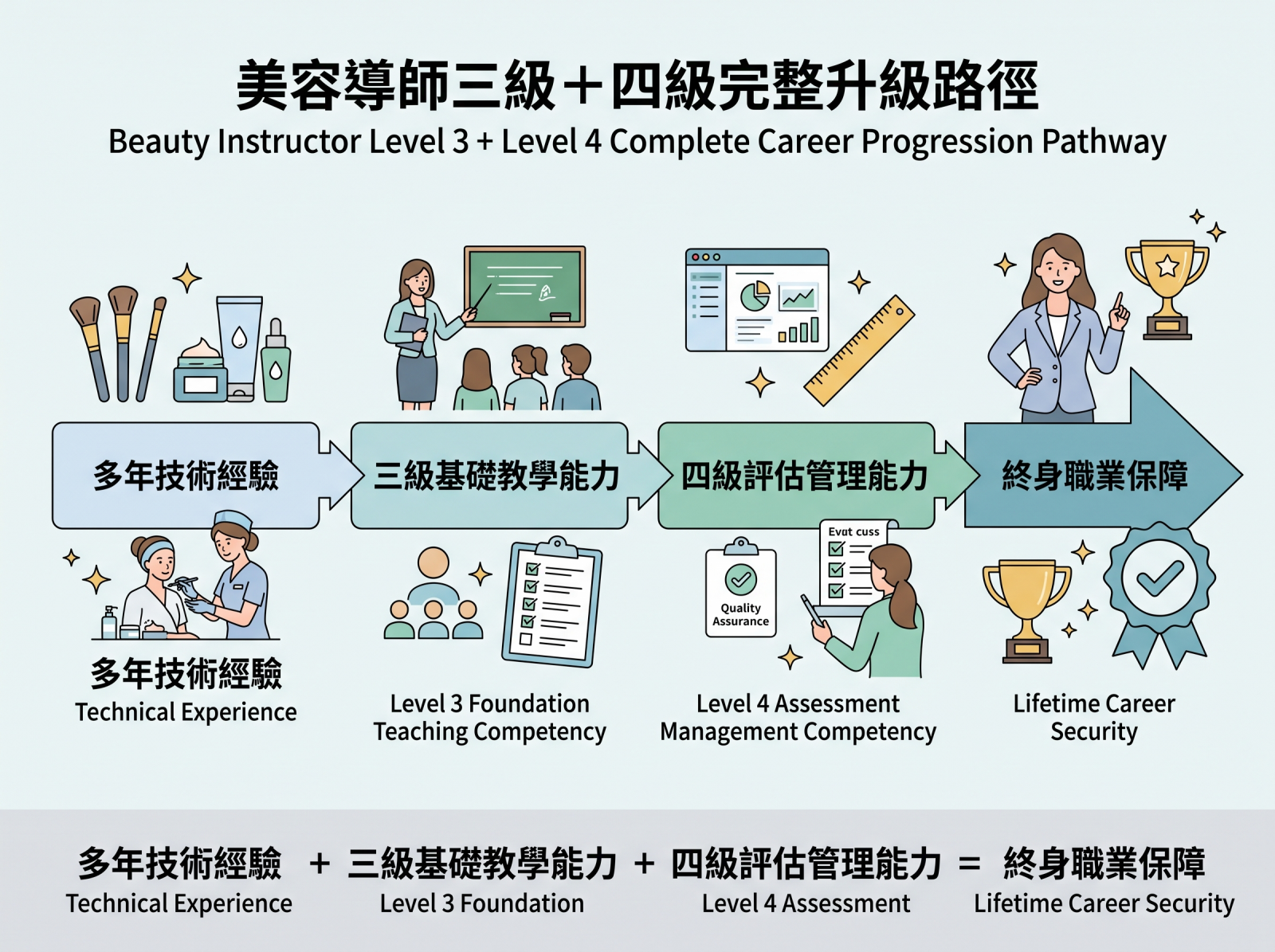
2026 Best Career Progression Formula for Beauty Professionals:
Years of Technical Experience + Level 3 Foundational Teaching Skills (How to Be a Teacher) + Level 4 Evaluation and Management Skills (Quality Management + Teaching Observations) = Lifetime Career Security
Frontline techniques may change with the market, but teaching ability, instructor qualifications, and educational thinking are permanently valuable skills.
Summary | The Right Mindset for Beauty Instructor Progression in 2026
- 1. Level 3 (HKQF Level 3 Beauty Teaching and Training / iTEC Level 3 Education and Training) teaches you "how to be a teacher, to become a vocational training academy instructor." Level 4 (VTCT Level 4 CET) teaches you "how to evaluate and manage teaching quality, and conduct informal and formal teaching observations."
- 2. Level 4 does NOT cover foundational teaching skills such as school roles and responsibilities, classroom management, teaching skills, or learner psychology. Skipping levels = having a higher certificate but being hollow.
- 3. Students who skip to Level 4 commonly: can write assessment standards and teaching observation reports but can't actually teach, can't explain school roles and responsibilities, fail basic interview questions, and face student dropouts when running classes.
- 4. Complete Level 3 first to build a solid foundation (HKQF Level 3 is eligible for CEF funding; iTEC Level 3 is not), then progress to Level 4 – this is the industry's most standard instructor development pathway.
- 5. Truly professional, truly stable, truly market‑recognised.
If you want to truly upgrade from "technical practitioner" to "professional beauty instructor" and have solid teaching foundations + the highest international qualifications, contact our course consultants to learn more about the complete Level 3 Instructor Foundation Course (HKQF CEF‑funded / iTEC International Qualification) → VTCT Level 4 Advanced Instructor Upgrade pathway.
Further Reading
1. How to Get a Beauty Instructor Certificate? IQA International Instructor Qualification Guide|YWCA Community Teaching Internship + Dual Certification
2. How to Choose a Beauty School in Hong Kong 2026|8 Practical Evaluation Methods + Shortlist Zero‑to‑Hero Career Switcher Essential Reading
3. Hong Kong Beauty Job & School Selection Guide 2026|70% of Jobs Require International Certificates – 4 High‑Employability Schools Compared
4. CEF Continuing Education Fund Beauty Course Guide|HKQF‑Recognised Courses & Application Process
References & Authoritative Sources
HKQF Level 3 Certificate in Beauty Teaching and Training – Course Syllabus
iTEC Level 3 Certificate in Education and Training – Qualification Specification
VTCT Level 4 Certificate in Education and Training (CET) – Qualification Specification
Hong Kong Qualifications Framework (HKQF) – Beauty Industry Teaching and Training Competency Standards
LBEDU Luster Beauty International Education and Training Institute – Instructor Course Internal Research Data
CEF Continuing Education Fund Official Website (www.wfsfaa.gov.hk/cef)
Comments (0)
No comments yet
Leave a Comment